
Signals
What Is Muse Wonder? Meta's First Frontier Models, Who Actually Gets Them, and What the Benchmark Table Says When You Read the Footnotes
By the Top5Apps editorial team · Published October 12, 2026 · Updated October 12, 2026 · 8 min read
Short answer: Muse Wonder is a new series of two models — Muse Wonder and the larger Muse Wonder Full — that Meta announced today as 'our most capable models to date' and the first it calls frontier models. Independent scores back the claim within limits: Wonder Full scores 56 on the Artificial Analysis Intelligence Index, second among the frontier-tier models to Claude Opus 5.5's 58 and tied with Sonnet 5.5; Wonder scores 52, level with GPT-6.1 Sol. Who gets them is the part most coverage blurs: Wonder is live today on Meta's developer API and in Muse Code, Wonder Full exists only inside Muse Code subscriptions, and in the Muse app Wonder 'will roll out first to subscribers' — the free tier that made Muse our top personal agent stays on Spark-class models for now. The New York Times' framing — the models 'scored nearly as well as Anthropic's most advanced models' on Meta's data — is fair; Meta's own table claims wins on several rows and losses on others, and the footnotes in the model card matter. Here's the whole thing, with the vendor claims marked.

What Meta announced, in its own words
Meta's newsroom post — 'Introducing Muse Wonder and Muse Wonder Full: Frontier Models for Agents' — says the two are 'built to deliver state-of-the-art performance on personal and professional agentic tasks — from navigating an insurance claim to making sense of a lease to building a working app,' and that 'Muse Wonder is available today for developers and builders through the Meta Model API and Muse Code while Muse Wonder Full is available today for Muse Code subscribers. Muse Wonder will soon power experiences in Muse, and will roll out first to subscribers.' The research post frames it as 'the next step on our scaling ladder and a major leap toward personal superintelligence,' trained 'at our gigawatt-scale Prometheus data center,' and names two headline behaviors: Active Memory, 'carrying important context about you across conversations and actively retrieving the details relevant to the task at hand,' and Active Focus, 'trying alternative approaches, working through blockers, and adapting to new information' while it 'asks for clarification when needed and checks in before taking important actions.' Zuckerberg's thread (829,000 views) explains the split: 'Muse Wonder for fast frontier performance and Muse Wonder Full for the full version of the model.' The model card lists inputs of text, image, video, and audio, text output, and a 1M-token context. Parameter counts, training data, knowledge cutoff, and any open-weights plan are not disclosed. The internal codename, per CNBC's interview with Alexandr Wang, was Watermelon — hence Wang's post, 'MUSE WONDER 🍉.'
The benchmark table, and how to read it
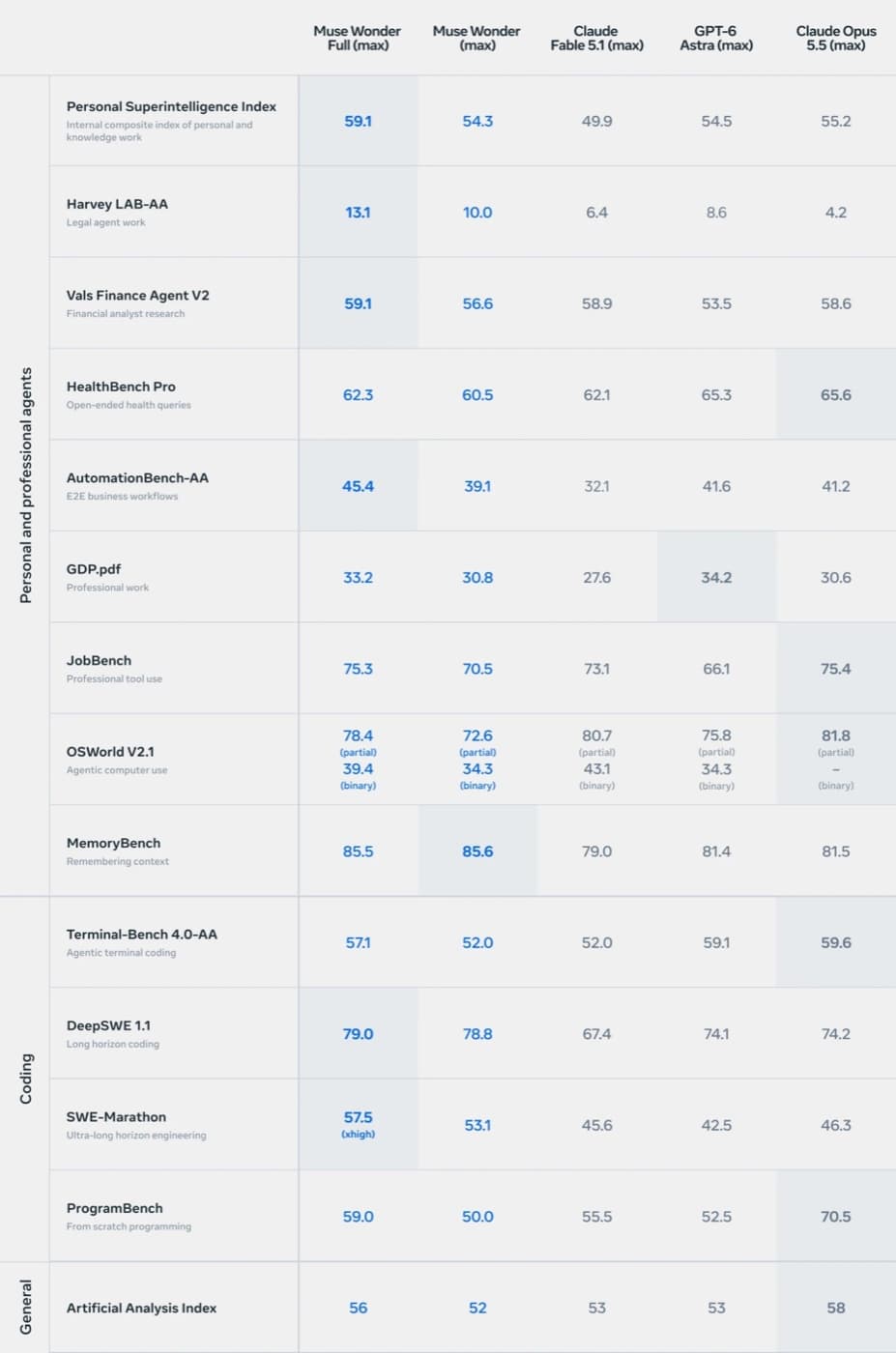
Where Meta claims the lead: its own Personal Superintelligence Index (59.1 vs Opus 5.5's 55.2), legal agent work on Harvey LAB-AA (13.1 vs 4.2 — everyone is bad at this), Vals Finance Agent (59.1 vs 58.9, a rounding-error win), AutomationBench-AA (45.4 vs 41.2), MemoryBench (85.5 vs 81.5), DeepSWE long-horizon coding (79.0 vs 74.2), and SWE-Marathon (57.5 vs 46.3). Where Opus 5.5 or Astra leads: HealthBench Pro (65.6 to Wonder Full's 62.3), GDP.pdf (Astra 34.2 to 33.2), JobBench (75.4 to 75.3), OSWorld computer use (Opus 81.8 partial to 78.4), Terminal-Bench 4.0 (Opus 59.6, Astra 59.1, Wonder Full 57.1), ProgramBench from-scratch coding (Opus 70.5 to 59.0 — the widest gap on the table), and the overall Artificial Analysis Index (58 to 56). Read as a whole: Wonder Full is a frontier model with a clear profile — strongest on memory, long-horizon agentic work, and professional tasks; a step behind Anthropic on health, from-scratch programming, and computer use. Muse Wonder, the fast version, trails Wonder Full on everything except MemoryBench.
- Which rows are Meta's own: the Personal Superintelligence Index is 'an internal composite of seven personal and knowledge-work evaluations,' two of them (FocusBench, VBT) internal; MemoryBench is 'an internal benchmark.' Those are the rows with the biggest Meta leads. Harvey, Vals, AutomationBench, Terminal-Bench, GDP.pdf, DeepSWE, SWE-Marathon, and the AA Index are third-party-sourced; HealthBench Pro, OSWorld, JobBench, and ProgramBench are public benchmarks Meta ran itself.
- The footnotes that matter. 'Model refusals receive zero credit and remain in the denominator.' 'Internally generated competitor runs use common settings where practical but remain best-effort: prompts, tools, and runtime may not be optimally tuned for proprietary models.' SWE-Marathon 'is not a controlled common-harness comparison' — Astra and Fable were run through Codex and Claude Code, and Wonder Full's 57.5 is at xhigh, not max. Where a provider's own number existed, Meta used it (Opus's OSWorld and HealthBench figures come from Anthropic's system cards).
- No run dates are given, and the promised safety write-up isn't out: 'A full report with additional safety evaluations will be available soon.' Casey Newton's reaction — 'just what you want to hear from Meta on a day that it claims to have reached the frontier' — is the fair one. The model card does say that 'without mitigations, we do not rule out the model reaching [the high risk] threshold in the Chemical & Biological domain,' and that it 'is not intended to be used by individuals under the age of 18.'
The independent number
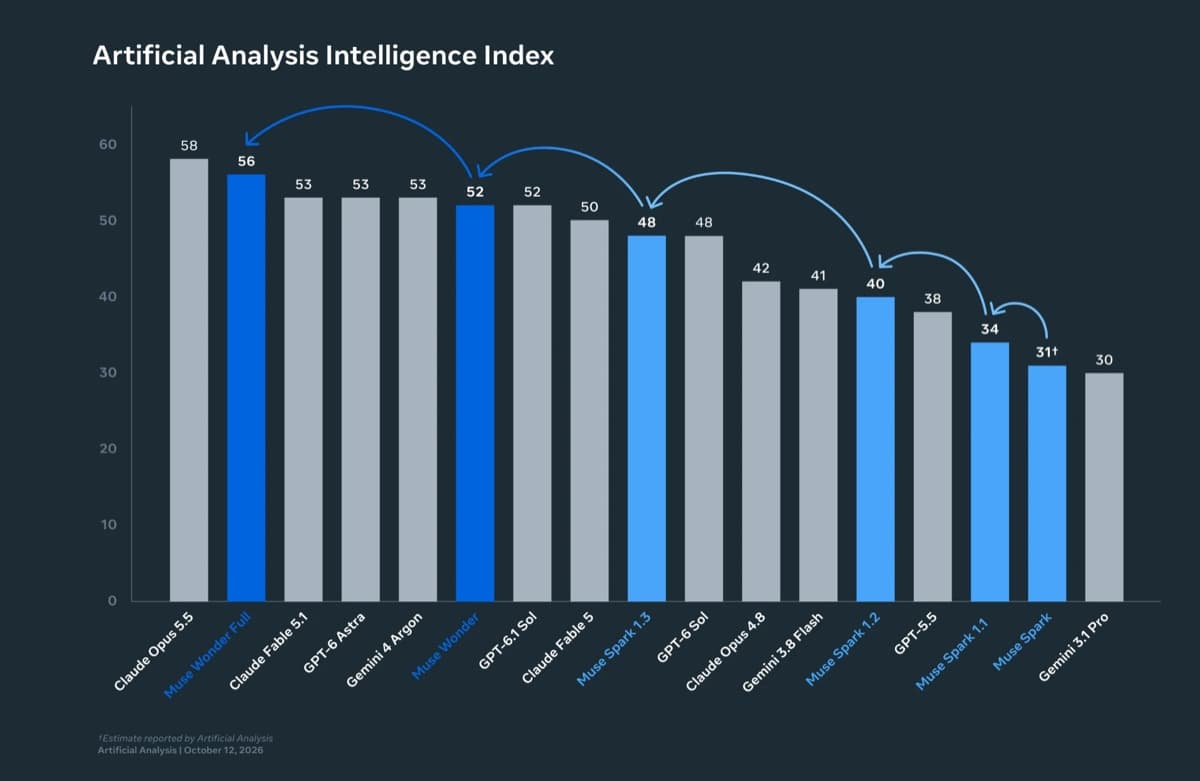
We read Artificial Analysis's leaderboard directly rather than trust the chart: Opus 5.5 (max) 58; Sonnet 5.5 (max), Opus 5.5 (xhigh), and Muse Wonder Full (max) all 56 — Wonder Full sits fourth of 219 entries; Fable 5.1, GPT-6 Astra, and Gemini 4 Argon 53; Muse Wonder 52, level with GPT-6.1 Sol. Meta's row matches. The omission is Sonnet 5.5, which ties Wonder Full at a fraction of the likely price, so 'second only to Opus' is true among the companies' flagships and not true of the board. Artificial Analysis's own notes: Wonder Full 'improves on Muse Spark 1.3 (max) across all ten Intelligence Index evaluations,' takes first on CritPt and GDP.pdf and second on GDPval-AA — and 'knowledge remains a relative weakness,' with an AA-Omniscience score of 30 against Opus 5.5's 46 and a 23 percent hallucination rate. Vals AI put Wonder Full fifth on its index and noted Meta 'just surpassed every OpenAI model' there. The Spark-to-Wonder jump on the chart is the real story for Meta: 31 → 34 → 40 → 48 → 56 in fourteen months.
Who gets it, and what it costs
- Muse app, free tier: not Wonder. Meta: Wonder 'will roll out first to subscribers,' and 'in the future, we'll be using Muse Wonder to develop specialized models that we can bring to everyone using Muse' — derived models, no date. Our tokens guide covers the Free / Power ($20) / Maximum ($100) tiers; Meta announced no change to them today.
- Muse app, subscribers: 'soon' or 'today,' depending on who you read. The newsroom and @AIatMeta say 'soon'; Zuckerberg's thread says 'You can use Muse Wonder to power your Muse by subscribing today.' The Verge reports Meta 'hasn't shared specifics or provided a timeline.' We'll note when it appears in the app.
- Developers: Muse Wonder on the Meta Model API today, reported at $4 per million input tokens and $20 per million output by Artificial Analysis and TechCrunch — the same list price as Claude Opus 5.5. Meta's own pricing page we could read still shows only Spark rates, so treat the figure as reported, not published. Wang told CNBC it would be 'meaningfully below' rivals' leading models; at $4/$20 it is not below Opus 5.5.
- Muse Wonder Full: Muse Code only. No API ('No publicly available API,' per Artificial Analysis), no app. It's a subscription product, below.
Muse Code, the product that gates Wonder Full
Muse Code is Meta's terminal coding agent — the Claude Code / Codex CLI form factor, installed with one shell command from dev.meta.ai — launched in beta August 5 on Spark 1.2 and out of beta August 31 with background subagents, a session-replay event log, bundled /plan and /grill and /goal skills, a TypeScript SDK, and a 'Muse Session Protocol.' Its tiers today: Everyday Usage $5 ('10–50 prompts every 5 hours'), High Usage $15 (5×), Power Usage $50 ('access to the most powerful Muse models,' 20×, early access), and Maximum Usage $200 (80×) — the $200 tier wasn't there at the September launch and appears to be new. Meta's page doesn't map models to tiers; CNBC says Wonder Full needs the $50 or $200 plan, and the 'most powerful Muse models' wording on the Power tier supports that. Pay-as-you-go API use stays on Spark 1.3 at $1.25/$4.25 — or $0.10/$0.20 on a 'contributor' rate that lets Meta use your data. For our rankings: Muse Code is now a real entrant in AI code editors — a frontier model behind a CLI at $50 is the same shape as Claude Code on Pro — and we've added it to that page's also-considered list pending hands-on; The New Stack's September test found it 'consumed substantially more tokens and produced a weaker result' than Claude Code on a refactor, which was Spark 1.2, not Wonder Full.
What isn't established
- Parameters, training data, knowledge cutoff, license, open weights. None disclosed. Wired reports Meta 'plans to release larger open-weight models in the future'; nothing in today's materials says Wonder is one.
- The July pre-training pause the NYT reported in August — we couldn't retrieve that piece; CNBC reported a pause and resumption at the time. Meta's account today is simply 'fourteen months ago, we began an overhaul.'
- Regions, glasses, Charm. No region list beyond a model-card line naming 'Meta Platforms Ireland Limited' as a provider, no mention of the glasses or the Charm device.
- The barbecue. Zuckerberg did host a Sunday cookout stream with a watermelon in shot and posted a Safeway watermelon on Monday ('Muse ordered me… how thoughtful!'); the exact 'A big watermelon' line the Times quotes is from the stream we couldn't watch.
- Whether Wonder is in the Muse app right now. We're checking; see the subscriber conflict above.
What changes in our rankings
Nothing today, and that's deliberate. Muse stays our top personal agent because the review scores the product — the free tier, the phone-first errands, the permission design, the VM — and the model that most people will use remains Spark 1.3 until Meta's 'specialized models' arrive; subscribers get a frontier model on top, which is a plus we'll score when it's in the app. Muse Code enters the code-editors conversation as an also-considered entry at $50 for frontier-class coding, pending a test. For the chatbot ranking, Wonder Full's 56 puts Meta level with Sonnet 5.5 and ahead of Fable 5.1 and Astra on the one independent composite everyone uses, with a documented weakness in world knowledge and hallucination rate that the agent-heavy benchmarks don't show — exactly the profile you'd expect from a model built for doing rather than knowing. The thing to watch is the safety report Meta promised 'soon'; the thing to remember is that 'nearly as good as Anthropic' now describes a company that, fourteen months ago, was at 31.
Where these apps rank