Top5Apps editorial · Updated September 3, 2026 · How we rank
AI video had its most dramatic year yet: clips gained native audio and dialogue, one-minute coherent scenes became normal — and OpenAI shut down Sora, the app that briefly made AI video a social network, after it proved ruinously expensive to run (our full breakdown). The field that remains is stronger than ever.
After hundreds of test generations this summer, our ranking: Google Veo 3.1 is the overall champion — best prompt adherence, native synchronized audio, and film-grade output. Runway is the professional's toolkit with the deepest creative control. Kling 3.0 produces the most convincing high-motion footage and is priced aggressively. Seedance — ByteDance's model line, now at 2.5 — is the multi-shot storytelling surprise, and Luma's Dream Machine remains the friendliest on-ramp for creators.
Every tool below generates from text or images; most now generate sound. Costs still scale with seconds, so we weight price-per-usable-clip heavily — re-rolls are the hidden budget line in AI video.
Best overall qualityFree tier: Limited — via Gemini appPaid from $19.99/mo (Google AI Pro)
Veo 3 was the 'holy sh*t' demo of 2025 — the first mainstream model to generate video with synchronized dialogue and sound effects — and Veo 3.1 refined it into the most reliable high-end video model you can use today. Characters speak with matched lip movement, glasses clink audibly, rain sounds like rain. Physics holds: liquids pour, fabric drapes, crowds move like crowds. In our blind tests, Veo clips get mistaken for real footage more than any competitor's.
Pros
Best prompt adherence and physical realism we've tested
Native audio: dialogue, ambience, and effects synced to the action
Flow editor supports scene extension, ingredients-to-video, and camera direction
1080p native with 4K upscaling on higher tiers
Cons
Generation limits even on paid tiers frustrate heavy production use
The best features live behind the pricey AI Ultra plan
Conservative content filters can block benign cinematic prompts
Best creative control & pro workflowFree tier: Yes — one-time creditsPaid from $12/mo
Runway has been making AI tools for filmmakers since before it was cool, and it shows: while others chase benchmark demos, Runway builds the boring, essential machinery of production — shot consistency, camera direction, editability, and export into real pipelines. Gen-4.5 is a genuinely excellent generator, and the surrounding toolkit is why studios, agencies, and A24-tier productions run it — and why investors have put $860 million into the company at a $5.3 billion valuation as of May 2026.
Pros
Gen-4.5 delivers top-tier quality with the industry's best control surface
Aleph model edits existing footage: relight, restyle, remove, re-angle
Character and object consistency via references, motion control, keyframes
Actually used in Hollywood pipelines — built for production, not demos
Cons
Credit costs add up fast at production volume
Raw text-to-video realism now slightly behind Veo and Kling
Steeper learning curve than the one-box competitors
Best realism-per-dollar & motionFree tier: Yes — daily creditsPaid from ~$7/mo
Kling came out of Kuaishou — TikTok rival, short-video DNA — and it generates the most believable human motion in the business. Dancers land jumps with weight, athletes move like athletes, fabric and hair behave. Kling 3.0 stretched coherent generation lengths further than the Western labs while adding audio and multi-shot narrative support, and its realism in blind tests now trades the top spot with Veo depending on the shot type. The receipts are public, too: Kuaishou's Q1 2026 earnings put Kling at over RMB 650 million (~$90M) in quarterly revenue, up 300% year over year, with an annualized run rate around $500 million by March.
Pros
Kling 3.0's human motion and physics are the most convincing in high-action shots
Longer coherent clips than most rivals, with multi-shot support
Free daily credits and the cheapest capable paid tier here
Strong image-to-video with expressive lip-sync and audio
Cons
Interface and docs feel less polished than Western rivals
Queue times on free/cheap tiers can be long
Data-residency questions give some enterprises pause (Chinese parent company)
Multi-shot storytelling with sound, from the TikTok machine
4.4
Editorial score
Best multi-shot narrative & audio valueFree tier: Yes — daily credits in DreaminaPaid from ~$10/mo (Dreamina)
Seedance is ByteDance's video model, and 2.0 made the industry sit up: give it a story beat and it returns a sequence — establishing shot, cut to close-up, reaction, payoff — with consistent characters, matched lighting, and synchronized sound across every cut. Where most models generate shots, Seedance generates coverage. When Sora died, reviewers kept naming Seedance 2.0 as the alternative that best preserved its audio-plus-multi-shot magic — and as of August 2026 it holds the #1 spot on Artificial Analysis's blind-vote image-to-video arena, ahead of every Western lab.
Pros
Native multi-shot generation: coherent scene sequences from one prompt
Synchronized audio, dialogue, and effects rival Veo's
Superb cinematic composition — ByteDance trained on what holds attention
Flows straight into CapCut for editing and captions
Best for beginners & mobile creatorsFree tier: Yes — monthly generationsPaid from $9.99/mo
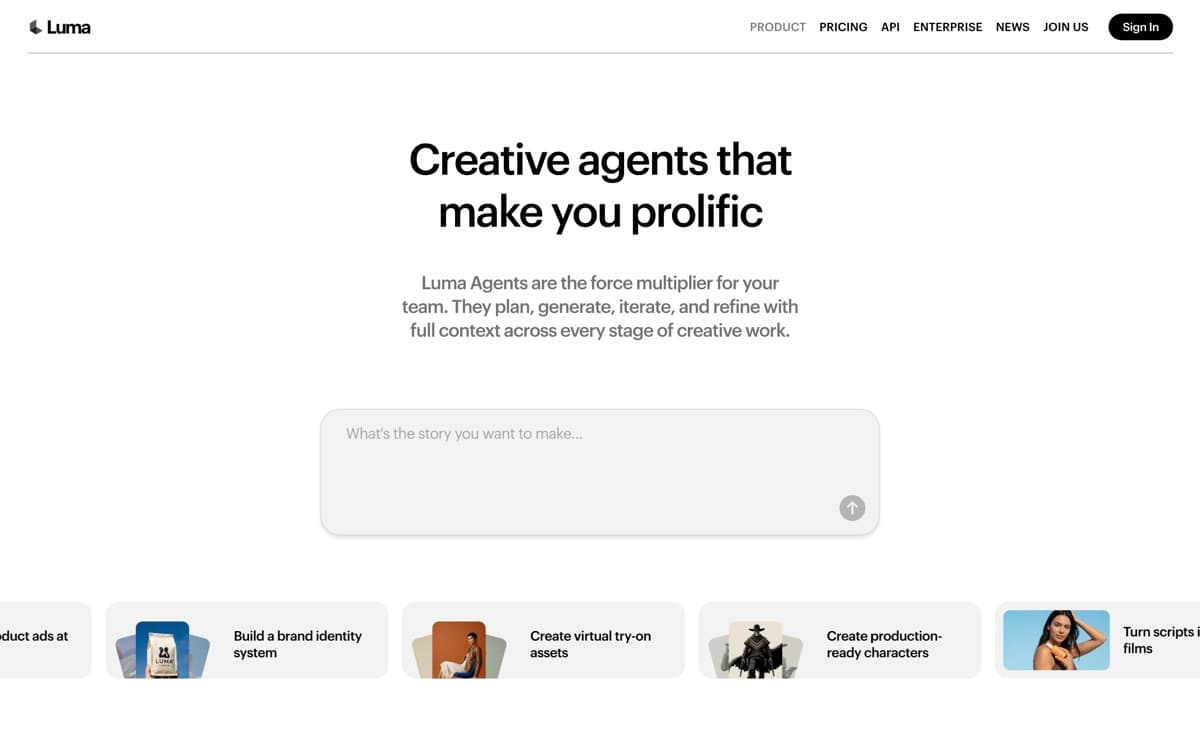
Dream Machine went viral in 2024 by being the first good video model anyone could just try — and Luma has protected that accessibility ever since while pushing the research frontier underneath. Ray3, its 2025 flagship model, added something genuinely novel: reasoning. It interprets your intent, drafts rough passes, self-critiques, and then commits compute to a final render — which means fewer wasted generations for people who don't speak 'prompt.'
Pros
The most approachable interface in AI video — iterate by chatting
Ray3 model reasons about your prompt and drafts before finalizing
First to generate in true HDR; strong visual fidelity for the price
Excellent iOS app — genuinely creative on a phone
Cons
Ceiling on realism and control sits below Veo, Runway, and Kling
Pika4.0— Still the most fun, effects-forward video toy — Pikaffects remain a social-content cheat code — but frontier realism has moved past it.
Hailuo (MiniMax)4.1— Strong motion and physics from another Chinese lab; a legitimate Kling alternative that mostly lacks Kling's ecosystem polish.
Higgsfield3.9— Camera-move specialist beloved by ad creatives; brilliant at swooshy product shots, narrower everywhere else.
Adobe Firefly Video4.0— The commercially-safe option with Premiere integration — the right call for brands that need indemnification more than spectacle.
How we ranked them
Our benchmark reel: 60 prompts covering dialogue scenes, high-motion action, product shots, animals, crowds, and physics stress-tests, generated fresh on every major model release. Blind panel scoring weights realism and coherence (35%), controllability and consistency tools (25%), audio (15%), workflow/output options (10%), and cost per usable clip (15%). And yes — Google also tops our image ranking; the note there explains how we think about that concentration. Full transparency on the other direction, too: on pure blind-preference arenas, Seedance currently outranks Veo clip-for-clip — our composite still favors Veo on prompt adherence, native audio, and the Flow toolchain. Veo earned this slot on output, no vendor pays us, and if arena preference is your weighting, the Seedance review is one scroll down. Method details: how we rank.
Life after Sora
OpenAI's Sora app shut down in April 2026 (the API follows in September). If you're migrating: Veo 3.1 for maximum quality and audio, Seedance 2.0 for the social-app remix energy, Runway for professional control, Kling for volume on a budget. Export your Sora library before the sunset deadline — our migration guide walks through it.
Budget for re-rolls, not clips
Sticker prices mislead in this category. A model with better prompt adherence at 3× the per-clip price is often cheaper per usable clip. Track your own hit rate during trials — it varies wildly by content type — and buy the unlimited/relaxed tiers (Runway Unlimited, Kling volume packs) the moment you're generating daily.
Disclosure and rights are now table stakes
Platforms label AI video, watermark detection is mainstream, and likeness law tightened after 2025's deepfake controversies. Keep consent for any real person's face or voice, keep your prompts and licenses on file, and disclose AI generation where platforms require it. Boring, but it's what keeps monetization safe.
AI Video Generators: FAQ
What is the best AI video generator in 2026?
Google Veo 3.1 overall, for realism, prompt adherence, and native audio. Runway leads for professional control and editing existing footage, Kling 3.0 for high-motion realism per dollar, Seedance 2.0 for multi-shot storytelling, and Luma for beginners.
What replaced Sora after OpenAI shut it down?
No single product — Veo 3.1 took the quality crown, Seedance (now at 2.5) the multi-shot-with-audio niche, and Runway the professional workflow. Our migration guide covers exporting your Sora content and picking a successor.
Can AI video generators create sound and dialogue now?
The leaders can: Veo 3.1, Kling 3.0, and Seedance 2.0 generate synchronized dialogue, ambience, and effects natively. It's the biggest capability shift since the category emerged.
How much does AI video actually cost?
Casual use: free tiers exist everywhere. Regular creation: $10–30/month. Daily production: expect $76+ (Runway Unlimited) or volume credit packs, plus re-roll waste. Enterprise API pricing runs per second of output.
How long can AI-generated videos be in 2026?
Single coherent generations now commonly run 10–60 seconds (Kling and Seedance lead on length), and scene-extension tools chain shots into multi-minute sequences. Feature-length remains a stitching exercise, not a single prompt.