Top5Apps editorial · Updated September 10, 2026 · How we rank
AI voices stopped sounding like AI. The best 2026 models breathe, hesitate, whisper, and get audibly excited; they clone a voice from seconds of audio and speak seventy languages in it. That power reshaped audiobooks, ads, customer service, and video production — and made choosing the right tool (and using it ethically) actually matter.
Our ranking after months of production use: ElevenLabs is the undisputed overall leader — the best voices, the deepest platform. Murf is the business workhorse for teams making training and marketing content. Hume generates the most emotionally intelligent speech and powers the most human-feeling voice agents. Cartesia is the developer's choice for real-time voice applications where every millisecond counts, and Speechify wins for consuming content rather than creating it.
All five offer free tiers. Pricing scales with characters or minutes generated, so we've priced real workloads — a YouTube video, a course module, a month of a support agent — not just sticker tiers.
Best overallFree tier: Yes — ~10 min/moPaid from $5/mo
ElevenLabs is to AI voice what Photoshop is to images: the default professional tool and the benchmark everyone else quotes. The Eleven v3 model family delivers speech with genuine acting — it interprets context, lands emphasis, breathes between clauses, and follows inline direction like [whispers] or [laughs]. In our blind tests, listeners misidentify its output as human more than any competitor's, in English and across dozens of languages.
Pros
The most realistic, expressive voices in the industry (Eleven v3)
Instant cloning from seconds of audio; professional cloning from 30 minutes
70+ languages with accent and emotion preserved across them
Full platform: dubbing, agents, music, sound effects, voice library
Cons
Character-based pricing climbs steeply at audiobook scale
So capable it demands governance — teams need clear consent policies
Feature breadth has made the dashboard busier each year
Best for business content & teamsFree tier: Yes — trial minutesPaid from $19/mo
Murf figured out who actually buys AI voice at scale: L&D departments, marketing teams, and product educators with a mountain of training videos, explainers, and ads to narrate. Everything about it serves that buyer. Voices are pre-vetted for professional narration rather than dumped in an infinite library; the editor syncs narration against your slides or video timeline; pronunciation libraries keep the product name right in all 40 modules; workspaces keep the whole team using the same brand voice.
Pros
200+ vetted studio voices tuned for narration, ads, and e-learning
Real editor: sync voice to slides/video, tune pitch, pauses, pronunciation
Team workspaces with shared projects and brand voice consistency
Say It My Way lets you record intonation and transfer it to any voice
Cons
Expressive ceiling below ElevenLabs and Hume for dramatic content
Best emotional expressiveness & voice agentsFree tier: Yes — monthly creditsPaid from $10/mo
Hume began as an emotion-science research lab, and it built the only voice AI that genuinely understands feeling in both directions. Octave 2, its speech model, doesn't read text — it interprets it, choosing pacing, tension, and warmth from narrative context like a director-noted actor. Give it a fight scene and voices tighten; give it a lullaby and they soften. For fiction, games, and character work, its output is the most alive in the industry.
Pros
Octave 2 acts scripts with emotional nuance no rival matches
Describe a voice in words — 'weary detective, light rasp' — and it exists
EVI conversational agents respond to *how* users sound, not just what they say
Voice design from prompts is a superpower for fiction and games
Cons
Smaller voice library and language coverage than ElevenLabs
Developer-first: content-creator tooling is thinner
Long-form production workflow requires more assembly
Best for developers & voice agentsFree tier: Yes — monthly creditsPaid from $5/mo
Cartesia builds the voice layer for software that talks back. Founded by the Stanford researchers behind state-space models (the architecture challenging Transformers on speed), its Sonic models start speaking in under 100 milliseconds — fast enough that phone agents interrupt naturally, game characters banter without lag, and translation feels simultaneous. In the voice-agent gold rush of 2025–26, Cartesia became the pick axe. And the speed story is measured, not marketed: its Ink-2 transcription model topped Artificial Analysis's streaming leaderboard in July 2026 at an 8% word-error rate, versus 10% for Deepgram and 12% for ElevenLabs' equivalent.
Pros
Lowest latency in the industry — speech starts in tens of milliseconds
Sonic-3 quality now competitive with the premium labs
State-space model architecture runs cheap at scale (and on-device)
Instant cloning from three seconds of audio
Cons
No content-creator suite — it's infrastructure, not a studio
Voice library and language coverage behind ElevenLabs
Best for listening & accessibilityFree tier: Yes — basic voicesPaid from $139/yr (~$11.58/mo)
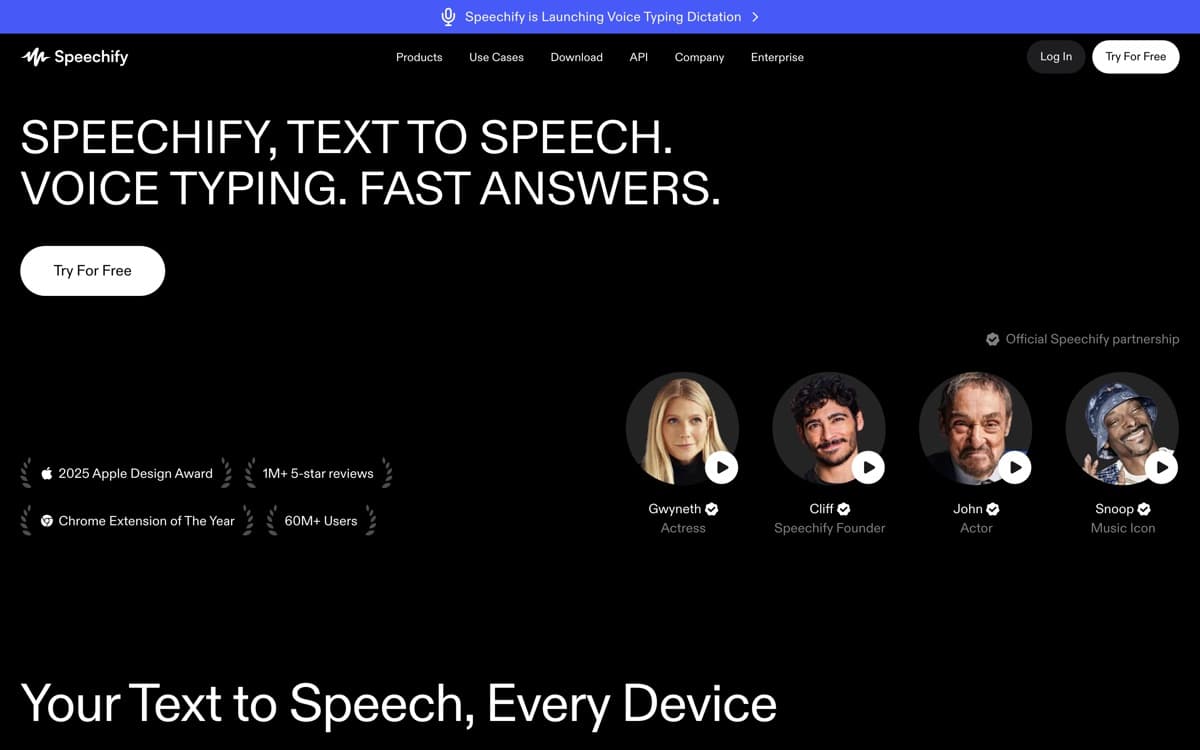
Speechify flips this category around: instead of giving your words a voice, it gives your ears access to everything written. Founded by a dyslexic student who needed textbooks read aloud, it became the world's most popular reading app — past 60 million users across nearly 200 countries as of July 2026 — paste, upload, photograph, or browse to any text and a natural voice reads it at up to 4.5× speed. Commuters finish reports; students absorb chapters; people with dyslexia or vision impairment get real independence.
Pros
Best-in-class reader: PDFs, articles, emails, books, even photographed pages
Celebrity voices (Snoop Dogg, Gwyneth Paltrow, MrBeast) make listening fun
Up to 4.5× speed with surprisingly preserved clarity
Everywhere you read: browser, phone, desktop, scanned paper
Cons
Creation tools trail the specialists above
Premium price is steep for what's mostly consumption
OpenAI voice (Realtime/TTS)4.1— Superb conversational latency inside the OpenAI stack; a natural default if you're already building on their API, less compelling standalone.
WellSaid Labs4.0— The enterprise compliance darling with rock-solid consented voices; quality is professional if less thrilling than the frontier.
Resemble AI4.0— Strong enterprise cloning plus deepfake detection — a differentiated security angle for brands worried about voice fraud.
Google Cloud TTS (Chirp 3)3.9— Massive language coverage at commodity prices for infrastructure builders inside GCP.
How we ranked them
We scored blind listening tests across narration, ads, dialogue, and multilingual samples (40%), capability depth — cloning, dubbing, agents, controls (25%), workflow fit for the tool's target user (20%), and real-workload pricing (15%). Latency benchmarks were measured on production APIs in July 2026. On the tie: Murf and Hume both score 4.5 — Murf ranks higher because business narration is the bigger job market; if your work is expressive or conversational, read them in reverse order. Full method: how we rank.
Buy for your actual job
Creating content → ElevenLabs (or Murf if it's corporate and collaborative). Building a product that talks → Cartesia first, ElevenLabs Agents second. Emotional or character-driven narrative → Hume. Consuming more of what you read → Speechify. The tools barely compete with each other once you name the job.
The consent line
2025's voice-deepfake scandals produced real consequences: platform crackdowns, state likeness laws, and the EU AI Act's disclosure rules. The professional standard now is simple — written consent for any real person's voice, disclosure where required, and preference for designed voices (Hume-style) when a project doesn't need a real identity. Every tool above enforces some version of this; don't be the case study.
Price per finished minute, not per tier
Character-based pricing punishes long-form and re-takes. Estimate your monthly finished minutes, multiply by ~2 for revisions, and compare that number across tools — the cheapest tier is frequently not the cheapest workflow, especially against Murf's per-user model or Cartesia's volume rates.
AI Voice Generators: FAQ
What is the best AI voice generator in 2026?
ElevenLabs overall — best quality, cloning, dubbing, and platform breadth. Murf leads for corporate teams, Hume for emotional performance and agents, Cartesia for real-time developer applications, and Speechify for listening to content.
What's the best free AI voice generator?
ElevenLabs' free tier offers the best quality-per-dollar-of-zero; Cartesia's free developer credits are the builder's equivalent. Expect attribution requirements and monthly caps on all free tiers.
Is AI voice cloning legal?
With consent, generally yes. Without it, you're violating platform terms and — in a growing list of jurisdictions including several US states and the EU — the law. Get written consent, keep records, disclose where required.
Can AI voices really replace voice actors?
For informational content — e-learning, IVR, product videos — they largely have. For premium performance work, top actors now license their voices through platforms with revenue share; the winning model is looking like collaboration plus consent rather than replacement.
Which tool is best for real-time voice agents?
Cartesia for latency and cost at scale; ElevenLabs Agents for the most complete out-of-box platform; Hume EVI when emotional perception matters (support, coaching, companionship).