Top5Apps editorial · Updated September 3, 2026 · How we rank
AI detection is the most misunderstood category we cover — so let's be direct: no detector is proof. Every tool on this page outputs probabilities, not verdicts; every one produces false positives; and 2026's humanizer tools, hybrid drafting, and heavy editing blur the line detectors try to draw. Anyone selling certainty is selling something else.
Used honestly — as one signal among several, with humans making the final call — the best detectors are genuinely useful: publishers screening freelance submissions at scale, educators starting (not ending) integrity conversations, and platforms triaging spam floods. We tested the field against fresh text from GPT-5-class, Claude, and Gemini models, plus human control sets including non-native English writers, and ranked the five that balance accuracy with candor about their limits.
Pangram Labs now leads on raw accuracy in both our tests and the published academic benchmarks. GPTZero remains the best all-around platform, especially for education. Copyleaks wins the enterprise/LMS integration race, Originality.ai is the publisher's workhorse, and Turnitin is the institutional default that improved meaningfully this cycle.
Best accuracyFree tier: Yes — limited scansPaid from ~$15/mo
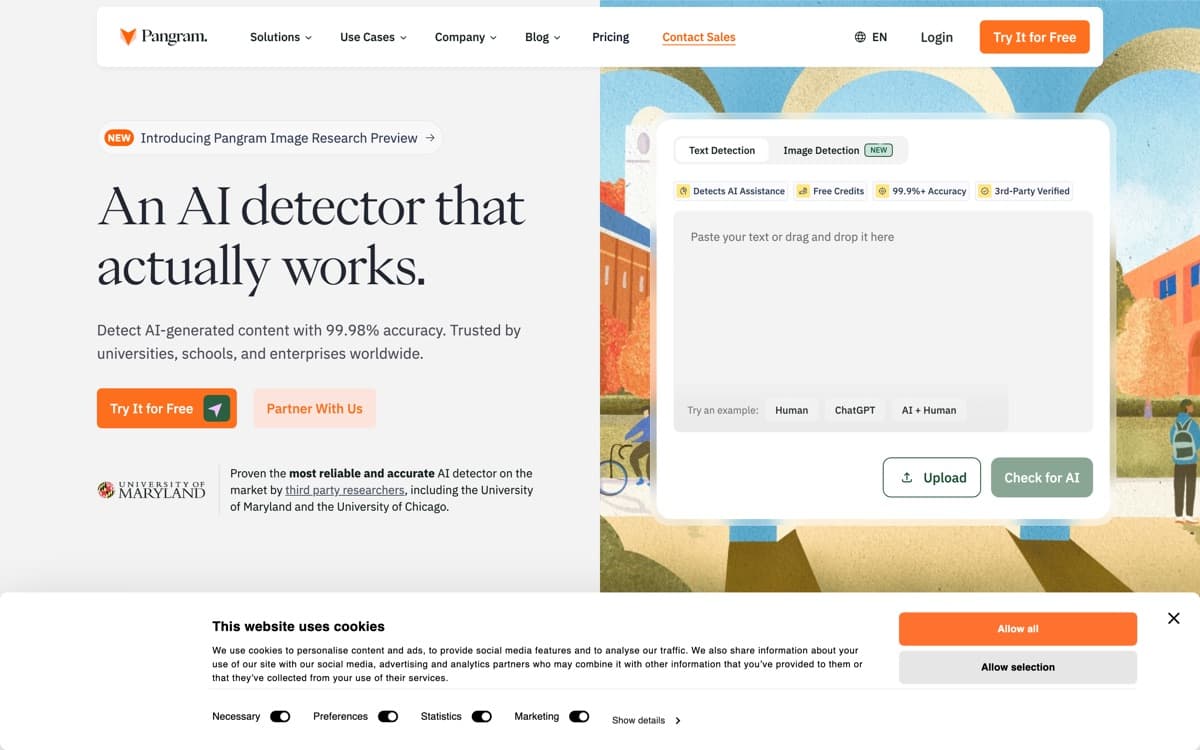
Pangram arrived in 2024 making an uncomfortable claim — that the incumbent detectors were far less reliable than advertised — and then kept winning the independent evaluations that followed. Peer-reviewed comparisons through 2025 and 2026 repeatedly place Pangram at or near perfect on benchmark sets where legacy tools wobble, with false-positive rates an order of magnitude lower. Our own gauntlet (fresh model outputs, edited hybrids, non-native human writing) matched the literature: it's the most trustworthy signal in the category right now. The receipts keep arriving — a peer-reviewed June 2026 evaluation of long-form academic papers found Pangram was the only commercial detector that performed well, at 97.5% inclusive accuracy with zero false positives, while the legacy rivals missed 70–100% of the AI-written papers outright.
Pros
Top accuracy in independent academic evaluations, including on 2026-era models
Dramatically lower false-positive rates than legacy detectors in our tests
Holds up better against paraphrasers and 'humanizers' than rivals
Fair to non-native English writers — the classic failure mode, addressed
Cons
Younger company with a thinner integration ecosystem (no LMS plugins yet)
Web dashboard is spartan next to GPTZero's platform
Pricing tiers still stabilizing as the product matures
Best for educators & all-around platformFree tier: Yes — ~10k words/moPaid from $15/mo
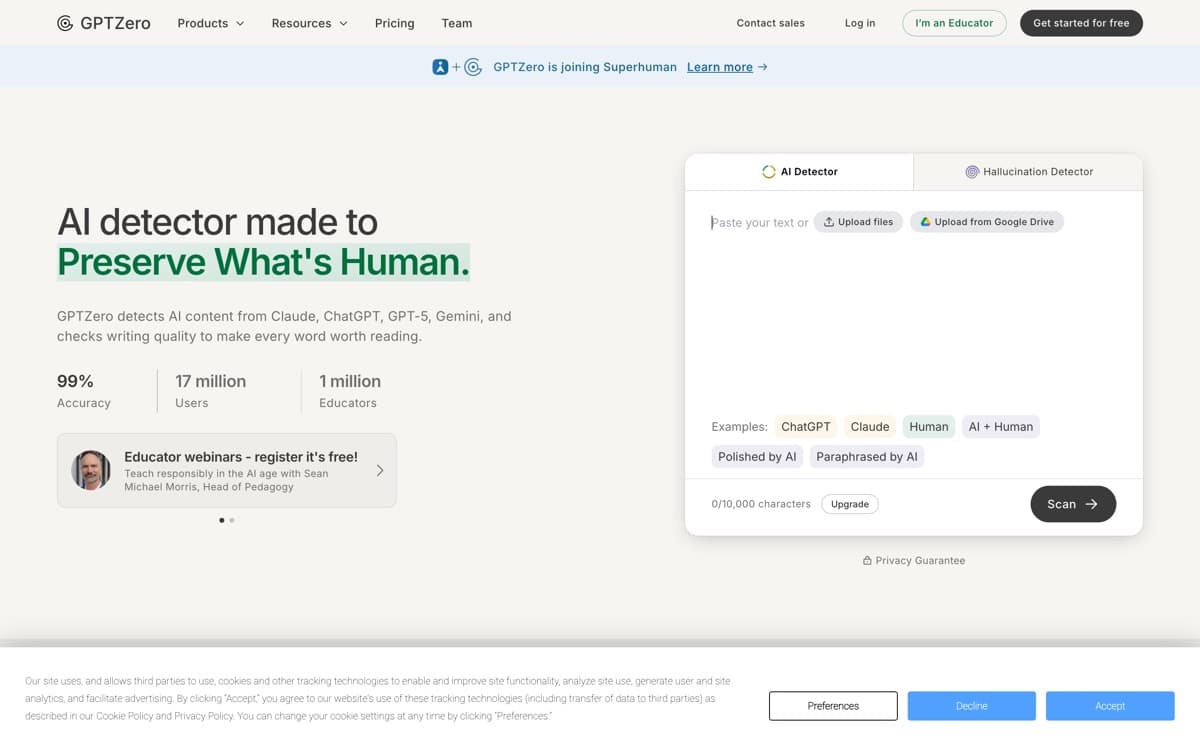
GPTZero — famously built by a college student in a January 2023 weekend — grew into the category's most complete product and education's default — 19 million registered users and $30 million in annual recurring revenue by the time Superhuman, Grammarly's parent company, acquired it in June 2026. The detection core is solid: sentence-level highlighting, confidence bands rather than false precision, multilingual support, and steady model updates. But GPTZero's real evolution was realizing detection scores alone can't carry integrity decisions — so it built the evidence layer around them.
Pros
The most complete platform: dashboards, batch scans, source citations, writing analysis
Writing Reports show *process* (typing cadence via replay) — evidence beyond scores
Sentence-level highlighting with calibrated confidence bands
Educator-friendly integrations: Canvas, Google Classroom, Moodle
Cons
Raw accuracy now trails Pangram in independent tests
Free tier tightened over the years
Advanced features (deep scans, reports) meter quickly on lower tiers
AI detection plus plagiarism, wired into the enterprise
4.3
Editorial score
Best enterprise & LMS integrationFree tier: Limited trial creditsPaid from $7.99/mo
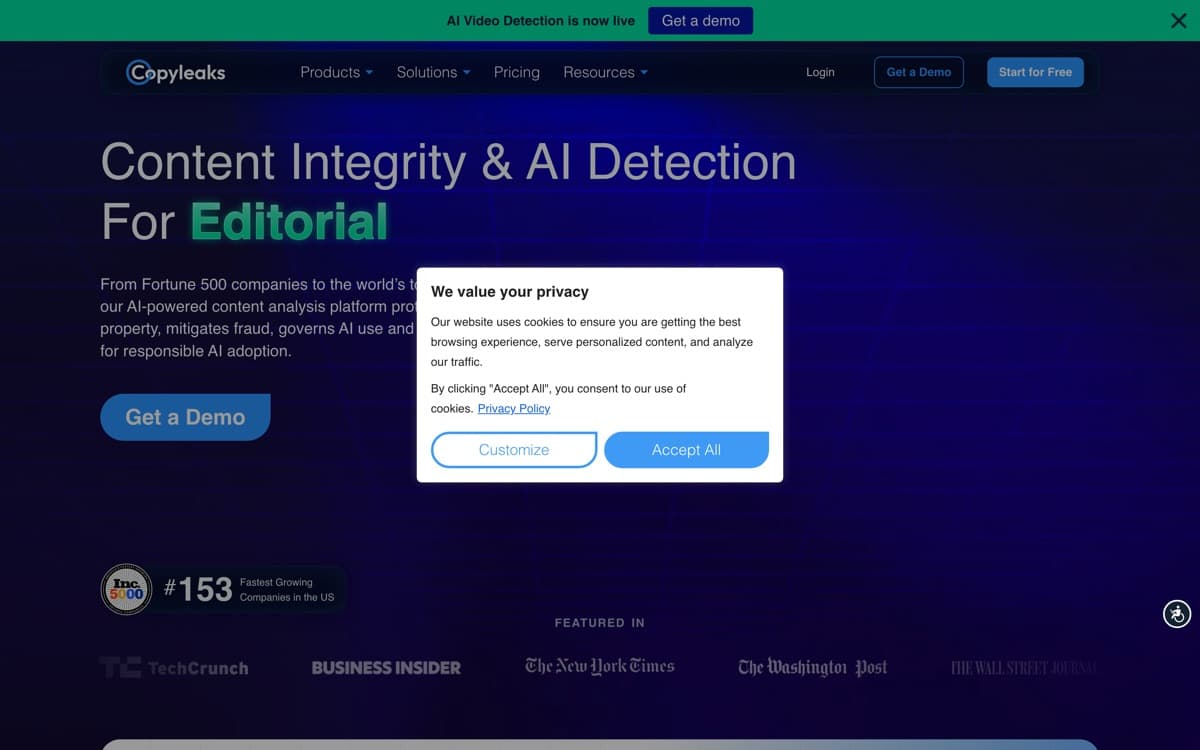
Copyleaks wins deals the others don't compete for: a decade of plagiarism-detection heritage, meaning the LMS integrations, APIs, compliance certifications, and multilingual coverage that institutions and platforms require were already built when AI detection arrived. One submission returns both verdicts — copied and/or generated — in a unified report, which is exactly the workflow schools and publishers actually run.
Pros
One scan, two answers: AI detection and plagiarism together
30+ language coverage — the multilingual enterprise leader
Deep LMS/API integrations (Canvas, Moodle, Blackboard, custom pipelines)
AI Logic explanations show *why* text was flagged
Cons
Independent tests show more false positives than Pangram/GPTZero
Credit-based pricing gets confusing across products
Marketing accuracy claims deserve the usual skepticism
Best for publishers & SEO teamsFree tier: Free AI checker for short textPaid from $12.95/mo
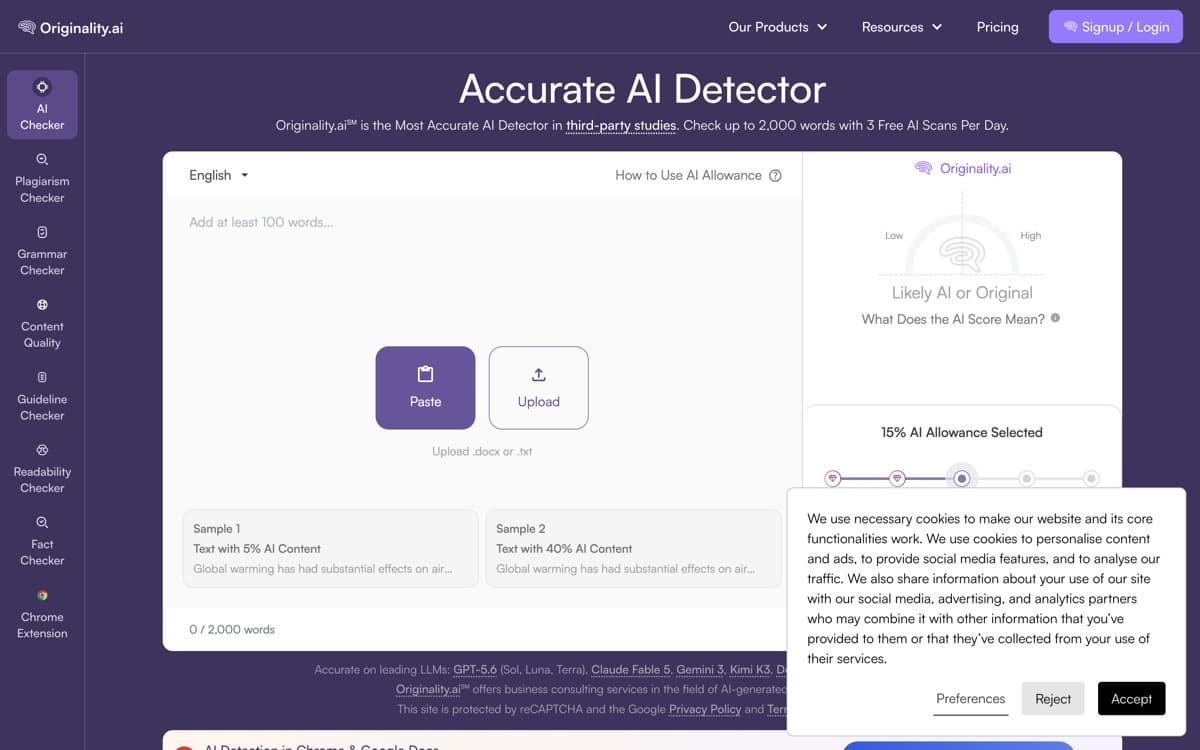
Originality.ai built for a specific customer with a specific fear: the publisher paying freelancers by the word, wondering which invoices are secretly ChatGPT. The workflow shows that focus — bulk scans across a whole site, team seats with per-editor histories, shareable report links for writer disputes, a WordPress plugin, and a Chrome extension that (with consent) watches a Google Doc's construction the way GPTZero's reports do. Detection, plagiarism, readability, and a fact-checking aid run in one pass: an editorial QC desk, not just a classifier.
Pros
Built for content operations: team seats, full-site scans, shareable reports
Detection + plagiarism + fact-check aid + readability in one pass
Chrome extension watches Google Docs writing sessions
Pay-as-you-go option ($30 for 3,000 credits) for irregular volume
Cons
Tuned aggressive — more false positives on polished human prose
'AI-influenced' scores can unfairly ding grammar-tool users
Web-content focus; not designed for academic integrity workflows
The institutional incumbent, wiser after its stumbles
4.0
Editorial score
Best for institutions (LMS-embedded)Free tier: No — institutional licensingPaid from Institutional contracts
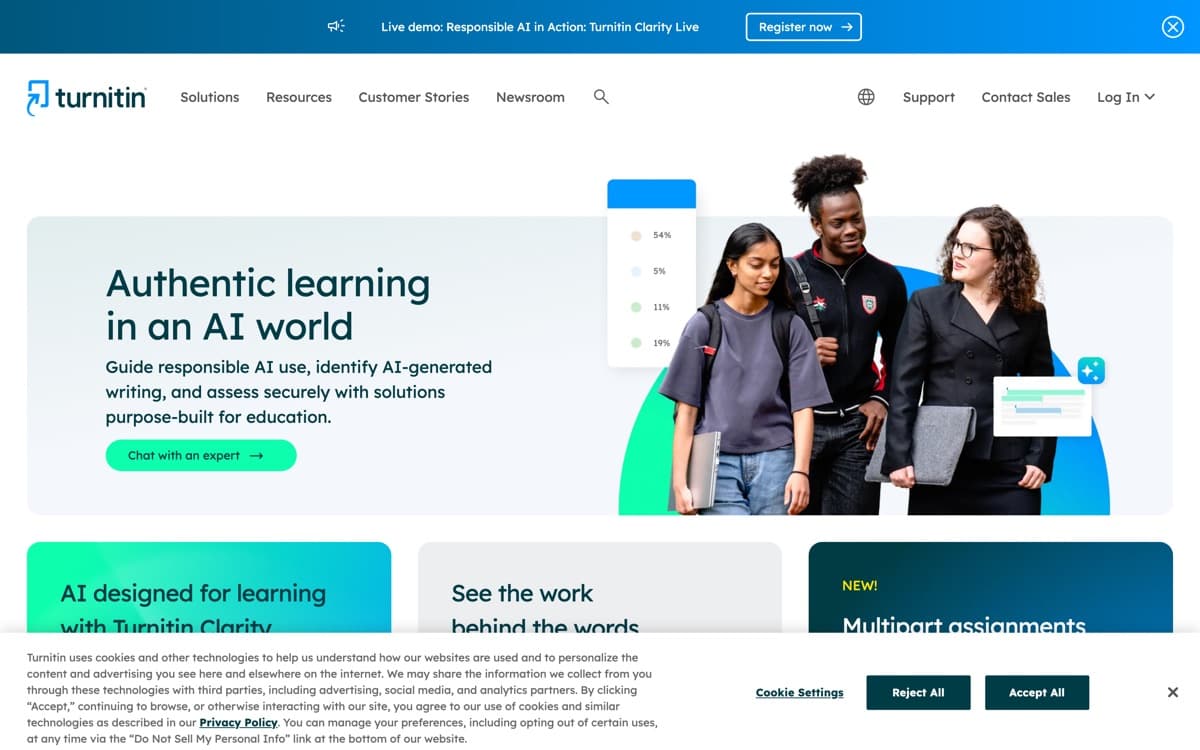
Turnitin is where AI detection meets institutional reality: it's already embedded in the assignment inboxes of most of the English-speaking academic world, so its AI indicator reaches more graded work than every other tool combined. The 2023 launch was rocky — confident percentages, painful false positives, universities publicly disabling it — and the 2024–26 rebuild deserves credit: scores now arrive banded with explicit uncertainty language, paraphrase-tool detection improved materially, and the surrounding governance features (policy templates, audit trails, process documentation) reflect lessons learned the hard way. The scale it polices is a stat in itself: Turnitin's own platform data shows about 15% of essay submissions since October 2025 were more than 80% AI-written — five times the rate at its detector's 2023 launch.
Pros
Zero-friction deployment inside the grading workflow schools already use
AI score alongside similarity report in one submission view
Improved calibration and paraphrase-detection after early false-positive era
Governance layer: policies, audit trails, and appeals processes built in
Cons
Not available to individuals — institutional contracts only
Accuracy still trails the specialist leaders in independent tests
Early-2023 false-positive reputation lingers in student trust surveys
Winston AI3.9— Solid accuracy claims and pleasant UX for individual checks; hasn't matched the leaders in independent validation yet.
ZeroGPT3.2— Free and ubiquitous, but accuracy and false-positive discipline lag badly — fine for curiosity, not decisions.
Sapling3.8— Developer-friendly API detection with reasonable performance; a pragmatic embed for platforms.
QuillBot AI Detector3.4— Free and convenient inside a popular writing suite; ironic given QuillBot's paraphraser is what detectors fight.
How we ranked them
We built a 600-sample test set: fresh outputs from GPT-5-class, Claude, and Gemini models; hybrid human-edited AI text; paraphraser/'humanizer' processed samples; and human controls including non-native English writers and formulaic professional prose. Tools were scored on true-positive rate (30%), false-positive rate — weighted double for human-harm (30%), robustness to evasion (20%), and honesty of reporting/UX (20%). Method: how we rank.
The rule that should govern every use
Detection scores are probabilistic evidence, never proof. The responsible pattern everywhere: detector flags → human reviews → process evidence gathered (drafts, history, conversation) → decision by a person under a written policy. Any workflow that auto-punishes on a score will eventually hurt an innocent writer — most often a non-native English speaker. Every vendor above now says some version of this; hold them (and yourself) to it.
Match tool to stakes
High-stakes individual decisions (academic integrity, employment) → maximize accuracy and process evidence: Pangram plus GPTZero's Writing Reports. Volume triage (publishing, platforms) → Originality or Copyleaks workflows with human review queues. Institution-wide deployment → Turnitin for workflow plus a specialist second-opinion layer. Never single-tool a decision that matters.
Where detection is heading
The arms race favors provenance over forensics: watermarking (Google's SynthID text, C2PA), platform-level AI labeling, and process-based verification (documented drafting) are growing while pure statistical detection gets harder with each model generation. Budget accordingly — detection buys you triage today, but policy and provenance are the durable investments. And the triage volume is only growing: a 55,000-page Graphite study (using Copyleaks as a detection engine) found roughly half of new online articles have been AI-generated since early 2025.
AI Detectors: FAQ
What is the most accurate AI detector in 2026?
Pangram leads independent academic evaluations and our testing, with the lowest false-positive rates. GPTZero remains strong with the best education platform around its scores.
Can AI detectors be wrong?
Yes — always assume so. False positives disproportionately hit non-native English writers and formulaic prose; false negatives rise with editing and humanizer tools. Use scores as signals requiring human judgment, never as verdicts.
Can AI detectors identify text from GPT-5, Claude, or Gemini?
The current leaders detect raw output from frontier models well. Heavily edited or deliberately 'humanized' text erodes every tool's confidence — which is why process evidence increasingly matters more than scores.
Do AI 'humanizers' actually beat detectors?
They reduce detection rates significantly against most tools — Pangram holds up best in published robustness tests. The cat-and-mouse continues; assume evasion is always partially possible.
Is there a truly free AI detector worth using?
GPTZero's free tier (~10k words/month) is the best no-cost starting point; Pangram offers free limited scans. Free tools without published accuracy data (ZeroGPT et al.) aren't worth trusting for anything consequential.