

ChatGPT Review (2026)
The default AI assistant — and still the most complete
Top5Apps editorial · Last tested & updated September 24, 2026 · Reviewed under The Receipts Standard
Developer
OpenAI
Free tier
Yes — generous
Paid from
$20/mo
Platforms
Web, Windows, macOS, iOS, Android
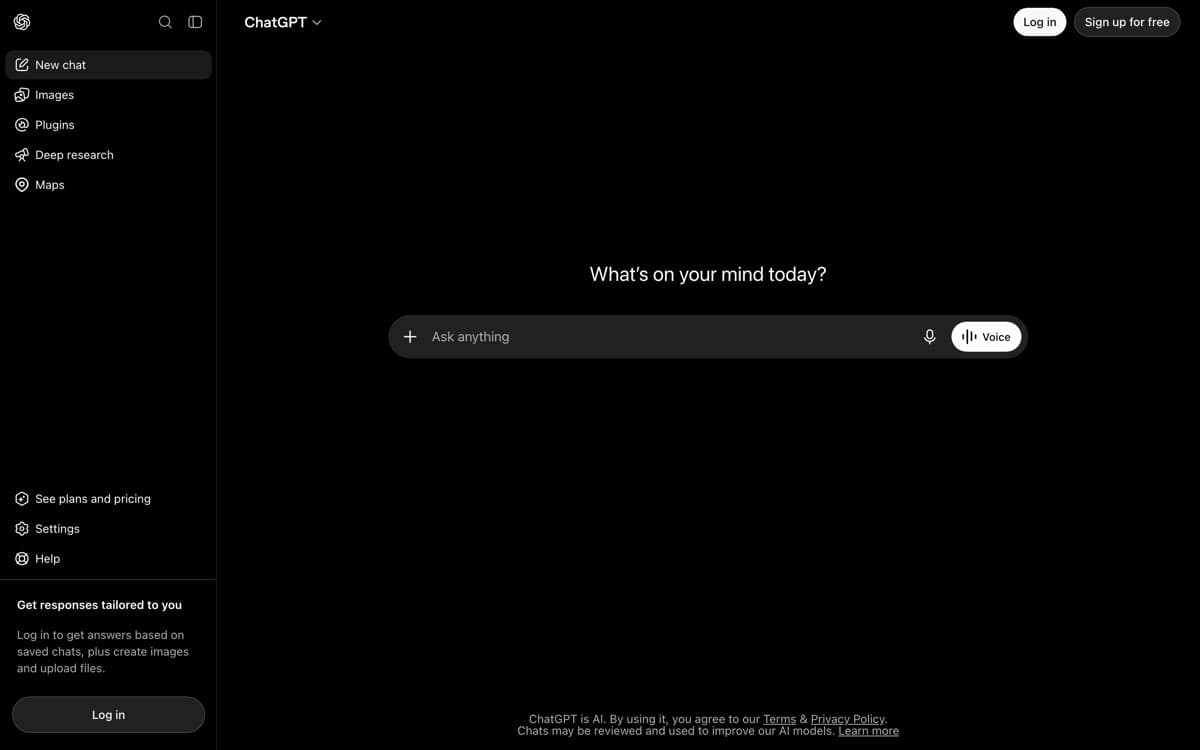
What is ChatGPT?
ChatGPT is where most people start with AI, and in 2026 it's still the product to beat. OpenAI's GPT-5 model family routes your request to the right level of reasoning automatically, so everyday questions come back fast while hard problems get real thinking time. The result is an assistant that's consistently good at almost everything — writing, coding, math, analysis, brainstorming — even when it's not the absolute best at any single one. The scale says it plainly: ChatGPT crossed 1 billion weekly users in August 2026 — announced as OpenAI made free text chats unlimited and rolled out the GPT-5.6 generation as the new default — with 50 million users paying as of February. And the next act arrived September 3 — messily: GPT-6 Astra, the first OpenAI model designated at its Preparedness Framework's 'Critical' cybersecurity threshold, with computer use as the flagship capability. The rollout began with vetted enterprise programs, ran bumpy enough that Sam Altman apologized a day later (with banked-reset compensation for the wait) — then finished faster than promised: by the evening of September 4, Astra was live for every paid plan. Read the access map before you upgrade your expectations, though. In the Chat picker Astra appears only as 'GPT-6 Pro' on Pro, Business, and Enterprise plans with weekly message caps; Plus subscribers get Astra in ChatGPT Work and Codex, but not in main Chat at all; free users get nothing yet; and it isn't the new default — GPT-5.6 Sol remains the everyday model, with the sharpest cyber capabilities still gated behind the Daybreak programs. The pattern repeated on September 22 with GPT-6 Sol and GPT-6 Luna, the family's mid and small tiers, launched about ninety minutes after Anthropic's Opus 5.5: they run in ChatGPT Work and Codex for every paid plan, and are 'not yet available in Chat' — Free and Go users can try Luna only inside the desktop app. The headline is the API price, halved to $2/$10 (Sol) and $0.10/$0.50 (Luna) and stated as permanent; the independent read is flatter, with Artificial Analysis scoring Sol level with GPT-5.6 Sol (48 vs 47) and Vals ranking it #8, 'approximately on par with GPT 5.6 Sol at 1/2 of the cost.' OpenAI also loaded a banked Codex/Work usage reset into Plus, Pro, and Business accounts. This review reflects GPT-5.6 hands-on in Chat; a re-test with the GPT-6 family in Work is queued.
What separates ChatGPT from the pack is the surface area. Voice conversations feel natural enough for language practice. Deep Research will spend twenty minutes reading the web and return a cited report. ChatGPT Work — which absorbed the standalone agent mode in September 2026 — runs a cloud browser on a separate machine to fill forms, compare prices, and assemble spreadsheets, asking before anything that costs money or can't be undone. The image layer jumped a generation on September 8: ChatGPT Images 2.5 rolled out to every tier — free included — adding Sketch (type '@Sketch' and draw right in the chat as a visual guide) and starter templates for flyers, posters, and product shots. Add memory, projects, connectors to Gmail, Drive, and GitHub, plus a library of custom GPTs, and ChatGPT is less a chatbot than an operating system for getting things done. The newest layer takes that literally: Computer History (August 2026) lets the Mac app remember selected activity across your apps and websites — interaction events, not screenshots — so you can pick work back up without re-explaining it. It's opt-in and off by default, with a timeline you can inspect and wipe; it's Pro/Business/Enterprise only, and on August 20 it reached the EEA, UK, and Switzerland after launching everywhere else first.
ChatGPT: pros and cons
Pros
- GPT-5-class models with strong reasoning across almost every task type
- ChatGPT Work completes multi-step tasks — browsing, files, spreadsheets — in its own cloud browser
- Deep Research produces genuinely useful cited reports
- Huge ecosystem: connectors, custom GPTs, voice mode, image generation
- Memory makes it noticeably more personal over time
Cons
- Free text chats are now unlimited, but the best reasoning models still meter — caps land mid-task at peak times
- Feature sprawl — settings, model pickers, and modes can overwhelm new users
- Long-document handling still trails Claude and Gemini in our testing
Standout features
ChatGPT Work and the cloud browser
Give it a goal — 'find three flights under $400 and put them in a spreadsheet' — and ChatGPT Work runs it in its own browser on a separate cloud computer, clicking, reading, and assembling the result. OpenAI's stated rule: it asks for confirmation before actions that create 'a financial, legal, account, or other real-world commitment.' The standalone 'agent mode' was retired in September 2026; Work is where that capability lives now — and it remains the most polished consumer agent on the market.
Deep Research
The feature that turned ChatGPT from a Q&A tool into a research assistant. It reads dozens of sources, weighs them, and writes a structured, cited report. We've used it for market research that would have taken an analyst a full day.
Memory and personalization
ChatGPT remembers your projects, preferences, and writing style across conversations (and you can view, edit, or disable everything it stores). After a few weeks it stops feeling like a generic tool and starts feeling like your tool.
ChatGPT pricing
The free tier is genuinely usable: GPT-5-level responses with usage caps, file uploads, voice, and limited image generation. Plus at $20/month raises every limit, unlocks the stronger reasoning modes, ChatGPT Work with its cloud browser, and more Deep Research runs. Pro now comes in two tiers ($100 and $200/month) for the heaviest reasoning models — including weekly GPT-6 Pro allowances of 50 and 200 messages respectively — worth it for daily professional research or serious coding, overkill for everyone else. Note that 'Pro' has never meant unlimited, and Astra makes the meters more visible than ever. Since September 22, every paid plan also gets GPT-6 Sol and Luna inside ChatGPT Work and Codex — cheaper models that stretch your usage, but not what answers you in Chat.
Teams and businesses get workspace plans with admin controls and data excluded from training by default — and as of late August 2026, Business workspaces can add Premium seats at $125/user/month ($100 annual): 5× a Standard seat's usage with the five-hour cap removed, for the teammates who live in ChatGPT Work and Deep Research. At the time of writing, Plus remains the best $20 most people can spend on software.
Our verdict
If you only subscribe to one AI assistant, make it ChatGPT. It has the fewest weak spots, the deepest feature set, and the fastest shipping cadence in the industry. Writers who care about prose style should also try Claude, and researchers should keep Perplexity in the rotation — but ChatGPT is the default for a reason.
Skip it if: Polished long-form writing is the whole job (Claude edits tighter), or you mostly need sourced factual answers (that's Perplexity) — or you'd rather not manage yet another subscription's rate limits.
4.9 / 5 — #1 in AI Chatbots 2026
ChatGPT: FAQ
Is ChatGPT free to use in 2026?
Yes — and more so than ever: as of September 2026, text chats are unlimited for free users on the default GPT-5.6 Luna model (GPT-6 Luna is available to free users only in the desktop app's Work mode), plus voice mode, file uploads, and limited image generation. Paid plans start at $20/month for the stronger reasoning models, ChatGPT Work, and more Deep Research.
What happened to Sora, ChatGPT's video app?
OpenAI discontinued the standalone Sora video app in April 2026 and is retiring the Sora API in September 2026. For AI video in 2026, see our best AI video generators ranking.
Does ChatGPT train on my conversations?
On consumer plans, OpenAI may use conversations to improve models unless you turn off training in settings (Settings → Data Controls). Team, Enterprise, and API traffic is excluded from training by default.
Head-to-head: ChatGPT vs Claude · ChatGPT vs Gemini
Related rankings: best personal AI agents · best AI code editors · best AI dictation