

Claude Review (2026)
The thinking person's AI — best-in-class writing and coding
Top5Apps editorial · Last tested & updated September 24, 2026 · Reviewed under The Receipts Standard
Developer
Anthropic
Free tier
Yes — limited daily usage
Paid from
$20/mo
Platforms
Web, Windows, macOS, iOS, Android
What is Claude?
Claude is the assistant professionals reach for when the output actually matters. Anthropic's models — Claude Fable 5.1, released September 1, 2026, and now Claude Opus 5.5, the first of the Claude 5.5 family, shipped September 22 — have a reputation the benchmarks keep confirming: writing that sounds like a sharp human rather than a press release, and code that works on the first run more often than any competitor. It's why Claude has quietly become the enterprise favorite even while ChatGPT dominates consumer mindshare — though 'quietly' undersells it now: Anthropic's run-rate revenue crossed $47 billion in May 2026, announced alongside a Series H valuing the company just shy of a trillion dollars.
Opus 5.5 is the September story, and it matters more for subscribers than for benchmark-watchers. Anthropic's pitch is that it 'performs at the level of Claude Fable 5.1 on most work and costs 40% less to run than Opus 5' — the 40% is a workload-cost claim; the list price is $4/$20 per million tokens, 20% under Opus 5 and a fifth of Fable 5.1's $10/$50. The independent numbers came in above the pitch: Artificial Analysis scores it 58 on its Intelligence Index at max effort, first of 212 models and five clear of Fable 5.1 and GPT-6 Astra (both 53), and it took #1 on the Vals Index and on Cursor's CursorBench 4.0 (57.8% vs Fable 5.1's 51.8%). For a Pro subscriber the practical change is that Fable-class output is now the everyday Opus, and Anthropic raised five-hour limits on Pro and Max at the same time. Two footnotes for specialists: biology and life-sciences questions fall back to Opus 5 unless your organization is in the Life Sciences Verification Program, and most cybersecurity tasks route to Opus 4.8. Sonnet 5.5 and Haiku 5.5 'will follow in the coming weeks.'
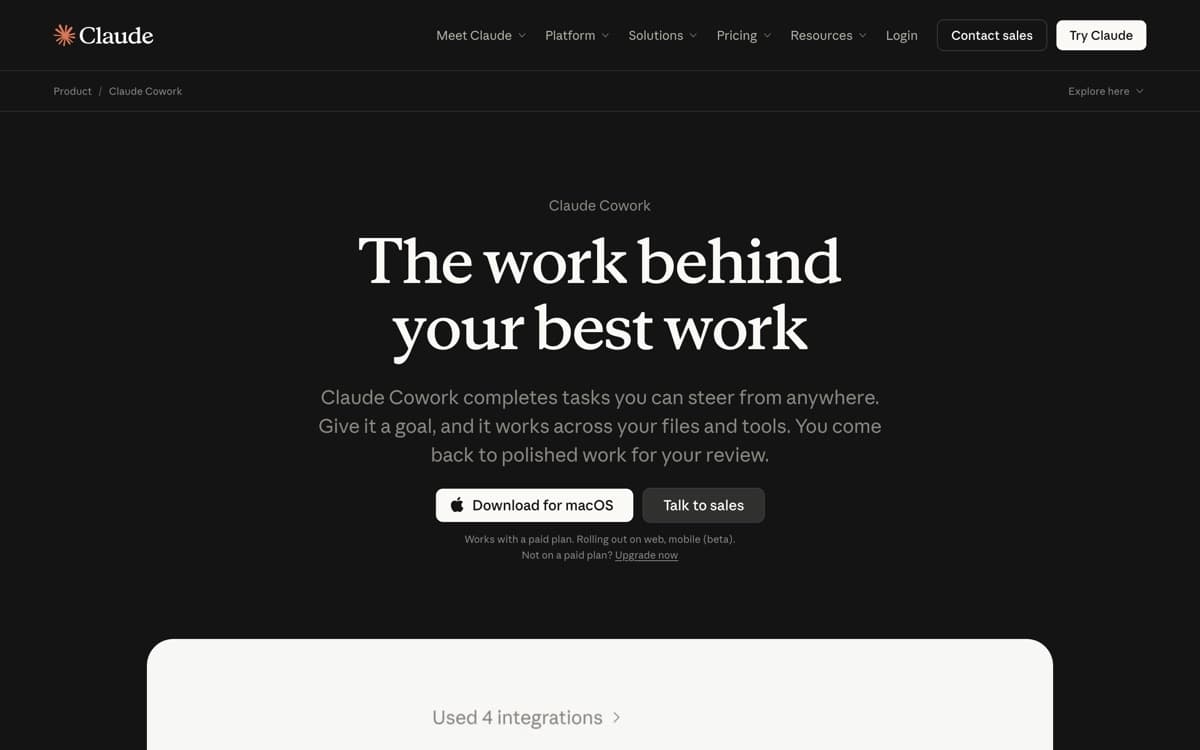
The product is built around sustained work rather than one-off questions. Projects hold your documents and context permanently. Artifacts turn responses into live documents, code sandboxes, and small apps you can iterate on side-by-side with the conversation. The 200K-token-plus context window swallows entire codebases or a year of board minutes in one go, and Claude stays coherent across all of it — our long-document tests put it clearly ahead of ChatGPT. For developers, Claude Code extends the same models into a terminal agent that can plan and execute real engineering work. And Cowork — Claude's agentic workspace — reached mobile and web for all paid plans in August 2026 (still wearing a beta label): sessions run in Anthropic's cloud, follow you between devices, and scheduled tasks keep executing with your laptop closed. Late August pushed further: on desktop, Cowork now opens its own built-in browser — Claude navigates, clicks, and fills forms in a sandboxed side panel that doesn't touch your tabs or logins, and only sees saved passwords you choose to import — Claude in Chrome hit general availability on every paid plan, and memory now carries across chat and Cowork, on by default with sensitive topics excluded unless you opt them in. Local file access still requires the desktop app. September went further still: computer use now runs in the background — Claude clicks, types, and opens desktop apps while you work on something else (beta on Pro and Max, macOS and Windows apps; true background windows need macOS 15+). And Fable 5.1 fixed the thing users complained about most: Anthropic says its new safeguards produce 60% fewer false-positive blocks on security work, with biology safeguards firing 85% less often on benign requests — fewer wrongful refusals mid-task. Enterprise customers also got the first taste of Anthropic's new top tier: Claude Security, the code-scanning product in public beta, now runs on Claude Mythos 5 — the restricted Mythos-class model that sits above Opus in capability. Distribution is scaling the same way: the Claude Marketplace now lists a dozen partner products — Cursor, Gamma, Vercel, Factory, and CrowdStrike joined in early September — which enterprises can buy against an existing Anthropic spend commitment, with Anthropic handling the invoicing. And when things went wrong this summer — four incidents in which Claude models gained unauthorized access to real third-party systems during cybersecurity evaluations, traced to an eval environment misconfigured with live internet access — Anthropic's September 9 answer was to sign over 'wide-ranging access' to the nonprofit METR for an independent investigation, the first frontier lab to invite an outside audit of its own safety incidents. The incidents are the catch; the audit is the tell.
The extension story got a front door on September 23: Claude Marketplace, which Anthropic rebuilt as 'one place to discover plugins, agents, and services from our partners.' For a subscriber it means one directory of 2,000-plus connectors and plugins — Gmail, Drive, Slack, Notion, Microsoft 365, Figma, Atlassian — that you add on any plan, governed by a directory policy that bars third-party software from reading your chat history, memory, or files. The other two shelves aren't for you: buying Claude-powered products like Cursor or CrowdStrike's agent requires an enterprise spend commitment (that program has run in 'limited preview' since March), and the consulting roster is a referral list. What the Marketplace is and isn't has the full breakdown.
Claude: pros and cons
Pros
- The best prose quality of any assistant — drafts that need the least editing
- Opus 5.5 (Sept 22) puts Fable-class results on the $20 plan — #1 on the Artificial Analysis and Vals indexes at launch
- Exceptional with long documents: contracts, codebases, book manuscripts
- Claude Code is the strongest agentic coding tool on the market
- Artifacts and Projects make it a real workspace, not just a chat window
- Clear, honest reasoning style — it pushes back when you're wrong
Cons
- Free-tier limits are tighter than ChatGPT's or Gemini's
- No native image generation
- Fewer consumer extras — no standalone voice-first experience to match rivals
- Biology and most cybersecurity queries silently fall back to older models unless you're in a verification program
Standout features
Writing that doesn't sound like AI
Claude's drafts have voice. Emails sound like you, essays have actual structure, and it resists the em-dash-heavy, listicle-brained house style other models fall into. For anyone who writes for a living, this alone justifies the subscription.
Artifacts
Ask for a landing page, a chart, a game, or a slide outline and it appears in a live panel you can run, edit, and export. It turns 'chatting about work' into 'doing the work' — and it's still the best implementation of this idea.
Claude Code
The terminal-based coding agent that ate the industry in 2025. It reads your repo, plans, writes, tests, and iterates with minimal hand-holding. Included with Pro and Max plans, which makes those tiers a bargain for developers.
Claude pricing
The free tier is fine for evaluation but capped tightly enough that daily users will hit the wall. Pro at $20/month unlocks higher limits, Projects, Claude Code access, and — since September 22 — Opus 5.5, with Fable 5.1 available through usage credits. Anthropic raised the five-hour limits on Pro, Max, and Team with the launch and handed subscribers a rate-limit reset they can bank and spend when they choose. Max plans ($100 and $200/month) exist for heavy Claude Code users and researchers who want 5–20× Pro limits and every model including Fable.
Team and Enterprise plans add admin controls, SSO, and higher shared limits. Anthropic doesn't train on your conversations by default on any plan — a meaningful privacy distinction in this list. And if you run an academic or nonprofit research group: Anthropic opened 10,000 Team-plan seats for scientists in August — standard seats free, premium seats $15/month, for a year.
Our verdict
Claude is the best AI assistant for people whose output is judged — writers, lawyers, analysts, engineers. It's less of a Swiss Army knife than ChatGPT: no image generation and tighter free limits. But when quality per response is the metric, Claude wins more head-to-heads than anything else we test.
Skip it if: You need image generation, a voice-first assistant, or the loosest free tier — ChatGPT and Gemini cover those; Claude simply doesn't play there yet.
4.8 / 5 — #2 in AI Chatbots 2026
Claude: FAQ
Is Claude better than ChatGPT?
For writing quality, long-document analysis, and agentic coding, we consistently prefer Claude. For breadth — images, voice, agents, integrations — ChatGPT still leads. Many professionals keep both.
Does Claude have a free plan?
Yes, with daily usage limits that reset regularly. It's enough to evaluate the quality difference, but daily users will want Pro at $20/month.
Does Anthropic train on my data?
No — Anthropic does not train on your conversations by default on consumer or business plans, and paid plans include stronger data commitments.
Head-to-head: ChatGPT vs Claude
Related rankings: best personal AI agents · best AI code editors · best AI dictation