

Cartesia Review (2026)
Real-time voice for builders — fast beyond reason
Top5Apps editorial · Last tested & updated September 10, 2026 · Reviewed under The Receipts Standard
Developer
Cartesia
Free tier
Yes — monthly credits
Paid from
$5/mo
Platforms
API, Web playground
What is Cartesia?
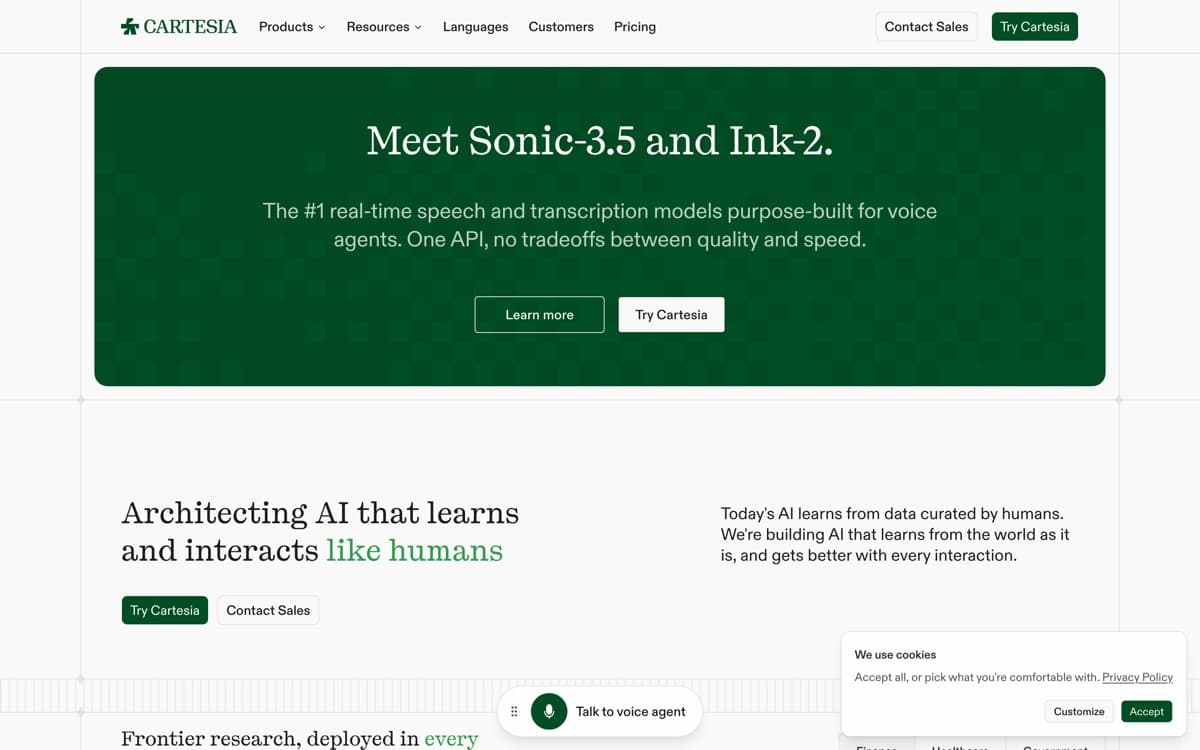
Cartesia builds the voice layer for software that talks back. Founded by the Stanford researchers behind state-space models (the architecture challenging Transformers on speed), its Sonic models start speaking in under 100 milliseconds — fast enough that phone agents interrupt naturally, game characters banter without lag, and translation feels simultaneous. In the voice-agent gold rush of 2025–26, Cartesia became the pick axe. And the speed story is measured, not marketed: its Ink-2 transcription model topped Artificial Analysis's streaming leaderboard in July 2026 at an 8% word-error rate, versus 10% for Deepgram and 12% for ElevenLabs' equivalent.
Sonic-3 closed the quality gap that used to excuse the speed: natural prosody, laughter, emotional range across 40+ languages, with instant cloning from a three-second sample. The economics matter as much as the milliseconds — state-space efficiency means high-volume deployments (support lines, NPCs, IVR replacement) run at costs that make per-character premium pricing look quaint, and on-device variants run without a network at all. If you're building rather than producing, this is the modern default.
Cartesia: pros and cons
Pros
- Lowest latency in the industry — speech starts in tens of milliseconds
- Sonic-3 quality now competitive with the premium labs
- State-space model architecture runs cheap at scale (and on-device)
- Instant cloning from three seconds of audio
- Clean developer experience: great docs, SDKs, predictable pricing
Cons
- No content-creator suite — it's infrastructure, not a studio
- Voice library and language coverage behind ElevenLabs
- Long-form narration tooling is minimal by design
Standout features
Sub-100ms streaming
Time-to-first-audio low enough for genuinely natural conversation — no awkward beat between question and answer. In voice UX, that beat is everything.
State-space efficiency
The architecture, not just optimization: cheaper inference at scale and credible on-device deployment. High-volume voice products keep margins that Transformer-based pricing eats.
Three-second cloning
Enroll a voice from a snippet and deploy it instantly via API — with consent controls — for personalized agents and localized products.
Cartesia pricing
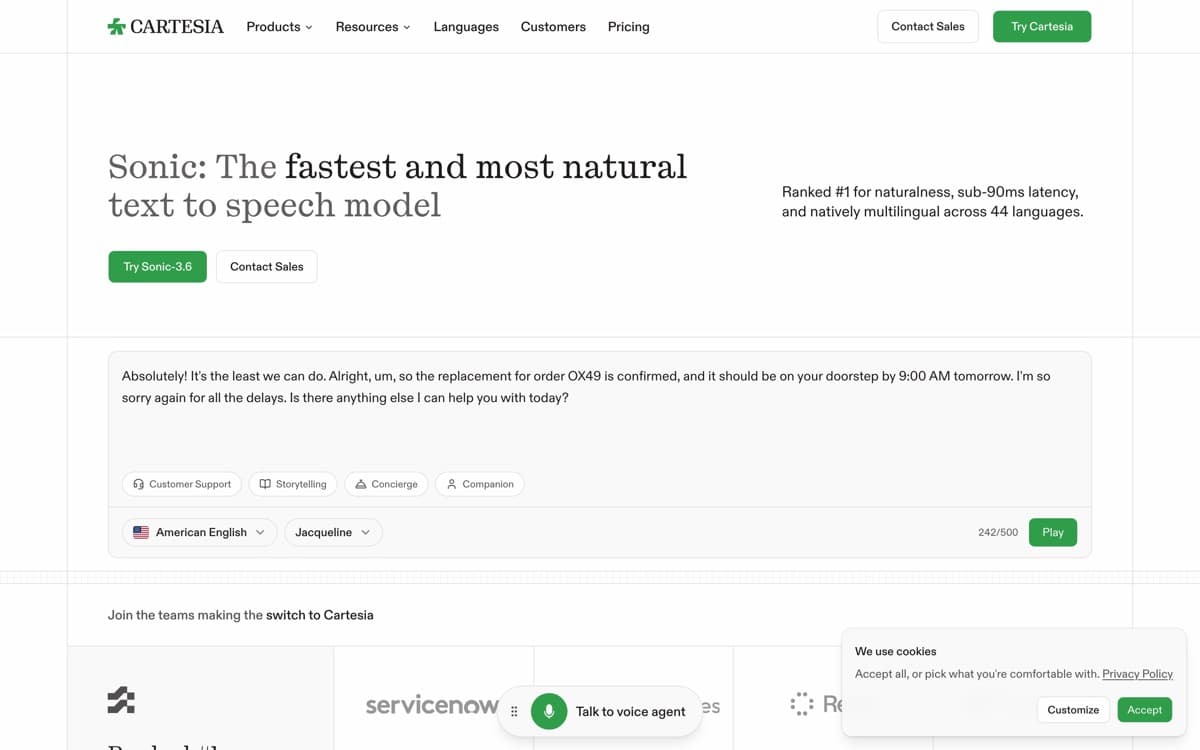
Free developer credits renew monthly. Paid plans from $5/month scale through creator and pro tiers to volume enterprise contracts; pricing is per character with steep committed-use discounts and on-prem options for regulated deployments.
For conversational products, model total cost per minute of dialogue — Cartesia routinely beats premium rivals by multiples at production scale, which is precisely its wedge.
Our verdict
Cartesia is the developer's answer in a category built for creators: the fastest, most economical real-time voice, now with quality that doesn't apologize. Content producers should stay with ElevenLabs; anyone shipping a product that speaks should benchmark Cartesia first.
Skip it if: You're not writing code. There's no creator studio here and there isn't meant to be — content producers belong two slots up with ElevenLabs or Murf.
4.4 / 5 — #4 in AI Voice Generators 2026
Cartesia: FAQ
Who is Cartesia for?
Developers building voice agents, games, translation, IVR, and companion apps — anything real-time. It's API-first infrastructure, not a content studio.
How fast is Cartesia really?
Time-to-first-audio runs in the tens of milliseconds on Sonic Turbo variants — the fastest we've measured, and the difference between conversational and clunky in live applications.
Cartesia vs ElevenLabs for voice agents?
ElevenLabs offers a fuller agent platform out of the box; Cartesia wins on latency, unit economics at scale, and on-device options. Many production teams prototype on the former and ship on the latter.
Related rankings: best AI audio tools · best AI video generators · best AI dictation