
Guides
How to Make the 'Usual Suspects' Line-Up AI Video (Van Damme, Snipes, Schwarzenegger, Stallone, and Norris Against the Height Chart — a Five-Person Scene Swap With Dialogue)
By the Top5Apps editorial team · Published October 15, 2026 · Updated October 15, 2026 · 7 min read
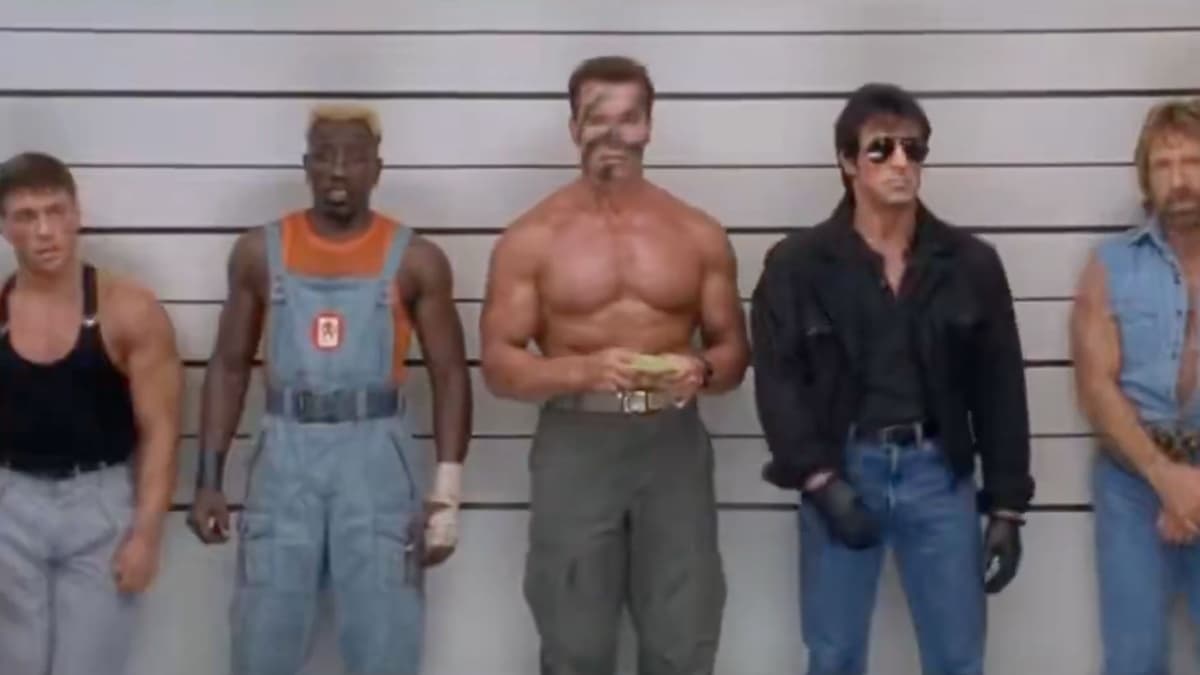
Short answer: it's a five-person scene swap on a single locked wide shot — the easiest composition in the series to recreate and the hardest to finish, because every actor has to step forward, speak, and crack up on cue. The video is 'The Usual Action Heroes (Naughty Language),' posted October 14 by This Ain't Canon — the AI-parody account of creator Omer Ariely — across Facebook, Instagram (474,000 likes), and TikTok (2.2 million plays), then reposted to X without credit the same afternoon ('This might be the craziest hero line-up in cinema history🔥', 223,000 views). Left to right against the height chart: Jean-Claude Van Damme in the Bloodsport tank top, Wesley Snipes as Demolition Man's bleach-blond Simon Phoenix, a shirtless, camo-painted Commando-era Arnold Schwarzenegger in the center, Sylvester Stallone in Cobra's aviators and jacket, and Chuck Norris in a sleeveless denim vest. They step forward and read the card; at twenty seconds the line dissolves into laughter, which is the joke inside the joke — the 1995 take did too. The creator's only disclosure is 'Created with @higgsfield.ai'; there's no prompt, no model, no watermark. So the method below is a reconstruction, and one line the packet circulating with this clip gets wrong: Chuck Norris died on March 19, 2026, which makes this four living actors and one estate — a different rights picture, covered below.
Why this scene was always going to get swapped
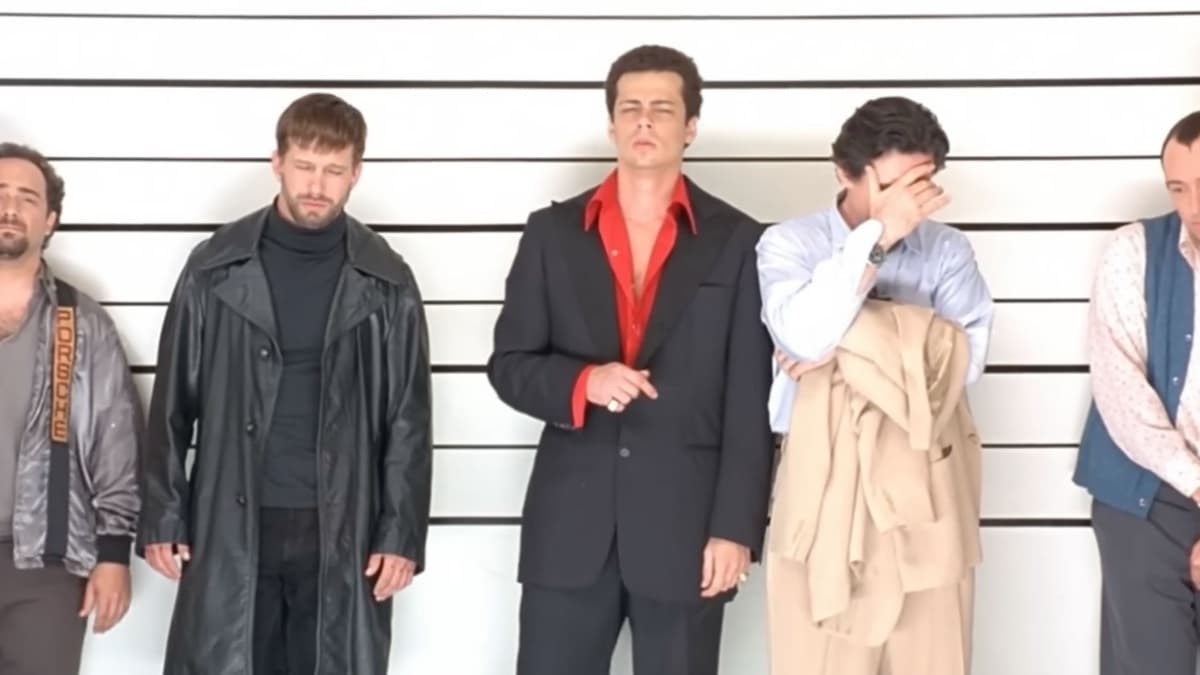
Bryan Singer's 1995 film opens its lineup on one wide shot: five men on five marks against a height chart, told to step forward one at a time and read a line off a card. Left to right it's Kevin Pollak (Hockney), Stephen Baldwin (McManus), Benicio Del Toro (Fenster), Gabriel Byrne (Keaton), and Kevin Spacey (Verbal Kint); the AI version puts Schwarzenegger in Del Toro's center slot, which an Instagram commenter clocked within the hour. The reason it's a perfect template is the reason it became famous. The scene was written straight; the actors couldn't hold it. Del Toro, per Mental Floss: 'All I remember is that someone farted… and no one knew who the guilty party was.' Pollak: 'Del Toro farted like 12 takes in a row.' Byrne: 'Finally, Bryan just used one of the takes where we couldn't stay serious.' A fixed camera, five fixed positions, one gesture each, and a shared break — that's a motion template, and the AI version keeps every element of it, laughter included.
What stays, what changes
- Stays: the wall and height marks, the five marks and spacing, the wide master, the step-forward-and-read beat, the cutaways to close-ups, the corpsing at twenty seconds, the scene's structure and timing. The AI cut is 46.7 seconds, scope-ratio 1278×552 — a widescreen frame rather than a phone crop, which is why it reads as a film.
- Changes: five faces, five wardrobes, each pulled from a specific movie (Bloodsport, Demolition Man, Commando, Cobra, Norris's 1980s look), and the voices. 'Naughty Language' in the title tells you the card line is the film's profane one; we're not reproducing it.
- The joke: a lineup of men who, in their own films, never get caught.
Method (reconstructed — the maker said only 'Higgsfield')
Every swap we've covered until now was one or two people. Five people, a locked master, close-ups, and spoken lines is the full stack, and it's why this took a creator with 585 TikTok videos rather than a one-click template. The pieces, all of which exist today:
- 1. Source. Trim the Movieclips scene to the lineup master and the close-ups you want — the whole thing is 1:39; the AI version keeps about half.
- 2. Five character sheets, each in its film wardrobe: three to four stills per actor (front, three-quarter, full body) in the Bloodsport tank, the Phoenix overalls, the Commando paint, the Cobra glasses, the denim vest. Nano Banana 2.1 takes 'up to 14' references in one prompt and 'maintains consistency for up to 5 characters' — exactly five — which makes it the natural tool for building the sheets and a first composite frame of all five on their marks.
- 3. Swap the master shot with a motion-transfer tool that accepts many references: Higgsfield Genjutsu Motion Transfer 'keeps the motion, camera and timing while rebuilding the scene from your references' from one 4–30-second clip and up to 30 reference images; Seedance 2.5 takes up to 30 images and 10 video clips and, per ByteDance, 'can preserve the appearances and voices of multiple characters.' Kling Motion Control is single-character and out.
- 4. Close-ups separately. Each actor's step-forward and card read is its own short generation from the matching close-up in the source — one character, one line — which is where the lip-sync models (Seedance 2.5, Kling 3.0, Veo 3.1, LTX 2.5) do their work. The voice is the hard part: the original audio is five other men; you either generate the line in a voice model and lip-sync to it, or keep the source audio and accept the mismatch. The AI cut has distinct speech bursts per actor, so it's the former.
- 5. The laugh. The corpsing beat is one more motion-transfer pass on the master with 'the line breaks into laughter' in the prompt — and it's the moment the AI version most clearly copied from the take rather than inventing.
- 6. Cut, grade, label. Assemble in CapCut at the film's aspect, match the grade across generations, and label it. The creator's captions do: 'AI-Generated Parody | Fictional Content.'
Prompt for the master, ours: Rebuild the police lineup in @Video1 with five new men on the same five marks, left to right: @Image1 (black tank top), @Image2 (bleached hair, orange shirt, denim overalls), @Image3 (shirtless, camouflage face paint, green fatigues), @Image4 (aviator sunglasses, black jacket, jeans), @Image5 (sleeveless denim vest). Keep the white wall with height lines, the camera position, the spacing, the timing, and each man's step forward from @Video1 exactly. Do not add or remove anyone.
What the maker didn't say, and what the X post got wrong
- No model, no prompt. 'Created with @higgsfield.ai' is the whole disclosure, on Instagram and Facebook; the TikTok caption omits even that. Higgsfield hosts Nano Banana 2.1, Seedance 2.5, Kling, and its own Genjutsu, so the credit narrows the stack without naming it. Everything above is inference.
- The viral copy stripped the credit. The X post with 223,000 views is a native re-upload with no attribution; the TikTok original has ten times its views. If you share it, name This Ain't Canon.
- The caption going around with it isn't real. 'Hollywood has everything to fear from Artificial Intelligence' appears on none of the creator's posts, the X post, or the reposts we found. It's a packet line, not a quote.
- No variants yet. Unlike the barn or the kitchen, 'circling' here means reposts of the same clip — Facebook, Instagram, TikTok, X, YouTube, 9GAG — not new lineups. The format is wide open: five marks, any five people.
Rights: an MGM scene, four living actors, and one estate
The film is MGM's (via the 1998 PolyGram library purchase); the scene is the property, and the Movieclips upload above is the licensed way to watch it. The faces are the exposure. Four of the five are alive and have said things about this. Stallone, on a podcast published today: 'There's a very chilling effect when you bring up AI in the art community… And I totally get it because, boy, it makes things so much easier.' Schwarzenegger, in 2023, on the Terminator's premise: 'So it's not anymore fantasy or kind of futuristic. It is here today.' Chuck Norris died on March 19, 2026, and his family has already asked the public, over AI-generated death misinformation this spring, not to 'believe or share any information unless it comes directly from the Norris family.' California's AB 1836, in force since January 2025, bars using a deceased personality's digital replica in an expressive audiovisual work without the estate's consent, with liability of 'the greater of $10,000 or actual damages' — the statute written for exactly this slot in the lineup. The NO FAKES Act, which would cover the other four federally, cleared Senate Judiciary in June and hasn't passed. Nobody involved has reacted to the parody. The creator's own disclaimer — 'Fictional content, not affiliated with or endorsed by any rights holders' — is the right wording; it isn't a license.
- Label it AI on the video, as the creator does, and credit the source scene.
- Living public figures in evident parody is the defensible version; a dead one is a different law — swap in someone alive, or leave the fifth mark for yourself.
- Your own five — friends, coworkers, a group chat — is the clean version and probably the funnier one. Five marks, five photos, one wall.
- Don't monetize it and don't sell the template; the scene isn't yours and the voices aren't either.
Our read
This is the first full-scene swap in the series — five people, dialogue, a laugh — and the first made by someone with a body of work rather than a template. It shows where the tools are: a locked wide shot with fixed marks is now a form, like the kitchen and the hotel lobby, and five-character consistency is a documented feature of a Google image model. It also shows the gap the tools don't close: the maker credits a platform, not a method, and the clip's biggest audience saw it without his name on it. The scene itself is the lesson — Singer wanted it serious, the actors couldn't manage it, and he kept the take. The AI kept the laugh too. Build your own line-up with people who said yes, and put the credit back on. Our AI video ranking covers where Genjutsu, Seedance, and Kling stand for the multi-person work.
Where these apps rank