
Guides
How to Make the Drake 'Burning Bridges' AI Video (the Shrek Version) — and Why 'The AI Videos Brought Me Here' Is the Comment Every Label Should Read
By the Top5Apps editorial team · Published October 6, 2026 · Updated October 6, 2026 · 8 min read
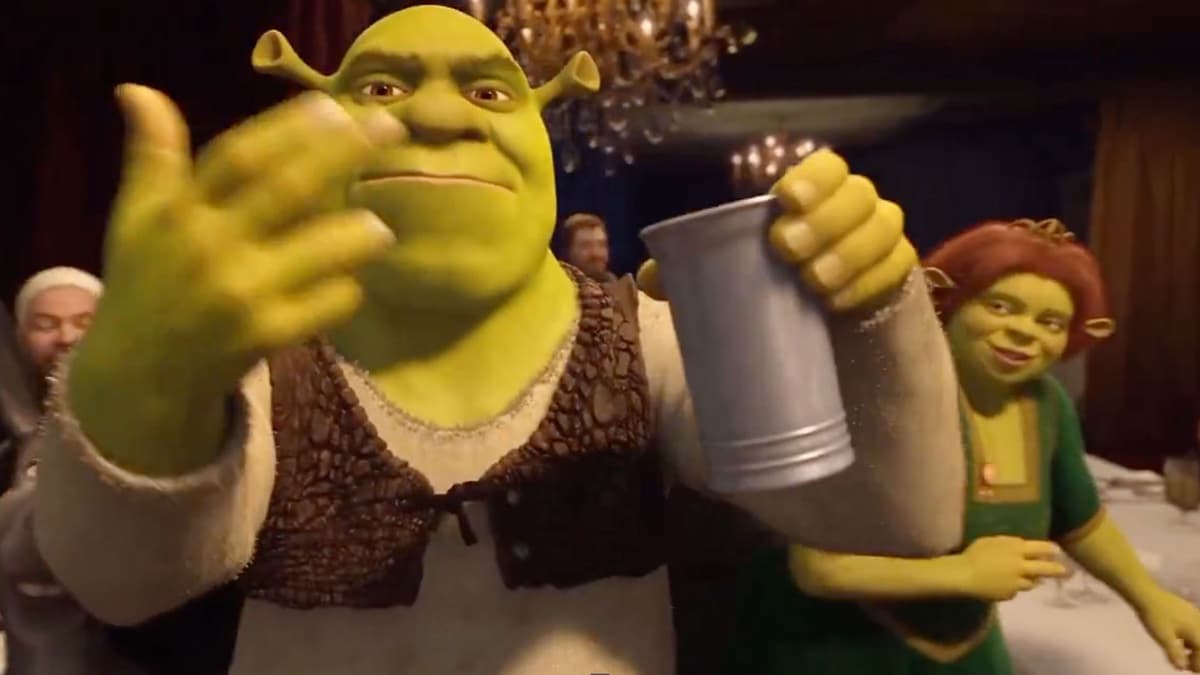
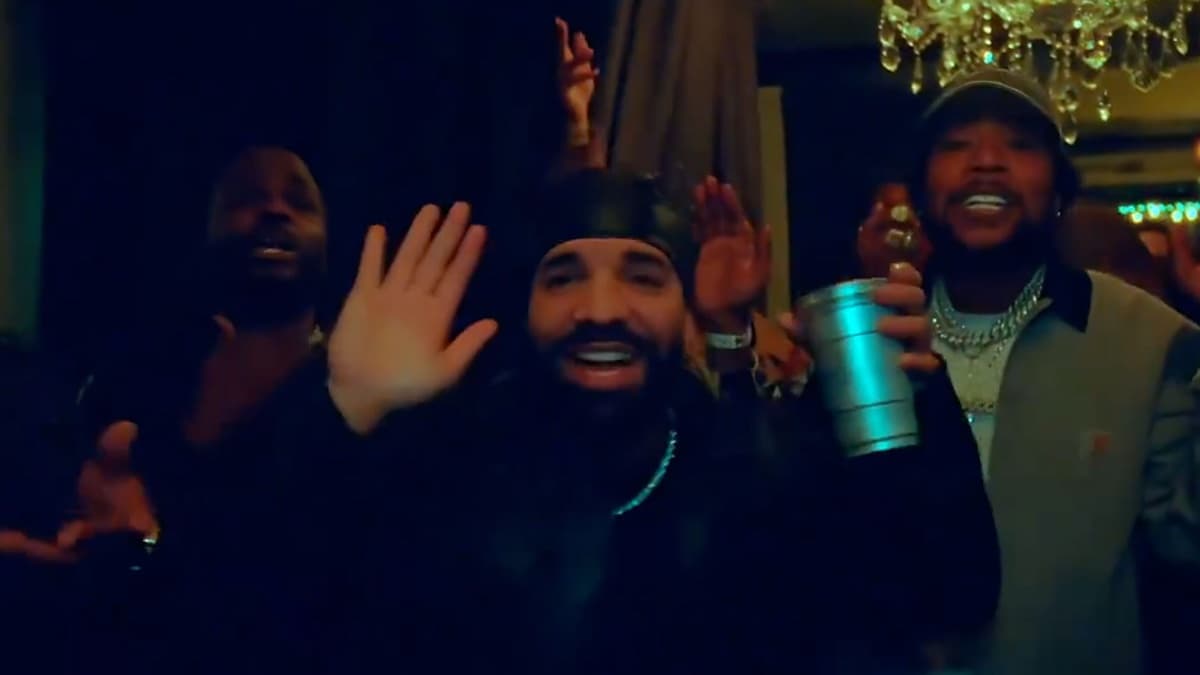
Short answer: trim the party section, pick the wave-at-camera beat, and run it through a character-swap tool — Higgsfield Genjutsu is the one every documented version used — with a reference sheet of your character; the room, the chandelier, the cup, and the camera stay. The source is the back half of Drake's 'Burning Bridges' video (May 15, 2026; 25.2 million views): a private dining room in Toronto, friends crowding a handheld lens, Drake in a black durag waving and raising a metal cup. Over the past two weeks it's become a swap template — first people inserting themselves, then characters. The one we'd point you at puts Shrek in Drake's spot with Fiona behind him, same chandelier, same wave. Caveat up front: we couldn't trace the Shrek clip to a poster, a date, or a view count, and no one has published a prompt for any version, so the method below is reconstructed from the self-insert tutorials that are documented. Then there's the comment section, which is where this trend stops being about Shrek.
What the source is
'Burning Bridges' is track eight on Iceman, one of three albums Drake released on May 15, and the one aimed at ASAP Rocky; it peaked at No. 13 on the Hot 100. The video, directed and shot by Theo Skudra, was filmed in the private dining room of Sotto Sotto in Yorkville, and its second half — from about 1:28 to the end at 3:52 — is the handheld party: warm light, crystal chandeliers, a crowd of friends mugging for the lens, metal cups and shot glasses raised. The wave that every swap keeps is around 2:58, with near-identical beats at 2:56 and 2:42. The video was already a meme factory before AI — the 'Where she at?' bar produced a GIF so widely used that Instagram removed it in June — which is part of why the swaps land: viewers know the shot.
How the versions were made
Every version we could pin down was made with Higgsfield Genjutsu. A Threads post from September 19 — 'Put myself into the Drake video using @higgsfield.ai's new Genjutsu' — is the earliest dated instance we found; an October 3 YouTube Short from a Higgsfield creator-partner carries the Genjutsu watermark on the chandelier-room footage. Genjutsu's own description: 'Swap characters, outfits, locations, and objects — or keep only the motion and rebuild the rest,' from a 4–30-second reference video and up to 30 reference images. The published step list, from a September 14 post with 1.2 million views: 'open Higgsfield and click on Genjutsu / Upload the video you want to recreate / Then upload your image or any character of your choice / Once both are uploaded, click generate / Genjutsu will recreate the original motion using your character while keeping the rest of the scene.' That's the whole documented method. The Shrek version is the same move with a cartoon reference instead of a selfie.
The method, step by step
- 1. Trim the source to 8–20 seconds of the party section. The wave at 2:58 plus the cup raise is the clip; keep the handheld sway, it's what makes the swap read as 'the real video.'
- 2. Reference images, one per character you're replacing. For Shrek and Fiona that's two sheets — front, three-quarter, full body — in the look you want (the film's 3D render, not a flat cartoon, or the lighting won't match the room). Our Jean Phil guide covers making a sheet; for an existing character, clean stills work.
- 3. Object Swap in Genjutsu, not Restyle: Restyle changes the whole frame's look ('20+ animation styles'); Swap changes the person and leaves the room. Map Drake to your lead; if you want a second character, map the friend at frame-right to it. Everyone else in the shot stays human — that's the Shrek version's joke, and also the easier generation.
- 4. Prompt (ours; nobody published one):
Replace the man in the black durag waving at the camera in @Video1 with the character in @Image1, matching his pose, wave, cup, and position exactly. Replace the man at frame-right in the grey jacket with the character in @Image2. Keep everything else from @Video1 unchanged: the dining room, chandeliers, warm lighting, the other people, the handheld camera movement, the cuts, and the audio. Render the characters as 3D-animated film characters lit by the room's practical lights, with shadows and reflections consistent with the scene.
- 5. Alternatives. Seedance 2.5 reference-to-video does the same thing with the clip and the sheets as references — its hosts' docs describe mapping 'a live-action dance' onto 'a stylized 3D fox character' that 'performs the identical full-body movement beat for beat,' which is precisely this. Kling Motion Control is single-character: with two or more people 'the motion of the character occupying the largest portion of the frame will be used,' so it's fine for Shrek alone and wrong for Shrek plus Fiona.
- 6. Expect three to five takes. The failure modes are a cup that melts into a hand, an ogre whose skin takes the room's color cast too literally, and background friends whose faces drift when the model treats them as part of the swap. Lock the background people in the prompt, as above.
- 7. Label it AI, and don't post it as a scene from the video. It won't be mistaken for one — that's the point — but the label rule is the same for every realistic depiction.
Rights: a UMG video, a DreamWorks ogre, and Drake's own history
The video is '© 2026 OVO, under exclusive license to Republic Records, a division of UMG Recordings' — Universal, the most litigious label on AI. Shrek and Fiona are DreamWorks Animation's, which is NBCUniversal's, and Universal is a plaintiff in both the Midjourney and MiniMax copyright suits, which cite Shrek images specifically. A character swap of a UMG video using Universal's film characters stacks the two most active rights holders in the business. And Drake is a complicated figure to parody with AI: in 2023 UMG pulled the fake-Drake 'Heart on My Sleeve' with a statement about 'deep fakes, fraud and denying artists their due compensation,' and in 2024 Drake himself released 'Taylor Made Freestyle' with AI Tupac and Snoop vocals — then removed it after the Shakur estate called it 'a flagrant violation of Tupac's publicity and the estate's legal rights.' No takedowns of the party-scene swaps have surfaced and neither Drake nor OVO has reacted. Treat that as the window being open, not permission: make it a parody, keep the audio claimable rather than monetized, don't sell it, and use an invented character if you want to be safe — Shrek is the funniest option and the least defensible one.
The comment section: 'The AI videos brought me here'
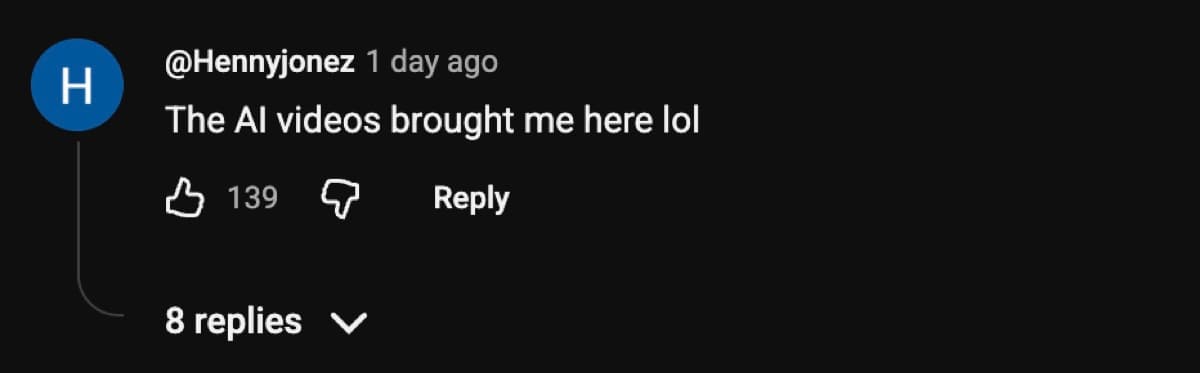
Now the part that matters. Sort the official video's comments by Top and the newest one near the top, posted a day ago, is from @Hennyjonez: 'The AI videos brought me here lol' — 139 likes and eight replies, each naming a different parody. 'Fr I saw a breaking bad one lmao.' 'Did anyone see the avengers one.' 'The one with Shrek should be remade as a separate video.' 'The Swift one was my final straw I had to at that point.' 'Hopefully the ai videos help it get the praise it deserves. Probably my favorite track off Iceman.' An hour before we checked, another: 'Thor and The Avengers brought me here. Who else?' A five-month-old video is getting new comments because people watched an ogre wave in it.
What the numbers say, honestly. Daily views on the official video rose from about 72,000 on September 29 to about 96,000 on October 3 — roughly 33 percent, per Kworb — which is real and small; the song is not back on Spotify's daily Top 200, and there's no chart movement. What's new isn't the scale, it's the direction. Every AI music trend we've covered until now flowed away from the artist: the Papaoutai AI cover took Stromae's melody to another label's release; Hotel Lobby swaps took Quavo's performance to template vendors. Here the parodies are ads for the original, because the swap only works if you recognize the shot, and recognizing the shot means wanting to see it. That's why the one precedent that fits is Quavo's: on September 23 he reposted the untouched 2022 performance with 'Aye Take we viral again The original!!!' — the artist treating the AI wave as a launch window for the real thing.
If you're a musician: what this suggests, and what it doesn't
- Shoot a swappable shot. The scenes that get swapped share a form: one recognizable person, a fixed camera relationship, a gesture, a room with character. Hotel Lobby, the White Chicks car, the Drake wave. You can't engineer virality, but you can avoid shooting a video with nothing in it a character-swap tool can grab.
- Repost the originals when the wave hits, the way Quavo did — and link the song. The comment thread is doing the work; the artist's job is to be where it points.
- Make the audio easy to find. 'Where is this song from' is the question every parody raises. A pinned comment or a caption on the official upload answers it; right now the answer under 'Burning Bridges' is being supplied by fans.
- What it doesn't suggest: releasing your own AI parodies. The ones that spread were made by fans with other people's characters, and UMG's position hasn't moved — Lucian Grainge's January memo: 'UMG will not stand by and watch irresponsible business models take hold.' The label's own licensed-AI answer is the UMG–Udio 'walled garden' for fan remixes, due this year. Until something like that covers video, the artist's move is the repost, not the generator.
- Measure it. Thirty-three percent on a five-month-old video is a signal, not a strategy. If a label tracked which videos got swapped and what happened to streams in the following fortnight, it would know in a month whether this is a channel or a curiosity. Nobody has published that yet.
Our read
The Shrek version is a good joke made with a one-click tool; the comment under the original is the first evidence that AI parodies can send people back to the song. Technically there's nothing new here — Genjutsu Object Swap, a character sheet, a 20-second trim, the same stack as every two-person swap in this series. Culturally there is: a trend that advertises its source instead of replacing it. The right response from the people who own 'Burning Bridges' isn't a takedown and isn't an official ogre; it's to notice that the audience just built a funnel and to put the song at the bottom of it. Our AI video ranking covers where Higgsfield's models and Seedance stand for the rest of your projects.
Where these apps rank