
Guides
Can AI Identify and Appraise Antiques and Vintage Items? Yes — Here's the App We've Used to Flip Hundreds of Thrift Finds
By the Top5Apps editorial team · Published October 7, 2026 · Updated October 7, 2026 · 7 min read
Short answer: yes — for identification and a resale price range, AI is now good enough to change how you shop secondhand, and the app we use for it is Patina. You photograph the item; in a few seconds you get a name (maker, era, model), a market estimate, tags like 'mass produced' or 'rare find,' and a Flip Score for how worth-your-time it is. We've used it for a year across hundreds of flips — Goodwill racks, estate sales, garage sales — sold on eBay, Vinted, Depop, and Poshmark, and the estimates have been close enough to buy on. The best single example: an embroidered Palestinian thobe Patina pegged at $250–$625 sold on Poshmark at the top of that range. One honest limit up front. An AI range is a resale estimate, not an appraisal — for insurance, estates, or a tax deduction you still need a credentialed human. Our editor knows the team behind Patina and has used the app since launch; the receipts are below.
What Patina is, verified
- An iPhone app — 'Patina - Identify & Value' on the App Store, iOS 17 or later, iPad too. No Android, no web version; the developer says so itself.
- $7.99 a month, $44.99 a year ($3.75 a month), or $5.99 a week, after a 7-day free trial with 'full access to every feature.' Patina says there are 'no feature limits, no scan caps.' We've never hit one.
- Launched July 2025; current version 1.2.4 from June 2026. App Store rating 4.9 — from nine ratings, so treat that as early.
- How it prices: the developer says estimates come 'from actual completed sales across eBay, Chairish, 1stDibs, and other major marketplaces… not asking prices.' The app doesn't show you those comps, which is the one critical App Store review's complaint and ours too.
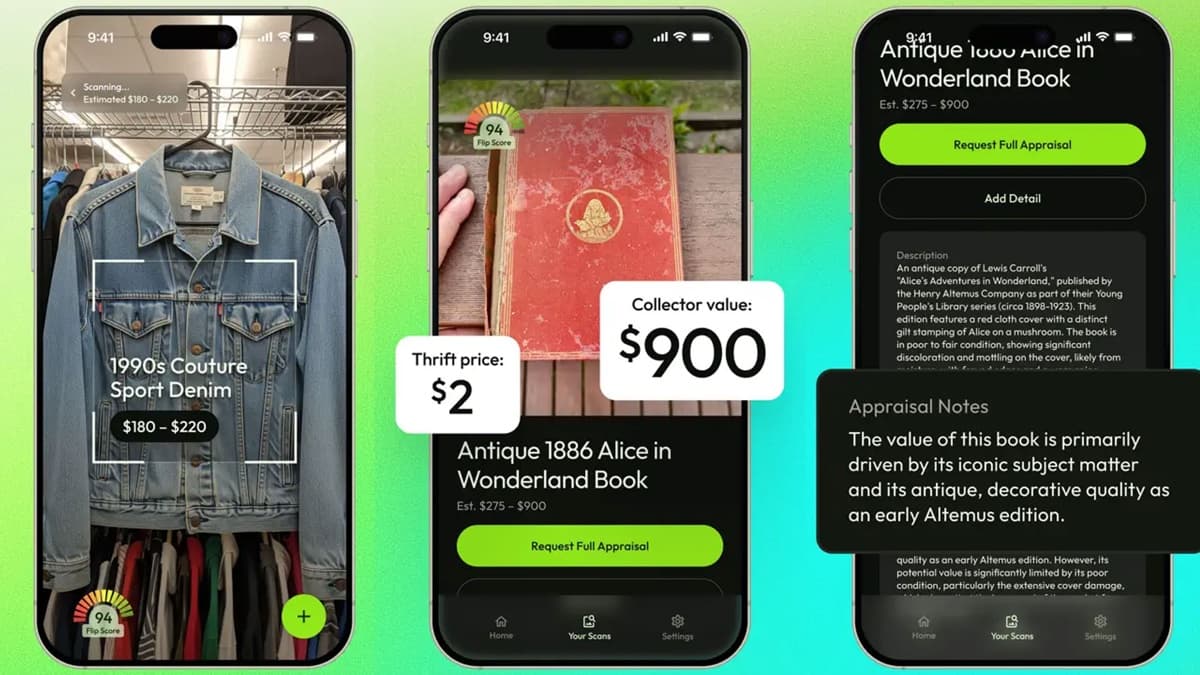
- What a scan gives you: name and attribution, an estimated range, tags (vintage, collectible, hand-carved, mass produced, rare find, hot item, cultural), a Flip Score dial, a 'Deep Dive' for a longer write-up, 'Add context for better appraisal' to tell it what the photo can't show, and a saved 'Your Scans' list you can sort by newest or minimum flip value.
- It also writes the listing — title, description, pricing — which is the feature that turns a scan into a sale in under a minute.
How we use it: a year of flipping
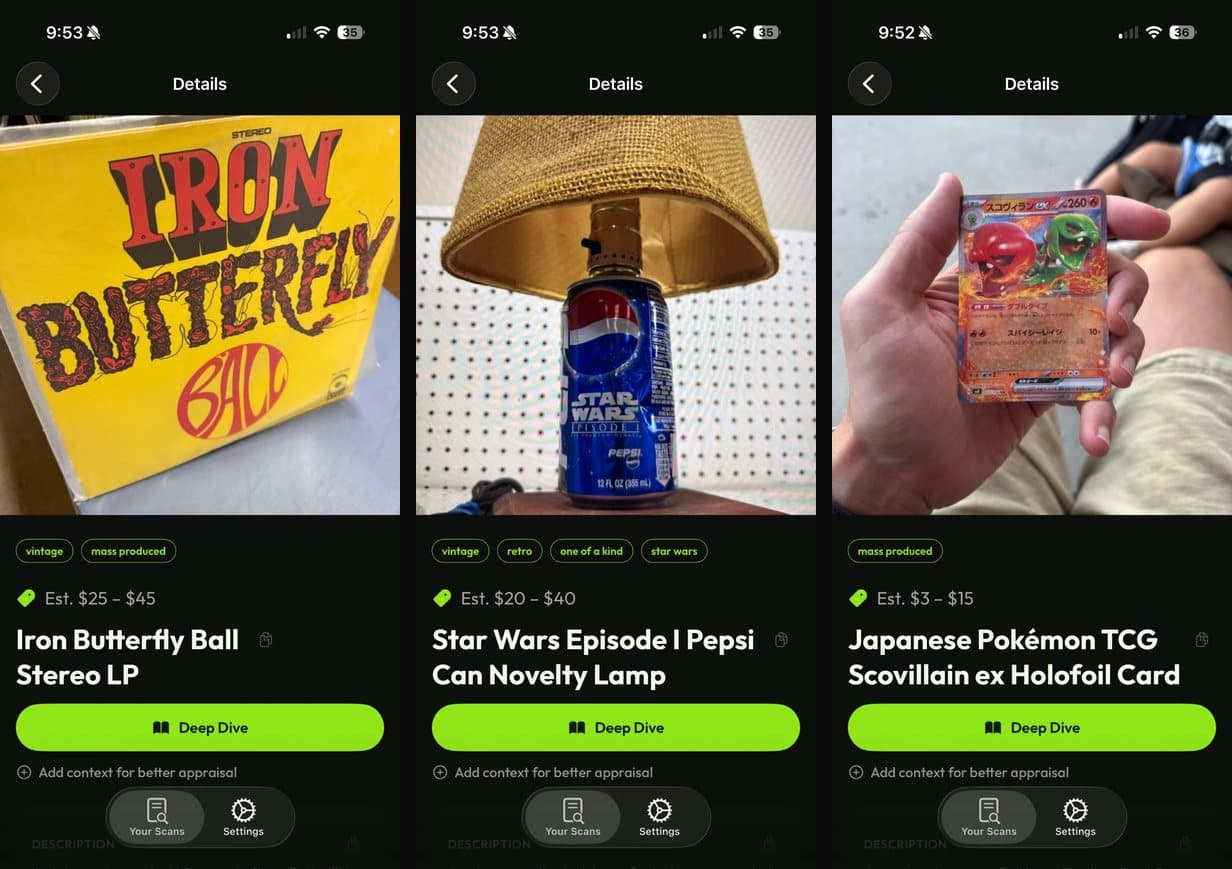
The workflow is the same in a Goodwill aisle or an estate-sale garage: pick up anything that looks older or stranger than its neighbors, scan it, and let the tags and the range decide. 'Mass produced' with a $0–$2 range (a Pokémon Dedenne card) goes back on the shelf. 'Rare find / hot item / valuable' with $220–$280 (a Topps Chrome Cavan Sullivan rookie refractor numbered to 199) comes home. In between is where the app earns its subscription: it told us a small glazed owl was a Rinconada De Rosa ceramic figurine ($30–$75), that a yellow LP was Iron Butterfly's Ball in stereo ($25–$45), and that a lamp made from a Star Wars Episode I Pepsi can was a one-of-a-kind novelty worth $20–$40 — three identifications we would not have made unaided, each with a price that matched what the thing actually sold for.
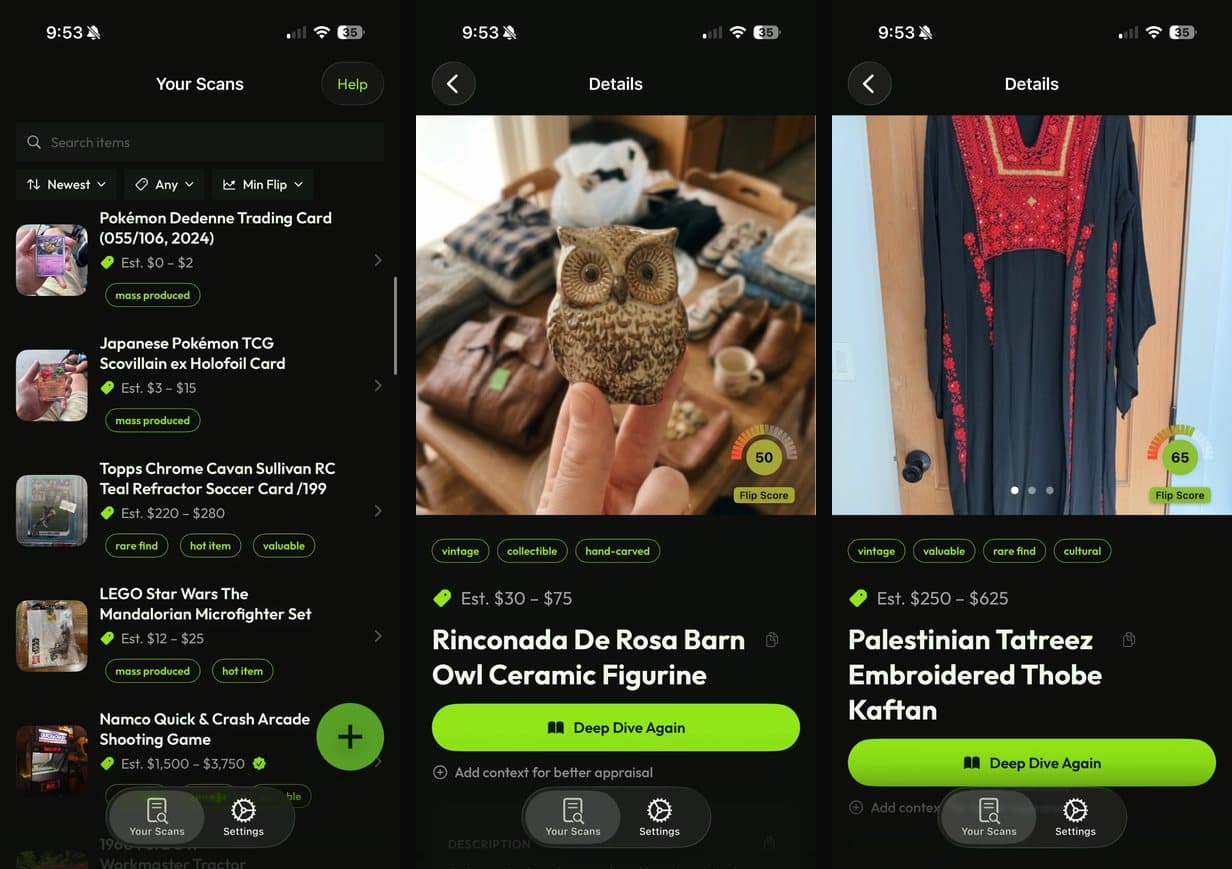
The thobe is the case that made us trust it. A black kaftan with dense red tatreez embroidery, bought cheap at an estate sale. Patina identified it as a Palestinian tatreez embroidered thobe, tagged it vintage, valuable, rare find, and cultural, and estimated $250–$625. Listed on Poshmark, it sold for the top of that range. That's one sale, not a study — but it's the kind of item a generalist reseller would otherwise have priced at $40 and lost hundreds on, and it's why the app pays for itself on one good month.
Where it needs a human
- It may be reading the price tag. Our Cavan Sullivan card was photographed in its case with a '$220.00' sticker visible, and Patina's range came back $220–$280. That may be a correct read of the market; it may also be the model anchoring on text in the frame. Scan with stickers covered when you want an independent number.
- It doesn't show its comps. 'Based on real market sales' is the pitch; the sold listings behind a range aren't surfaced. Before you pay real money for an item, check eBay's sold filter yourself. Two minutes.
- Its own marketing example is wrong in an instructive way. The App Store screenshot titles a red cloth book 'Antique 1886 Alice in Wonderland' and values it at $275–$900 while the description beneath dates it to the Henry Altemus Company's Young People's Library, 'circa 1898–1923,' in 'poor to fair condition.' The Altemus reference literature says the firm published no non-Bible books until 1889, its first Alice in 1895, and that a 'Henry Altemus Company' imprint means 1900 or later; it puts a nice copy of that series at $25–$75 and calls these reprints 'quite common and generally very hard to sell.' So: right series, impossible year, a range ten times the market for a damaged copy. The lesson isn't that the app is bad — it's that a confident range on a book is where generalist AI is weakest, because edition, printing, and condition move value by orders of magnitude and a cover photo shows none of them.
- Add context. The 'Add context for better appraisal' button is the fix for most of the above: tell it the edition page, the maker's mark, the condition issues, the measurements. Our estimates tightened noticeably when we did.
- Privacy footnote. The homepage says 'Your photos stay on your device'; the privacy policy says images submitted 'for appraisal' are retained in anonymized form 'to train our machine learning models.' Assume the latter.
An AI estimate is not an appraisal
This matters legally, not just semantically. For a charitable deduction over $5,000, the IRS requires a 'qualified appraisal' prepared by a 'qualified appraiser' — someone with a recognized designation or documented experience — 'in accordance with the substance and principles of the Uniform Standards of Professional Appraisal Practice,' and for art over $20,000 the signed appraisal is attached to your return. Insurers, estates, and divorce courts want the same credentials; USPAP is the national standard, and bodies like the International Society of Appraisers and the American Society of Appraisers certify the people who write them. Patina's own FAQ concedes the point for fine jewelry: 'you'll still want a certified appraiser — but Patina helps you know what's worth that extra step.' That's the right division of labor. Use the AI to find out whether an object is worth a professional's hour; use the professional when the number has to hold up to someone else. Human services exist for the middle ground — Mearto ($25 for one specialist opinion) and ValueMyStuff (from about £25) turn around written valuations in a day or two — and for identification alone, Google Lens and eBay's image search are free. For the thrift-aisle decision, though, a dedicated resale app is simply faster, and this is the one we use.
Who should pay for it
- Resellers and casual flippers — the $7.99 is recovered on the first item it stops you from underpricing or overpaying for. The scans list doubles as inventory.
- Anyone clearing a parent's house. The 'what did I inherit' problem is exactly a scan-everything problem: triage three hundred objects into keep, sell, donate, and get-appraised.
- Collectors in one lane should expect generalist weakness — cards, coins, and books have specialist tools and population reports the AI doesn't replace.
- Not for: insurance schedules, estate filings, donations, or anything where a number needs a signature.
Our read
AI appraisal has crossed the line from novelty to tool, and the proof is behavioral: we now scan before we buy, every time. The resale market it serves is growing — ThredUp's 2026 report projects U.S. secondhand apparel alone at $78.8 billion by 2030 and found 48 percent of secondhand shoppers already use AI shopping tools — and the apps are early, which is why we're not building a full category around them yet. Patina is the one we pay for because the identifications are the real value: knowing a $4 owl is a Rinconada De Rosa, or that a black dress is a tatreez thobe, is what turns a Goodwill run into a few hundred dollars, and the price range is a strong first guess that a two-minute sold-comps check confirms or corrects. Treat it as a very fast, very well-read friend at the estate sale — the kind you trust to say 'buy that,' and never to sign the insurance form.