
Signals
'AI Can Make 3D Animation for Disney Now': What el.cine's 3-Million-View Platypus Clip Actually Is, Who Made It and With What (He Says Seedance 2.5 on Filmera), Why No Tool Makes 198 Seconds in One Pass, What Disney Is Actually Doing With AI, and the Test We'd Give It
By the Top5Apps editorial team · Published November 9, 2026 · Updated November 9, 2026 · 15 min read
Short answer: it's a 3-minute-18-second, 1080p, Pixar-style chase cartoon, 70 shots long, made by an AI consultant who says in the replies that the model was Seedance 2.5 running on a site called Filmera, and it has nothing to do with Disney. The post that carried it, 'AI can make 3D animation for Disney now' from el.cine (@EHuanglu) on November 7 at 7:31 AM Pacific, added 853,834 views between our two readings, from 2,289,370 on Saturday morning to 3,143,204 on Sunday morning, about 37,000 an hour, which made it the fastest-growing thing we tracked this weekend. He has since posted an 'ep 02', 2 minutes 27 seconds, which had 11,916 views after 22 hours, or 0.4% of the original's.
Three things are true at once. The clip is genuinely good-looking: lit, cut and timed with taste, and the animals hold their designs across three minutes, which is the thing people doubted was possible a year ago. The caption is a stretch: no one at Disney commissioned it, Disney's own account of what it uses AI for is rendering, denoising and 3D conversions, and the studio that would make this film for real just capped itself at 16,500 person-weeks of labor per picture. And the post is, in part, an advertisement: the creator's own reply tells you to 'connect to filmera.ai mcp, just upload your script.' Below: what is in the frames, who made it and with what, why no model makes three minutes in one pass, what Disney is actually doing, and the test we would give any tool that claims this.
The short version
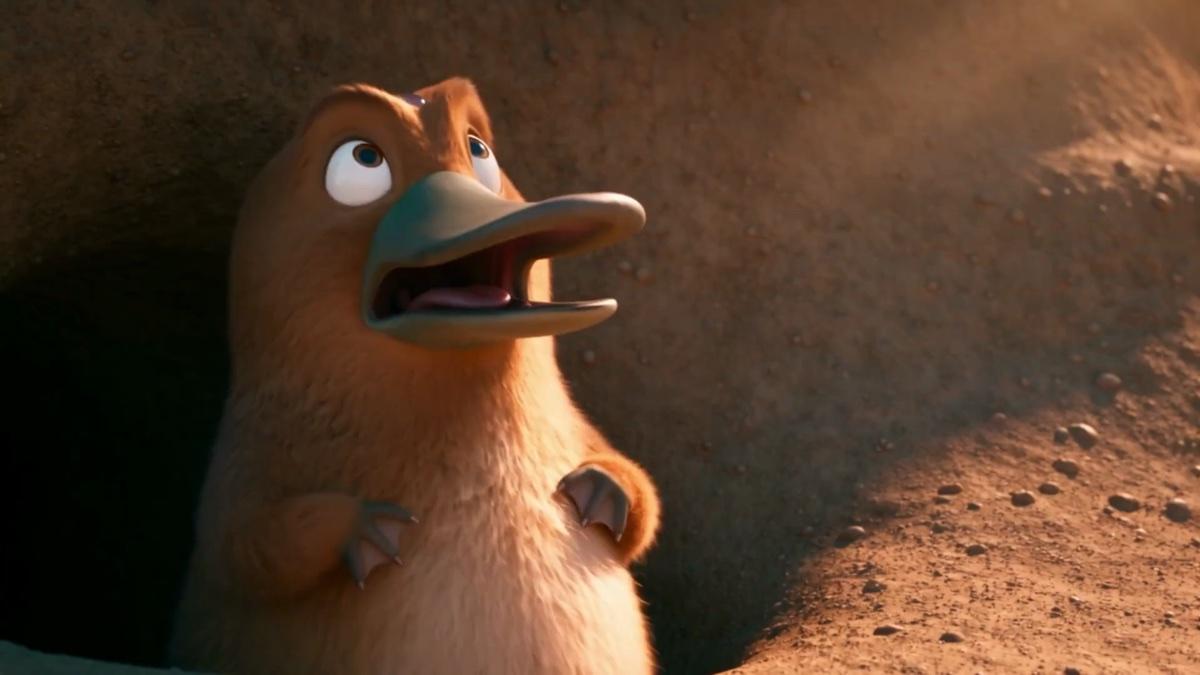
- What it is: 197.9 seconds at 1920×1080 and 30 frames a second, one continuous soundtrack, no title, no credits, no watermark. A platypus, a crocodile and a wolf chase each other from an Australian-looking river to a snow slope, with a dung beetle and a penguin along the way.
- How it's built: 70 shots. Median 2.5 seconds; 65 of the 70 are 5 seconds or shorter; the longest is 9.9. That is the fingerprint of generated video stitched in an editor, not of a single long generation.
- Who and what: el.cine, 150,623 followers, 'AI consultant | film director' in San Francisco. Asked 'Which app?' he answered 'Seedance 2.5 on filmera'. Three hours later he posted the pitch: 'connect to filmera.ai mcp, just upload your script, Claude or GPt turns it into this kind of animation automatically.' No prompt, design tool, voice or editing software is named anywhere in the thread.
- The tools' limits: Seedance 2.5 makes 'up to 30 seconds in a single generation, with the option to extend twice.' Kling 4.0 does 30 seconds a pass with 15 reference assets. Google's current model does 3 to 15. Nothing documented makes 198 seconds, and nothing documented lets you change one character's timing in a finished shot without regenerating it.
- Disney: not involved. Its $1 billion OpenAI deal to put 200 characters in Sora died when OpenAI shut Sora in March; the cash went to buybacks. Disney sent cease-and-desists to Google and to ByteDance, the maker of Seedance, in the past year. Its CEO's description of AI in filmmaking is 'rendering and things like denoising.' Pixar's next earnings data point is November 17.
- Our read: a finished clip proves taste, which this maker has. A client job proves direction: can you change one thing and have it hold across the cut? That is the test, and nobody, including el.cine, has shown it yet.
What's actually in the 198 seconds
We downloaded the 1080p file X serves and read it with ffmpeg. It is 197.88 seconds long, H.264 at 30 frames a second, with a stereo AAC track. Scene detection at a conservative threshold finds 69 cuts, so 70 shots. The mean shot is 2.8 seconds, the median 2.5, and the distribution is tight: 47 shots are 3 seconds or under, 65 are 5 or under, 68 are 8 or under, and the longest runs 9.9 seconds. Nothing in it is a single take longer than ten seconds. The soundtrack is continuous; there is no silence longer than a second and a half anywhere, which is what a music-and-effects bed looks like on a waveform; we did not transcribe it, so we can't say whether anyone speaks. There is no title, no card at the end, no credit and no watermark in any corner we checked at full resolution. The X player labels it 'Made with AI'.
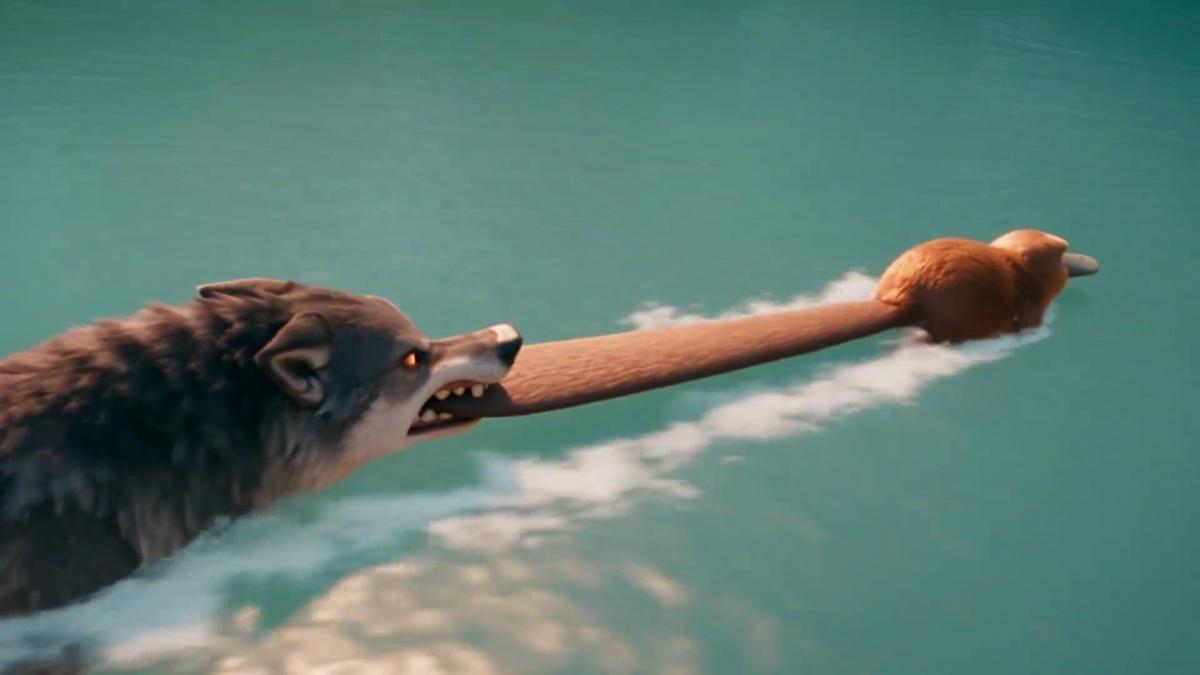
The story is a chase. A platypus pokes out of a burrow in a red-earth riverbank, eucalypts behind; a crocodile lunges in the river; a grey wolf with lit eyes joins; the platypus is carried through rapids; there is an interlude on a cliff edge and a dung beetle rolling its ball across snow; then the whole cast is on a mountainside, the crocodile on skis, the wolf and croc racing downhill, the platypus riding a penguin like a sled, and a final white-out. The animals are consistent across every scene, which is the achievement: same platypus, same crocodile's underbite, same wolf's eye colour from river to snow. The physics are the tell. Water splashes like a particle system that hasn't been art-directed, fur and snow smear in the fast shots, and the snow-race shots cut away before any contact. One reply put it as 'this is more like Ice Age 1', which is fair to both sides: the style is a decade old and the execution is better than most of what gets posted with that caption.
Who made it, and the part that's an ad
el.cine's bio reads 'AI consultant | film director | sharing practical ways to use AI for you and your business. all views are my own.' The account has posted 36,947 times since 2019 and has a history of exactly this format: a short, striking AI clip with a one-line caption that names a studio. On May 13 it was 'crazy.. AI made 3D Pixar animation with just one prompt', a 17-second clip that reached 3.75 million views. In June it was 'AI is getting ridiculous.. it can turn disney storyboard into an actual film.' Neither post involved Pixar or Disney either. The 2025 timeline includes a Higgsfield 'step by step tutorial' with a '15 top-tier plans giveaway' and a Veo 3.1 post that asked people to 'repost and comment' for a free prompt. We found no disclosed sponsorship for this clip, and we found no press coverage of it anywhere; it travelled on X alone.
el.cine@EHuanglu
@automaitionx Seedance 2.5 on filmera
View original post ↗
el.cine@EHuanglu
connect to https://filmera.ai mcp, just upload your script, Claude or GPt turns it into this kind of animation automatically, try it here:
View original post ↗
Twelve minutes after posting, asked 'Which app?', he answered 'Seedance 2.5 on filmera.' That is the creator's own attribution, so the model is settled: ByteDance's Seedance 2.5, which our video generator ranking has at number 4. Three hours later came the second reply, the one that reframes the post: connect to Filmera's MCP server, upload a script, and 'Claude or GPT turns it into this kind of animation automatically.' Filmera is a Delaware company whose homepage says 'Remake any film as your own' and 'Say what to change — no prompts to write.' Its pricing page lists Casual at $10 a month, Starter at $36 and Pro at $69, billed yearly, with '22 video and 16 image models on every plan' including Seedance 2.5, Kling 4.0, Veo 3.1, Nano Banana Pro and GPT Image 2, and prices Seedance 2.5 Draft at 22 credits a second. Neither the homepage nor the pricing page mentions an MCP server, Claude or GPT; the 'upload your script' workflow exists, as far as we can see, in the reply and nowhere on the site. Three people in the thread asked whether he made it himself with Filmera, whether it was 'pure seedance 2.5', and for the prompt or workflow. None was answered.
So the honest description of the pipeline is three layers, of which the creator has named one. A script and character designs went in, by his account turned into prompts by a language model; Seedance 2.5 produced the shots, at most 30 seconds a pass and in practice 2 to 10; and a human cut roughly 70 of them to a music bed, exported at 1080p and uploaded. Everything about the first and third layers, including how many generations were thrown away, is undisclosed. Our Star Wars guide last week worked through the same kind of reconstruction for a 30-second clip; this one is seven times longer and the method is the same, repeated.
Why no tool makes three minutes in one pass
The vendor documentation, read on November 9, is unambiguous. ByteDance's Seedance 2.5 page says 'Create videos up to 30 seconds in a single generation, with the option to extend twice,' and describes it as 'a next-generation audio-video joint generation model' with 'powerful editing capabilities'; Dreamina, its consumer front end, advertises a beta long-video mode to 180 seconds, which is still short of this clip and is a chain of extensions, not one generation. Kuaishou's Kling 4.0 user guide, dated November 4, allows '3–30 seconds, adjustable in 1-second increments' per generation, 'up to 15 reference assets in total across images, videos, voice profiles, and elements,' up to 10 keyframes, multi-shot 'enabled by default,' and lists video extension 'up to 2 minutes' as 'Coming soon.' Google shut down the Veo 3.1 preview in the Gemini API on October 22 (our Veo review covers the Vertex version, which continues) and replaced it with Gemini Omni 1.2 Flash, which makes '3 to 15 second videos with native audio' with 'character consistency across up to 6 reference images.' Luma's Ray3.2 makes 'clips up to 20 seconds long at 1080p' with up to 16 keyframes. Vidu's Q4 preview tops out at 16 seconds. OpenAI's Sora, which would have been the Disney-licensed one, no longer exists.
| Model | One generation | Consistency inputs | Native audio | Longer than one pass |
|---|---|---|---|---|
| Seedance 2.5 (ByteDance) | Up to 30 s | Reference videos; 50 multimodal assets via BytePlus | Yes, joint audio-video | 'Extend twice'; Dreamina beta to 180 s |
| Kling 4.0 (Kuaishou) | 3–30 s | 15 assets: 10 images, 5 videos, 3 voices, 7 elements; 10 keyframes | Yes | Extension to 2 min 'coming soon' |
| Gemini Omni 1.2 Flash (Google) | 3–15 s | Up to 6 reference images | Yes | Multi-turn editing; no extension stated |
| Luma Ray3.2 | Up to 20 s | 16 keyframes; tracks up to 8 faces | Per vendor | Scenes (storyboard-first), Aug 2026 |
| Vidu Q4 preview | Up to 16 s | Up to 15 reference images | Yes, dialogue | Not stated |
| Sora (OpenAI) | Discontinued | — | — | App closed Apr 26, API Sep 24, 2026 |
Two conclusions follow. First, a three-minute film from these tools is necessarily an edit of many generations, and the shot-length histogram above is what that looks like. Second, and more important for the 'for Disney' claim, none of these systems documents the operation a studio does all day: taking an approved shot and changing one thing in it. Seedance's 'editing requests' and Google's conversational edits change objects or segments; Runway's Aleph and Pika's swaps replace things. We found no vendor that lets you keep a shot and move one character's action half a second later while everything else stays put. You regenerate and hope, which is a different craft from animating.
What Disney is actually doing with AI
The caption says 'for Disney'. Disney's own record says something more specific. On December 11, 2025 Disney announced 'a three-year licensing agreement' under which OpenAI's Sora would 'generate short, user-prompted social videos' from 'more than 200 animated, masked and creature characters from Disney, Marvel, Pixar and Star Wars,' with 'a $1 billion equity investment in OpenAI' and one carve-out that matters here: 'The agreement does not include any talent likenesses or voices.' Three months later OpenAI discontinued Sora ('We're saying goodbye to Sora'); Disney said it would 'respect OpenAI's decision to exit the video generation business.' On its August 5 earnings call, CFO Hugh Johnston raised the buyback to 'at least $9 billion' and explained that the reason was 'largely to utilize the cash that had been set aside previously for the OpenAI deal.' The billion was never spent.
What Disney did spend its energy on was enforcement. It sued Midjourney with Universal in June 2025; sent Character.AI a cease-and-desist in September 2025 and is now the $20 million stalking-horse bidder for that company's assets in bankruptcy, having hired its CEO as Disney's first enterprise CTO; sent Google a letter in December 2025 naming Veo, Imagen, Nano Banana, Gemini and YouTube; and on February 13, 2026 sent ByteDance one over Seedance 2.0, calling its conduct a 'virtual smash-and-grab of Disney's IP' that was 'willful, pervasive and totally unacceptable.' Seedance is the model el.cine credits. A platypus and a crocodile are nobody's property, which is presumably why they are the cast, but the sentence 'AI can make 3D animation for Disney' describes a company that is suing the field, not hiring it.
We're leveraging AI across core technical processes throughout our production pipeline to increase our ability to get films to market in a speedier fashion. It's letting us expand the number of titles that we can offer in 3D... And it lets us accelerate processes like rendering and things like denoising, which is reducing the time it takes to complete shots. — Josh D'Amaro, Disney CEO, Q3 FY2026 earnings call, August 5, 2026
Asked directly on that call how AI is used in filmmaking, Disney's CEO Josh D'Amaro listed 3D conversions, visual effects on more shots, rendering and denoising, and framed all of it with 'AI amplifies what our storytellers can do – it doesn't replace them' and a creative process that 'will always be human-centered, artist-driven, and creator-led.' Nothing on the list generates animation. TheWrap reported in November 2025 that after a year, Disney's Office of Technology Enablement had found the AI systems 'didn't meet its standards to replace the pricier aspects of production,' that 'Disney animators were just as opposed to the technology as actors,' and that Disney barred the team from training on its own library. Pixar's chief creative officer Pete Docter told Hipertextual in June: 'If I can use AI to amplify that and improve it, great. But if I simply tell the AI, "Do this"... it will just regurgitate things that have already been done' (our translation). The Animation Guild's 2024 contract, which runs to July 2027, lets a studio 'require employees to use any AI System' but not 'in a manner that results in the displacement of any covered employee.' The next thing Disney says on the record will be at its fiscal Q4 call on November 17.
And the scale the caption invokes is worth stating plainly. Zootopia 2 took 'a crew of nearly 700 people' and 'more than 2,000 shots' on 'a reported budget of $150m.' A Pixar story artist told a Hoppers panel this year that 'it takes roughly five years to make a Pixar film,' including 'four years of revision' on one character. At Monsters University it took '29 hours to render a single frame'. In July, Pixar laid off roughly 150 people and, per a longtime employee, capped future films at '16,500 person-weeks of labor,' down from 18,500 to more than 20,000. That cut is the real Disney AI story this year: not a model making the movie, but a studio planning to make the same movie with fewer people and 'a more agile and technologically-enabled workforce.' A three-minute short with 70 shots is, by shot count, 3.5% of one of those films, with no notes.
The test we'd give it
A finished clip answers one question: does the maker have taste? This one does. It does not answer the question a producer asks, which is whether the pipeline survives a note. So the test we would run on Seedance 2.5, Kling 4.0 or any Filmera-style wrapper is the smallest version of a real job. Build an original scene with two of your own characters, three shots: a wide, a medium, a close-up, same lighting, same lens, the characters consistent across all three. Then give it one timing note of the kind every animation director gives every day: the crocodile's lunge lands half a second later, and the platypus reacts to it, in all three shots. Count the rerolls to get there. Time the cleanup. Then check the only thing that matters: did the change hold across the cut, or did the wide now disagree with the close-up?
- Pass: the note lands in all three shots within a handful of generations, the characters and light don't drift, and the edit still cuts. That is a tool a two-person studio can bill clients with.
- Partial: the note lands in one shot and the other two have to be regenerated from scratch, which is where the vendors' own documentation puts most 2026 tools. Usable for shorts you control; unusable for anything with an approver.
- Fail: the timing can't be addressed at all except by rewriting the prompt and praying, and the three shots no longer match. That is what 'AI can make 3D animation' usually means in practice, and it is why the finished clip and the client job are different claims.
Two data points from el.cine's own timeline are relevant. The first is that he hasn't shown this: three people asked for the workflow or the prompt and got nothing, and the only published process is 'upload your script.' The second is 'ep 02'. Posted at 3:29 AM Pacific on Saturday, it had 11,916 views, 207 likes and 15 replies after 22 hours against the original's 3.1 million. Sequels usually underperform, but a ratio of roughly 260 to 1 says the audience came for the caption, not the platypus. If a tool could make a Disney-grade series, the second episode is where you would see it; what the second episode shows is that the first one was a post.
What the replies got right
John Doe@StanleyMasinde_
No it can't. Or maybe it'd be better if the tool was used by a professional.
View original post ↗
Xiang Li@XiangLi1986
@EHuanglu Character consistency across shots matters more to me than a single beautiful frame. Curious how much cleanup this needed, and whether it holds up when the camera angle changes.
View original post ↗
The second reply is the whole review in two sentences. Consistency across shots is the thing this clip does demonstrate, for three minutes, and 'how much cleanup this needed' is the thing it cannot, because the cleanup is the job and the job is off camera. The first reply gets at something else: the people who could use this well are the ones who already know what a shot is for, and for them the question is cost per revision, not whether the platypus is cute. Most of the rest of the thread split between 'approaching Looney Tunes levels' and 'slop,' which is the same argument every one of these posts produces and tells you nothing about the tool.
Our read
The clip is real, the attribution is the creator's own, and the caption is marketing. Seedance 2.5 on a hosted wrapper produced seventy consistent, well-lit shots of original animals, which the 17-second version of this claim the same account posted in May did not have to sustain. That progress is worth noticing and our Seedance review already credits it. But 'for Disney' is doing work the evidence doesn't support: the studio named is the one that spent 2026 sending letters to the model's maker, whose CEO describes AI as a render-farm accelerant, whose animators' union contract forbids displacement, and whose only generative deal collapsed with the product it was built on. The version of this sentence that is true is 'AI can make a three-minute stylized short that looks like a mid-2010s studio feature, for a subscription and an editor's time, if you have taste.' That is a real thing, and it would be a better post.
What we'd watch: whether Kling ships the two-minute extension it lists as coming soon, which would halve the stitching; whether any vendor documents a per-character retime, which would change the client math; what Disney says about AI on November 17 with a new CEO and a leaner Pixar; and whether el.cine ever answers the workflow question. Rankings: no movement. Seedance stays where it is; nothing here changes what the model does, only how many times someone ran it.
Where these apps rank