
Guides
How to Create an AI Character Like Jean Phil: The Character Sheet, the Reference Swap, and What Not to Copy
By the Top5Apps editorial team · Published October 2, 2026 · Updated October 2, 2026 · 8 min read
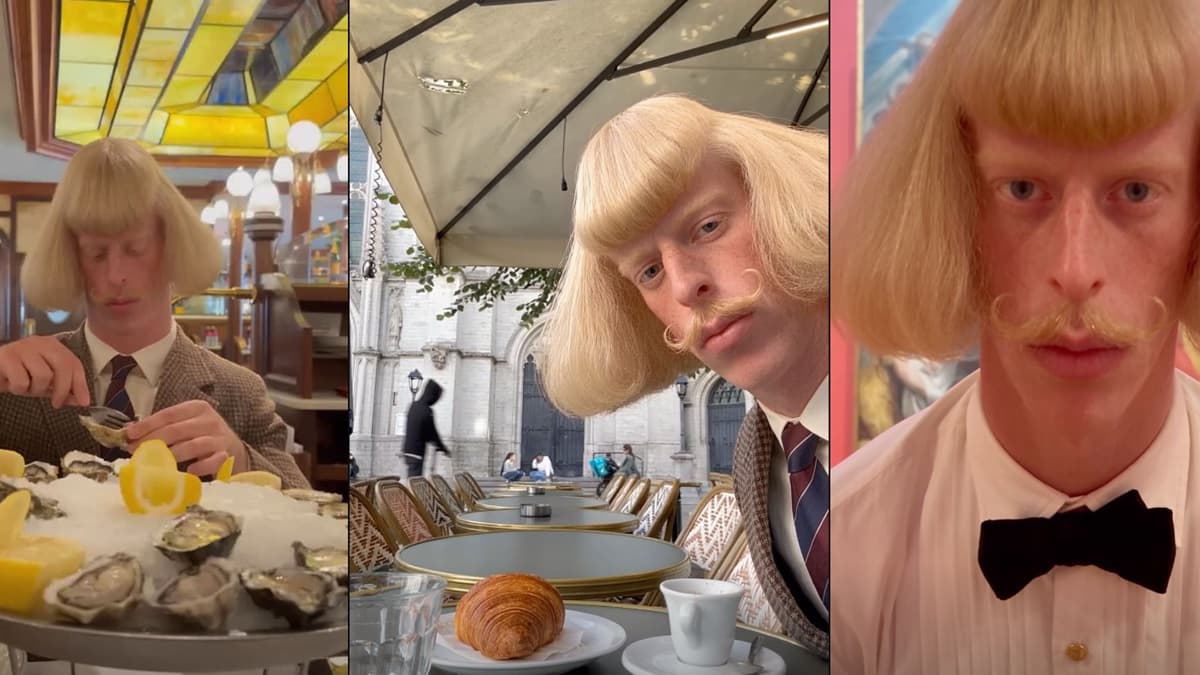
Short answer: make a character sheet, then swap that character into short clips that already work — and keep the face, the outfit, and the one gesture identical every time. Jean Phil (the account's full name is Jean Philanthrope) is a silent Frenchman in a brown houndstooth suit who shadowboxes and dances in ordinary places. His earliest known Instagram post is dated September 17, 2026; by October 2 his TikTok alone had 230,000 followers and 3.8 million likes from eight videos. Know Your Meme and Dexerto call him AI-generated; the account's anonymous creator has never said so. The method for building a character like him is not a secret and not a $299 course: one reference image → a multi-angle character sheet → a reference-to-video model such as Seedance 2.5 → five clips before you judge it. Here's each step, the prompt, what it costs, and what to stay away from.
Who Jean Phil is — and what's actually known
Know Your Meme describes an 'AI-generated French internet persona' whose first TikTok video, on September 19, drew 1.5 million views in three days; a park boxing clip passed 5.6 million. His clips use existing songs — La Fève's 'FINIS-LES,' Nelly's 'Dilemma,' Kanye West's 'Praise God' — and he never speaks. Dexerto states flatly that he's AI. What nobody has is confirmation. French outlet rotek.fr: 'pour le moment, le principal intéressé n'a réagi à aucune rumeur à son égard.' No creator is named, no AI label appears on the account in any report, and Know Your Meme's own explainer says there's 'still no definitive answer.' The strongest evidence is circumstantial: no online presence before September, and a near-clone account whose movements match his 'au dixième de seconde près' — to the tenth of a second.
He isn't alone. Dexerto has profiled Benjamin Stachio, a triple-moustached bar dancer with 62,500 Instagram followers, as 'part of the same wider trend'; others include Archibald Brown and a character called Brigitte Macaron. Same shape every time: one exaggerated feature, one setting or gesture, no history.
Why he stuck: three things that aren't 'a better model'
- A silhouette you can read at thumbnail size. Bob, moustache, suit. Recognizable in a one-second scroll.
- One behavior. Air-boxing, then a stiff dance. No plot, no dialogue. Confidence with a straight face is the joke.
- No past. No old posts, no real name, no studio credit — so 'is he AI?' did the distribution. One AI-spotting account's verdict on him reached 1.6 million views by itself.
The workflow, as the people copying him describe it
Simone Canc@simonecanciello
dead internet theory is real. you can actually create an AI character and get 200k followers in 1 week. please don't buy a $299 course. > create a realistic character sheet > swap your character into viral videos
View original post ↗
That September 30 post passed 5.6 million views in two days; the one before it named the stack: 'ask chatgpt to create a character sheet from a pinterest pic or video > download a viral tiktok > replace the person with your character > use seedance 2.5 with references.' Two caveats. Canciello is describing his own recreation method, not a confirmed account of how Jean Phil was made — and the '16M views in 3 days' in that thread refers to a different character, Brigitte Macaron. With that said, here are the four steps.
1. Lock a character sheet before you generate a single clip
Start from one reference — a generated still is cleanest, because you own it — and ask an image model for a sheet: several angles, same outfit, same hair, plain background. The point is consistency, not a pretty portrait. Google's own framing of the problem when it launched Nano Banana: 'a depiction that's close but not quite the same doesn't feel right.' The sheet circulating for Jean Phil shows five full-body turnaround views and three close-ups, one with fists raised. A prompt structure that works, adapted from Kapwing's published version:
A photoreal character reference sheet of the person in the attached image. Plain light grey studio backdrop, soft even lighting. Top row: three large head-and-shoulders portraits — front, three-quarter, profile. Bottom row: four smaller full-body views — front, left, right, back. Same person, same outfit, same hair, same lighting in all seven views. No text, labels, or watermarks.
2. Borrow a structure, not a person
Pick a short clip whose motion already travels: a dance, a walk, a single gesture, a fixed stage. You're taking the choreography and the cut rhythm. This is the same move as our Hotel Lobby and STORM guides — with one difference that makes it cleaner: the face you're inserting is invented.
3. Swap your character in with references
- Seedance 2.5 is the tool named in the viral posts. It accepts 'up to 30 images, 10 videos, and 10 audio clips' as references, tagged @Image1, @Video1 and so on — and the documented rule is to 'name a role, bind it to a reference, then refer to the role by name.' Attach the sheet and the source clip; tell it to use the video only for motion, timing, and camera.
- Higgsfield Genjutsu does the same job: Motion Transfer for whole performances, Object Swap to replace one person and keep the scene. Up to 30 references. A 15-second clip at 1080p runs about $7 in credits, per Higgsfield.
- Higgsfield Soul ID is the heavier option — 'a trained identity layer' built from five or more photos in a few minutes — designed for real people's likenesses, which makes it more than you need for an invented face.
- One-click templates: Starrd has a 'Gang Gang Dance' template it describes as the Jean Phil dance trend — 250 credits for a 29-second clip, packs from $4.99, running Seedance 2.5 at 480p. CapCut templates are widely mentioned; we couldn't find one.
Use @Video1 only as the reference for motion, body movement, timing, and camera. Replace the person with the character in @Image1 — same face, hair, moustache, and outfit as the sheet. Keep the location, lighting, and color from @Video1. Do not change the cut timing.
4. Post the character, not the tool
The accounts that grew didn't caption 'made with Seedance.' They posted the character doing the thing, and left the tool for the replies. That's a growth observation, not a disclosure strategy — see the rules below.
A character you can actually own
- Copy the system, not Jean Phil. A second blonde bob in a houndstooth suit is a tribute act.
- One exaggeration, then stop. A haircut, a collar, a walk. If you need a paragraph to describe them, the thumbnail won't work.
- Write the behavior in one line. 'He only shadowboxes.' 'She only checks her watch and leaves.' Each clip is that behavior in a new room.
- Reuse the sheet every single generation. Drift — a bob that changes length, a moustache that migrates — is how these accounts die.
- Put them where a crowd already is: a dance that's moving this week, a famous set, a recognizable street.
- Make five clips before you judge it. One viral video is a lottery ticket. Five clips of the same face is a character.
What to stay away from
- The music. His clips run on commercial tracks, and the template vendors pair the dance with Chef Boy's 'Gang Gang.' A template that dubs a hit song is not a license. Keep the motion, swap the audio, or use something you can clear.
- Real people. The format works because the face is invented. Dropping a celebrity or a private person into the same machine is a different project with different rules — on October 1, Victoria Monét and Quavo recreated the Hotel Lobby set for real and captioned it 'No AI… support human legacy.'
- The mystery. 'Is he real?' works once, as a discovery. Running an ongoing account as a real human is where platform rules bite: Meta applies 'AI info' labels 'when we detect industry standard AI image indicators or when people disclose,' TikTok requires labels on realistic AI-generated people, and US endorsement rules treat a virtual influencer that 'appears to be' a person as an endorser. An obvious character who never claims to be footage is the durable version.
- The coin. A $JEANPHIL token launched on Solana on September 19, is promoted from the character's official bios according to French press, peaked around $12.2 million in market value, and sat near $1.9 million on October 2 — down about 85%. Whether the same people run the account and the token isn't established; Cointribune: 'impossible… to assert that all these accounts belong to the same team.' Dexerto frames the whole genre as a meme-coin formula. Build the character; skip the token.
- The course. The highest-view post about this method exists to say the steps are already public. Now they're here too.
A first session: one hour, one character, three clips
- 10 minutes: generate one reference image with your one exaggeration. Then the sheet.
- 10 minutes: pick one gesture and three short source clips in three ordinary places.
- 30 minutes: three generations, same sheet attached each time, at 480p or 720p. Check the hair and the outfit against the sheet before you check anything else.
- 10 minutes: post one, labeled as AI. If people ask how, the answer is the sheet plus the reference swap — not a new tool.
- Cost: an image model you likely already have, plus roughly $2–7 a clip depending on resolution, or a $5 template pack.
Our read
Jean Phil is a haircut and a punch thrown at nobody, and that's the lesson. The models that make him possible have been out since July; what's new is someone treating a synthetic face like a brand — one look, one move, relentless repetition — instead of like a demo. That's a craft anyone can learn in an afternoon, and unlike the Hotel Lobby and STORM trends it doesn't require borrowing a real person's face or someone else's performance. The parts of his playbook worth leaving behind are the ones that made him a news story rather than a character: the borrowed music, the pretense of being human, and a token that has already lost most of its value. Our AI video ranking and image generator ranking cover which tools hold a face best when you're ready to go past a first session.
Where these apps rank