
Signals
What Is ChatGPT Wallet? OpenAI's Dots Can Now Check Out for You. How the Token Works, Who Pays When a Purchase Goes Wrong, and How It Compares With Stripe Link, Muse and Walmart
By the Top5Apps editorial team · Published November 14, 2026 · Updated November 14, 2026 · 19 min read
Short answer: ChatGPT Wallet lets OpenAI's dots pay for things with your credit card, and you approve every purchase with Face ID or a fingerprint. The dot and the store get a substitute card number that works for one purchase, so your real card number stays hidden. OpenAI launched it on November 13 for US ChatGPT Pro subscribers. The card protection is well built. OpenAI's own terms leave the harder problem, an agent that buys the wrong thing, to the store and your card issuer.
We read OpenAI's announcement, help article, Wallet terms, privacy notice and merchant guide, watched the launch video frame by frame, and checked the rival products and the US card rules on their own pages. We haven't used Wallet ourselves yet. (Disclosure, per The Receipts Standard: this site is produced with Claude-family tools, and Claude Duet is one of the rival products compared below.)
ChatGPT@ChatGPT
Now your dot can securely complete purchases on your behalf—with your approval. With ChatGPT Wallet, agents pay without access to your actual card details. Every purchase requires a security check. ChatGPT Wallet is rolling out starting today to dots, for Pro subscribers in the US.
View original post ↗
The short version
- ChatGPT Wallet lets a dot pay for things. You save a credit card once, your dot finds a product and fills in the store's checkout, and you approve each purchase on a sheet with Face ID or a fingerprint.
- The dot and the store never get your real card number. The card network issues a substitute number for that one purchase, the same idea as Apple Pay.
- Very few people can use it yet. Wallet needs ChatGPT Pro, a US address, a dot and an eligible credit card from American Express, Chase, Mastercard or Visa. Debit cards and virtual cards don't work.
- OpenAI's terms put responsibility elsewhere. The store is the seller, your card issuer handles disputes, and OpenAI says it doesn't decide or fund refunds or chargebacks.
- The 'first wallet' claim needs a footnote. Stripe's Link has let agents pay without seeing card details since April, and it powers purchases for Meta's Muse and Claude Duet. OpenAI's additions are a token straight from the card networks and a biometric check every time.
- US law protects you less than the marketing suggests. The $50 cap covers charges you didn't authorize. A purchase you approved is authorized, so your route is a billing-error dispute with your card issuer.
- It won't work everywhere. Amazon blocks outside agents, United Airlines says it will, and fraud filters can decline a legitimate agent purchase.
- Store owners have homework. OpenAI says Wallet needs no new integration, and a store should still check its firewall, its product feed and its fraud provider.
- Our read: try it on a cheap reorder from a store you know, and read every line of the approval sheet.
How a ChatGPT Wallet purchase works
ChatGPT Wallet is a payment feature for dots, the always-on agents OpenAI launched in September. You save a credit card once. After that, your dot can find a product, fill in the store's checkout and pay, and it has to stop and get your approval before any money moves.
OpenAI's launch video shows one purchase from start to finish, and the sequence is worth following closely because every step is a place where something can go wrong.
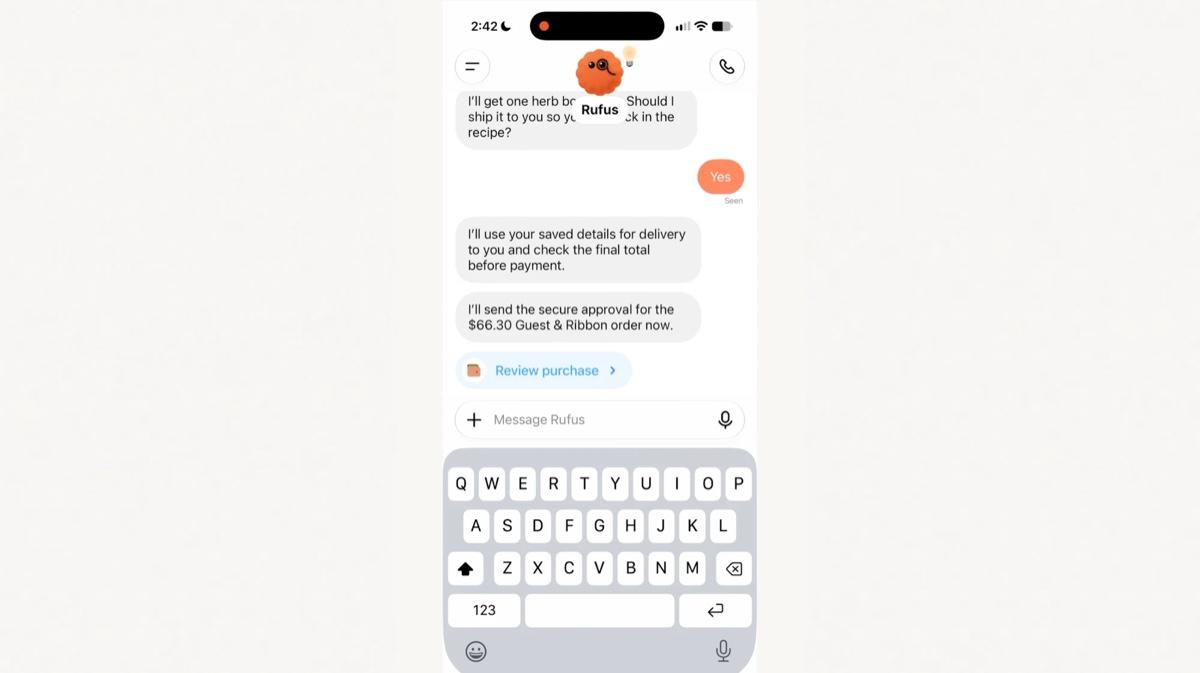
- You describe what you want. In the video, the user asks a dot named Rufus for a holiday gift for a friend who cooks, makes pottery and loves plants, with a budget of about $100.
- The dot picks a product. Rufus suggests a culinary herbs gift box from a store called Guest & Ribbon at $59.97 before tax, with free shipping.
- The dot fills in the checkout. After the user agrees, the dot says it will use the user's saved delivery details and check the final total before payment.
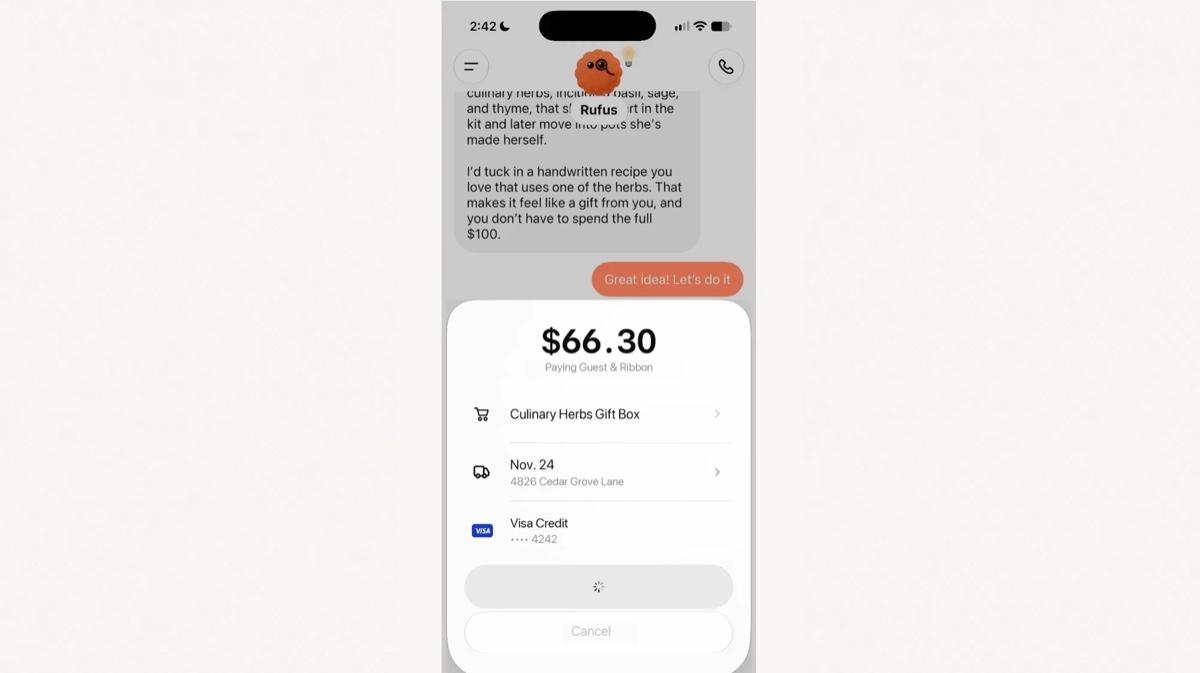
- You get an approval sheet. The sheet shows $66.30, the store, the item, the delivery date and address, and a Visa credit card ending in 4242, with an Approve button and a Cancel button.
- You pass a security check. Approving takes Face ID or a fingerprint scan on a supported device. If you're on a computer that can't do that, the dot gives you a link or QR code to finish on your phone.
- The dot finishes checkout. The dot reports an order ID and warns that the receipt may show different last four digits, because it paid with a virtual card number.
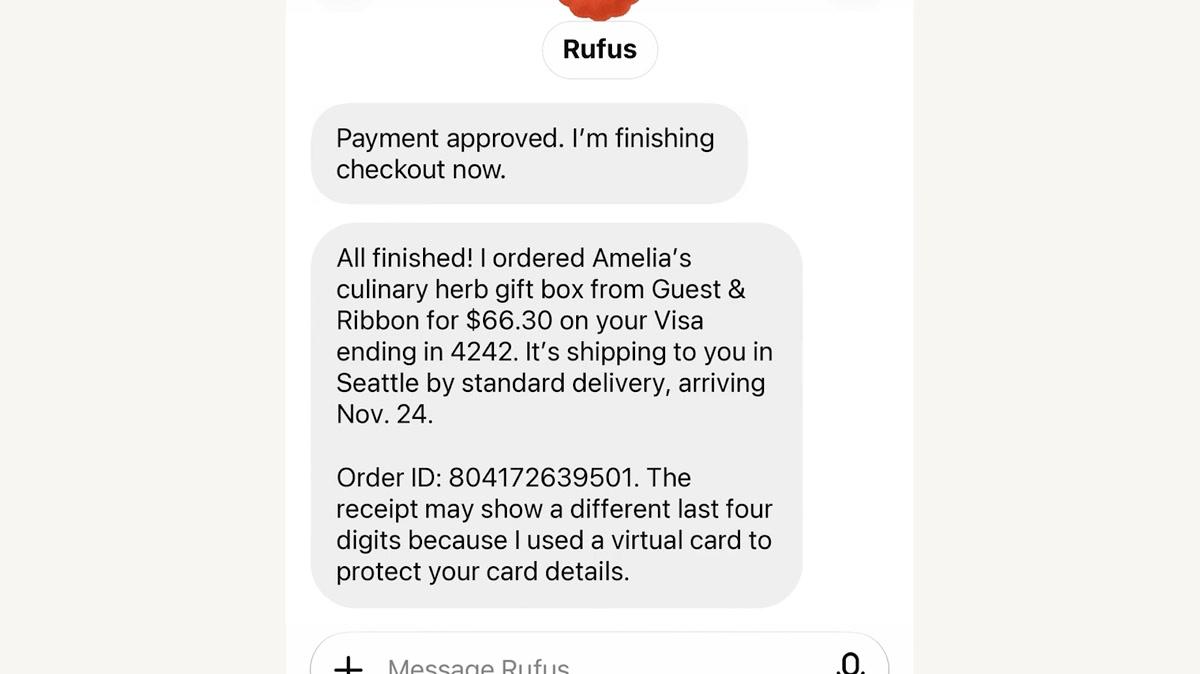
OpenAI's help article adds a caution that the video skips. When the dot says 'Ready to check out,' your approval is complete, and the store may still not have placed the order. OpenAI tells users to look for the store's own confirmation before trying again, because a failed checkout can leave a pending charge on the card.
What the token is, in plain terms
The headline claim is that the agent pays 'without access to your actual card details.' The mechanism behind that claim is a payment token, which works the same way a card works inside Apple Pay or Google Wallet.
When you approve a purchase, the card network creates a substitute card number with its own security code and expiry date. Your dot types that substitute number into the store's checkout form. The store charges it, and the charge lands on your real card account. The store never receives your real card number, and neither does the dot.
- OpenAI doesn't hold the real number either. The privacy notice says a payment provider collects your card details through a secure form, and OpenAI receives the token plus limited details such as the network, the issuer and the last four digits.
- The token covers one purchase. OpenAI's merchant guide tells stores that the customer 'consents only to the specific transaction' and that they must not reuse the credential for a separate purchase.
- Subscriptions are the exception. If you approve a recurring payment plan, the help article says the store 'may store the payment credential and charge it again' under the terms you agreed to. You cancel those charges with the store.
- Your biometrics stay on your device. The Wallet terms say OpenAI doesn't receive the fingerprint or face scan when your device performs the check locally.
Tokens protect you from one specific risk, which is a store or an agent leaking your card number. A token does nothing about the other risk, which is the agent buying the wrong thing. The approval sheet is the only protection against that second risk, so the sheet deserves a real read every time.
Who can use it today
| Requirement | What OpenAI says |
|---|---|
| Plan | ChatGPT Pro. The rollout is gradual, so an eligible account may not have Wallet yet. |
| Where | You must live in the United States and have a US billing address. |
| Age | 18 or older. |
| Cards | Eligible US-issued credit cards from American Express, Chase, Mastercard and Visa. |
| Cards that don't work | Debit cards and virtual cards. On a Chase card, only the primary cardholder can enroll, and an authorized user can't. |
| Device | One that supports biometric verification, such as Face ID or Touch ID. |
| Where in ChatGPT | Conversations with a dot only. Wallet isn't available in Chat, Work or standalone Codex threads. |
Those limits make ChatGPT Wallet a small test inside a very large product. OpenAI says 1.2 billion people use ChatGPT each week, and CNBC reported nearly 100 million paying users. Wallet reaches only the Pro subscribers among them who live in the US, have set up a dot and hold the right kind of credit card.
The limit is deliberate. Luke Gebb, who runs innovation at American Express, told CNBC that starting in a contained environment was the right approach, and that OpenAI can 'turn up the volume' when it chooses. The credit-only rule also has a practical side for users, because credit cards carry stronger dispute rights under US law than debit cards do.
Who is responsible when a purchase goes wrong
OpenAI's announcement talks about trust. OpenAI's Wallet terms talk about responsibility, and they place almost all of it on other parties. We read the terms in full, and five points stand out.
- The store is the seller. The terms call the merchant 'the seller and merchant of record' and say your purchase is a transaction between you and that store, under the store's prices, shipping rules and return policy.
- OpenAI doesn't refund anything. The terms say OpenAI 'does not decide or fund merchant refunds or card chargebacks' unless the law requires it. OpenAI may hand over its records of what you approved to help with a dispute.
- The terms admit the agent can be wrong. One line reads, 'AI systems can make mistakes.' The next tells you to withhold approval unless every detail is correct.
- Your approval covers exactly what the sheet showed. The terms limit your approval to the merchant, items, amount, card, recipient and delivery details on the screen. If a material detail changes before the order goes in, Wallet has to ask you again.
- The liability clause is broad. In capital letters, the terms say OpenAI doesn't assume liability for purchases, payments, orders or order fulfilment made with Wallet, and that you agree to resolve disputes through your card issuer, the network or the store.
OpenAI's guide for stores takes the same position from the other side. When a store asks who handles payment or order errors, the answer is that 'customers are ultimately responsible for the actions they take,' and that the store should treat the order as if the customer had placed it personally.
| The problem | Who OpenAI says to contact |
|---|---|
| The order is late, wrong or needs returning | The store, under the store's own policy |
| You want to cancel a subscription the dot signed you up for | The store |
| A charge was declined, is pending or looks wrong | Your card issuer |
| A charge appears that you don't recognize | Your card issuer, promptly |
| Wallet shows an error or the approval flow is stuck | OpenAI Support |
| The dot bought something different from what you approved | OpenAI Support |
| Someone else got into your ChatGPT account | OpenAI Support, and your card issuer for any charges |
One case in that table is new, and neither the terms nor the help article settles it. A dot can buy something different from what the approval sheet showed. OpenAI tells you to contact its support team in that case, and its terms say it doesn't fund refunds. Until OpenAI or a card network says more, a customer in that position would be relying on the store's return policy and on the card issuer's dispute process.
The terms also look further ahead than the announcement does. OpenAI's blog post says that 'over time' users will be able to pre-approve purchases within limits they set. The terms already say you must approve each purchase 'or grant ChatGPT the authority to approve each purchase in advance.' The legal groundwork for a dot that buys without asking is in place before the feature is.
What US law does and doesn't cover
OpenAI's announcement says users keep their card's 'protections for eligible disputes.' We read the federal rules behind that phrase. We aren't lawyers, and what follows is our reading of the regulations as published by the Consumer Financial Protection Bureau.
- The famous $50 limit probably doesn't apply. Regulation Z caps a cardholder's loss at $50 for 'unauthorized use,' which means use by someone who has no authority to use the card. A purchase you approved with your own fingerprint is an authorized purchase.
- Handing over authority has a cost. The official commentary on that rule says that when a cardholder authorizes another person to use a card and that person goes beyond the authority given, the cardholder is liable until the cardholder tells the issuer that the use is no longer authorized.
- The useful protection is the billing-error dispute. The same regulation lets you dispute a charge for goods you didn't accept or that weren't delivered as agreed. You have 60 days from the statement to give notice, and the issuer has to acknowledge the notice within 30 days and resolve it within two billing cycles.
- Debit cards carry more risk, which may explain the credit-only rule. Under Regulation E, a debit cardholder's loss from unauthorized transfers is capped at $50 only if the cardholder reports within two business days, rises to as much as $500 after that, and has no cap after 60 days. OpenAI hasn't said why Wallet excludes debit cards.
The rules were written for people buying things themselves, and regulators know it. Federal Reserve Governor Christopher Waller put the open question plainly in a speech on September 29: 'Who is on the hook if an agent makes the wrong purchase?' He said existing frameworks could potentially be adapted, and he announced no rule.
One card company has promised more. American Express said in April that 'in the future' it will protect eligible customers 'from charges related to AI agent error' when a registered agent sends Amex proof of what the customer intended. The promise carries a footnote that says terms and conditions will apply. Nothing OpenAI or American Express published this week says whether ChatGPT Wallet purchases have that protection today.
Banks appear to be heading the other way. The same Wall Street Journal report says several banks plan to treat a customer who gives an agent a card the way they treat a customer who hands a card to a family member, which makes the charges the cardholder's.
The rival agent-payment products, compared
OpenAI calls ChatGPT Wallet 'the first wallet that lets agents pay without access to users' actual card details and that requires a security check for every purchase.' The claim is true only if you read both halves together, because the first half describes a product that has existed since April.
Stripe launched a 'wallet for agents' inside its Link service on April 30. An agent using Link creates a spend request, the user reviews and approves it on a phone or the web, and Link hands the agent a payment credential only after that approval. Meta's Muse has paid this way since September 8, and Stripe's announcement says 'Muse never sees their underlying payment details.' Anthropic's Claude Duet has used Link and Shop Pay since October 21.
| Product | Available since | What the agent pays with | How you approve |
|---|---|---|---|
| ChatGPT Wallet (OpenAI, for dots) | November 13, 2026 | A token for one purchase, issued by Visa, Mastercard or American Express | An approval sheet plus Face ID or a fingerprint, for every purchase |
| Link wallet for agents (Stripe) | April 30, 2026 | A one-time card from Link or a Shared Payment Token | You review each spend request on a phone or the web. Stripe said spending limits would come later. |
| Meta Muse, through Link | September 8, 2026 | Your saved Link payment method at stores that accept Link, and a single-use virtual card elsewhere | You approve the total in the chat |
| Claude Duet, through Link and Shop Pay | October 21, 2026 | A one-time virtual card | You approve each purchase in the wallet app |
| Walmart Agent Profiles | Announced October 21, due within about a month | Nothing. Walmart says agents receive no card data and can't change payment methods. | You approve each purchase by default, or set a limit such as $50, $100 or $200 |
| Google Universal Cart | October 15, 2026 | Google Pay | You tap to pay yourself. Google's launch post doesn't describe an agent completing the purchase. |
Two things in ChatGPT Wallet are new against that list. OpenAI gets its token directly from the card networks, where Link's usual route outside its own merchant network is a single-use virtual card. And OpenAI requires a biometric check on every purchase, which neither Stripe's nor Meta's announcement mentions.
The difference between a network token and a virtual card matters more to stores than to shoppers. The Wall Street Journal reported on November 13, according to PYMNTS, that merchants have complained to Visa and Mastercard because single-use virtual cards are classed as commercial cards, cost more to accept and make returns harder to process. A network token charges the customer's own card account, which is why OpenAI can say the card keeps its rewards.
Walmart's design is the real alternative. Walmart doesn't give an outside agent any payment credential. The customer sets rules in a Walmart account, the agent shops inside those rules, and Walmart blocks any agent that breaks its terms. If large retailers follow Walmart, an agent's wallet will matter less than the permissions each store grants.
The week it launched into
ChatGPT Wallet arrived in a week when the companies around it were sounding cautious about agents that shop.
- Visa measured how often shopping agents get it wrong. Visa published a benchmark on November 5 that gave 22 AI models from 12 labs 15 shopping tasks. The models failed 42.8% of test runs, and about 54% of the failed runs still ended in a purchase. Visa didn't name the models.
- A large card issuer has been wary. The Journal reported that JPMorgan Chase blocks agents from shopping with a card number that a customer hands over, and that the bank has been slow to adopt the networks' agent tokens. Chase cards are eligible for ChatGPT Wallet all the same, with enrollment approved through the Chase app.
- Nobody has published a real test yet. We looked for hands-on reports from the first 24 hours and found none with a completed purchase. Wallet is rolling out gradually, and it's limited to Pro subscribers, so early evidence will be thin.
Visa's figure is the one to remember at the approval sheet. In Visa's tests, more than half of the runs that went wrong still bought something. OpenAI's design puts a person between that mistake and the charge, and the person is the control that has to work.
Where it won't work
OpenAI is frank that Wallet won't work at every store. The help article's answer to 'Can I use Wallet at every store?' begins with the words 'Wallet may not be able to complete checkout at every store.' Two separate obstacles stand in the way.
- Some companies refuse agents on purpose. CNBC reported that Amazon prevents agents from purchasing on its platform, and The Verge noted that Amazon blocked Meta's Muse agents earlier this year. United Airlines said on November 11 that it will prohibit 'unauthorized, third-party personal AI agents' from booking and managing reservations, and cited shared login details, unintended purchases and federal aviation rules.
- Some stores block agents by accident. A dot shops through a browser running in OpenAI's cloud. Firewalls and bot filters are built to stop automated visitors, so they can stop a dot that a real customer sent.
- Fraud systems can decline a legitimate purchase. OpenAI's merchant guide says risk systems 'are often tuned to detect bots,' and that a dot's browser can trip them by accident and cause purchases to fail.
OpenAI can't fix the first obstacle, and it's working on the other two. OpenAI says it's working with the fraud-prevention companies Forter, Riskified, Sardine and Signifyd and the payment processors Adyen, Checkout.com and Stripe so that their systems recognize purchases made by agents. The security companies Akamai, Cloudflare, HUMAN and Vercel already verify a dot's signed requests automatically.
If you run an online store, you have a new kind of visitor
ChatGPT Wallet changes who shows up at a checkout page. Until now, a store's checkout had one job, which was to get a person through it. More of the visitors filling in that form will now be agents acting for a person who is somewhere else, looking at an approval sheet.
OpenAI published a Commerce Partner Playbook alongside the launch. Its main message for store owners is reassuring: Wallet works with existing checkout pages and payment forms, and 'no Wallet-specific integration is required.' The optional steps are worth an hour of any store owner's time.
- Check that your site lets verified agents in. A firewall or content delivery network may block a dot's browser without anyone having decided to. OpenAI signs its requests with a standard called Web Bot Auth so that a site can tell a real ChatGPT visit from an imitation.
- Give agents accurate product facts. A store can claim its business in ChatGPT and upload a product feed with current prices and stock. An agent that reads a stale price will bring a customer to an approval sheet that doesn't match the store's checkout.
- Talk to your fraud provider. OpenAI now forwards signals about the real customer, such as country, time zone and network, in a 'Forwarded' header. A fraud tool that ignores those signals sees only a data-center browser and may decline the sale.
- Treat the token as single-use. The store receives a network token for one purchase. Recurring billing works if the checkout already supports it and the customer consents.
- Expect the support ticket to come to you. OpenAI's guide says order errors should be handled as if the customer had placed the order. A store that sells through agents will field returns for purchases an agent chose.
A store can't yet demand its own human confirmation step for agent orders. OpenAI's guide says it has no feature that lets a site owner control which actions a dot may take, and points to its own rule of human review before any consequential action. Stores also keep the option to refuse agents entirely, as Amazon has. OpenAI's guide argues that sites which block access 'may lose users or customers,' which is a claim from the company that benefits if stores believe it.
What OpenAI learns about your shopping
A token keeps your card number private. It doesn't keep your purchases private from OpenAI. The Wallet privacy notice lists what OpenAI collects when a dot pays for something.
- OpenAI records what you bought. The notice covers the merchant, the date and time, the amount, the items, quantities, taxes, shipping, discounts and product descriptions.
- OpenAI records where the order goes. The notice covers the recipient, the delivery details and the order's later status, including refunds, disputes and chargebacks.
- OpenAI keeps the approval record. The notice covers the purchase request, whether you approved or rejected it, the authentication result, and the time and device.
- OpenAI may share fraud signals with stores. The notice says OpenAI may provide device, security and fraud information to merchants to help them judge whether a transaction is legitimate.
- OpenAI rules out advertising use. The notice says OpenAI doesn't sell Wallet information or share it for targeted advertising.
The notice also says OpenAI uses Wallet information for the purposes in its general privacy policy, 'subject to your Data Controls.' It doesn't spell out whether purchase records can be used to improve OpenAI's models, so anyone who cares about that should check the data controls in ChatGPT's settings before adding a card.
Why OpenAI is doing this
ChatGPT Wallet is OpenAI's second attempt at checkout. CNBC reported that OpenAI introduced a feature called Instant Checkout in the fall of 2025 and pivoted away from it, and that by March 2026 it had rebuilt shopping around helping people find and compare products. Chaya Nayak, who leads monetization and payments product at OpenAI, told CNBC that Wallet is 'the next step' after product discovery.
OpenAI isn't taking a cut of Wallet transactions at launch, according to CNBC. The same report says purchases 'could eventually kick-start a new revenue stream,' and OpenAI launched business profiles and product feeds in ChatGPT three days before Wallet. A company that sees what people search for, what they buy and which stores complete the sale holds valuable information even before it charges a fee.
Should you use it, and how to start safely
Most people can't use ChatGPT Wallet yet, because it needs a Pro subscription, a US address and a dot. If you have all three, the feature is worth trying on a purchase where a mistake would cost you little.
- Start with a boring reorder. Pick something you've bought before from a store you know, such as printer paper or coffee filters. You already know the right price, the right size and the right delivery time, so you'll spot an error on the approval sheet at once.
- Read all five lines of the sheet. Check the store's name, the item, the total, the delivery address and the card. The total in OpenAI's own demo was $6.33 higher than the price the dot first quoted, because the quote left out tax.
- Look for the word 'recurring.' A subscription lets the store keep your payment credential and charge it again. If the sheet shows recurring terms and you wanted a single order, decline.
- Wait for the store's email. The dot's 'all finished' message is the dot's report. The store's confirmation email is the proof that an order exists. If a checkout fails, check for that email before you ask the dot to try again, or you may pay twice.
- Note where it breaks. A store that blocks the dot, a fraud check that declines the card and a checkout that times out are all likely in the first weeks. Each failure tells you which stores are ready for agent shoppers.
- Keep big and urgent purchases for yourself. Flights, hotels and anything with a deadline carry real costs if a checkout half-completes, and United Airlines has said it will block agents from booking.
We'd hold off on Wallet for anyone who doesn't check a card statement regularly. Every protection in this system ends with the card issuer, and a card issuer can only help with a charge the cardholder notices and reports.
Our read
ChatGPT Wallet is a careful product, and almost all of its care goes into protecting the card number. The token design is sound, the biometric check is a real improvement on tapping 'approve' in a chat window, and OpenAI launched with Visa, Mastercard and American Express all taking part. On the narrow question of whether an agent can leak your card, OpenAI has built the strongest answer so far.
The harder question is what happens when the agent buys the wrong thing, and OpenAI's own documents answer it by pointing at other people. The store handles the return. The card issuer handles the dispute. OpenAI keeps a record of what you approved, which will help the store and the issuer more often than it helps you. Visa's benchmark says agents make shopping mistakes often, and that the mistakes often end in a purchase.
We think the approval sheet is where this product will succeed or fail. A person who reads five lines before every Face ID check is well protected. A person who approves by reflex, the way most of us dismiss a cookie banner, has a signed record of consenting to whatever the agent chose. OpenAI's terms already allow for the step after that, in which the dot buys within limits without asking.
For stores, the direction is clear even though the volume is tiny today. Agents are arriving at checkout pages with a customer's approval behind them, the card networks are building the plumbing, and each large retailer is choosing between Amazon's refusal and Walmart's rulebook. A store that wants agent customers should make sure its site lets them in and its fraud tool doesn't turn them away.
Rankings: no movement today. Dots stay provisional in our personal AI agents ranking until we've tested them, and we've updated that page to reflect Wallet. We'll update this post when the first hands-on reports arrive, when OpenAI turns on pre-approved purchases, if Wallet reaches cheaper plans or debit cards, and when a card network says who pays for an approved purchase that went wrong.
Where these apps rank