
Signals
Will Apple Enter the Personal AI Agent Space Next Year? What an Agentic Siri Means for Muse, Dots and the Rest, What an On-Device Agent Can Do That an App Can't, What Apple Still Lacks, and Why the Siri Name Should Go
By the Top5Apps editorial team · Published November 8, 2026 · Updated November 8, 2026 · 13 min read
Yes, Apple will enter the personal-agent space, probably in 2027, and the report that set this off says so in the weakest possible verb. Mark Gurman's Bloomberg newsletter on November 8 says Apple is 'exploring' turning Siri into the kind of agent that OpenAI's Dots, Meta's Muse and Grok Bot already are, one that 'can remember projects and preferences over time, monitor connected sources for changes' and decide 'what needs to happen next.' His own read, per 9to5Mac's summary, is that Apple 'could make Siri more like an agent as early as next year,' and that it doesn't 'have much of a choice, given current consumer and market demands.' Apple has announced nothing. Its new CEO, John Ternus, told analysts six days earlier that Siri is 'primarily request-based today' and that agents are 'promising tools' as long as users know 'what they're giving access to.'
The question that matters isn't whether. It's what an agent built by the company that owns the phone can do that Muse, Dots, Grok Bot, Gemini Spark and Claude Duet cannot, what Apple still lacks after two years of promising this, and whether the word 'Siri' should survive the transition. Our editor's view is that it shouldn't: the brand is tarnished and Apple should start fresh. The data below mostly agrees with him, with one complication Apple already created for itself in June. Everything here is from Apple's own releases, calls and developer documentation, the companies' own statements, and surveys with named methodology, read on November 8.
The short version
- The report: Apple is exploring an agentic Siri; Gurman thinks 2027. No codename, no on-device-versus-cloud detail, no Apple statement. The same newsletter says Siri's leader, Mike Rockwell, 'continues to seriously consider stepping down.'
- Where Apple actually is: Siri AI, announced June 8 and shipped in beta September 14 on Gemini-based Apple Foundation Models, does personal context, onscreen awareness and actions inside Apple's apps. It acts in 15 Apple apps in the iOS 27.3 beta. Third-party app actions reach the App Store in spring 2027. It is a better assistant, not an agent.
- What the agents have built: Muse, our top-ranked personal agent, has 10 million set up in six weeks, 25% daily, and is number 2 on the US App Store today. ChatGPT has 1.2 billion weekly users to sell Dots into; Gemini has a billion. Apple has 2.5 billion active devices and 2.5 billion Siri requests a day, a distribution advantage measured in zeros.
- What owning the OS buys: the personal-context index, screen awareness, the ability to run in the background, the Side Button, on-device models with first call on the Neural Engine, and attested private cloud. Every app agent is locked out of all six by Apple's own sandbox; they compensate with cloud computers and public APIs.
- What Apple lacks: a proactive agent (by its CEO's own description), a stance on letting it spend and act (its 10-K now lists 'unintended or unauthorized actions by autonomous or agentic systems' as a risk), stable leadership, and a brand anyone trusts: Siri ranks last of ten AI brands in YouGov's 2026 satisfaction index, and 'Apple Intelligence' ranks eighth.
- On the name: we agree it should go. Google retired Bard and Assistant; Microsoft retired Cortana and Bing Chat; the brands that kept their names (Alexa, Meta AI) were the ones whose names people still said out loud without wincing. Apple's half-step, 'Siri AI', kept the damaged word and added the one people trust least.
What Apple has promised, and what has shipped
The pattern is the context for everything else. Apple promised a Siri that acts across apps on June 10, 2024; said on March 7, 2025 that it was 'going to take us longer than we thought'; moved Siri from John Giannandrea to Mike Rockwell under Craig Federighi that month; had Federighi tell the Wall Street Journal in June 2025 that the first architecture 'didn't converge in a way, quality-wise, that we needed it to'; and shipped nothing personal through five point releases of iOS 26. The turn came on January 12, 2026, when Apple and Google announced that 'the next generation of Apple Foundation Models' would be 'based on Google's Gemini models and cloud technology.' What followed was Siri AI, announced June 8 with the keynote line 'there are times when you expect more from Siri', and shipped September 14 as a beta in US English, with a dedicated Siri app, personal context, onscreen awareness, and actions inside Apple's own apps. Gurman's June verdict was that the new Siri 'finally works as it is supposed to for the first time in 15 years.'
Then, on November 3, Apple opened the developer preview that lets 'any developer' expose their app's actions to Siri AI through App Intents, with App Store submissions opening 'in the spring.' That is the date that matters for the agent question: until third-party actions ship, Siri AI can read your Mail and move your Calendar but cannot book the Uber or order the groceries, which is precisely what Muse and Dots do. Apple's own Q4 call made the gap explicit: 'It's primarily request-based today.' Gene Munster's read of that call was blunter: 'It's clear they don't want to talk about personalized agents,' which he called 'the biggest risk to the Apple ecosystem.'
The distribution gap, honestly drawn
Apple reports more than 2.5 billion active devices and 2.5 billion Siri requests a day. Counterpoint counts 450 million Apple Intelligence-capable iPhones shipped through the first quarter of 2026, and adds the sentence Apple's marketing would rather you didn't read: 'this indicates that AI is not a primary buying factor for iPhones.' Against that, the agents are small and fast. Zuckerberg told investors on October 21 that 'more than 10 million people in the US and Canada have set up Muse personal agents' in six weeks, that about 25% use it on any given day, and that 'Plaid told us that they had not seen activity like they are seeing with their connector on any other service before.' Sensor Tower had Muse at 10.2 million US downloads in 40 days, the twelfth app ever to do that and the first since Threads, with ChatGPT's first 40 days at 3.7 million for comparison. On November 8 Muse was number 2 on the US App Store's free chart, ChatGPT 4, Claude 9, Gemini 10.
The honest reading of the chart is that Apple's advantage is reach and the agents' advantage is intent. A Siri agent would be on 450 million capable phones the day it ships, which is Counterpoint's 'huge advantage.' But the people who set up Muse chose to hand an agent their Gmail, their calendar and, in a quarter of weekly users' cases, their shopping. Nobody has chosen Siri in fifteen years; it came with the phone. (Muse's own voice mode, live since November 5, is the first time an app agent has tried to be the thing you talk to all day.) The question Apple has to answer is whether being preinstalled still converts when the competition is an app people queue to download.
What an on-device agent can do that an app cannot
This is the part of the question that has a technical answer, and Apple's own documentation supplies it. The iOS sandbox 'is designed to prevent apps from gathering or modifying information stored by other apps'; an app reaches outside its own data 'only by using services explicitly provided by iOS.' Background execution, per Apple's WWDC25 session, 'isn't guaranteed. Instead, it's opportunistic, often discretionary, and tightly managed'; 'by default, backgrounded apps are suspended.' That is why every app agent on iPhone works the same way: the agent runs on a cloud computer somewhere else, reaches your services through public APIs and connectors, and messages you when it's done. Dots get 'their own cloud computer'; Grok Bots 'have their own cloud computer with browser and terminal access'; Duet runs 'on its own cloud compute'; Muse runs in a secure VM and reaches Gmail, Spotify and Plaid through their APIs. None of them can see your screen, read your Messages, wake when something changes on your phone, or answer when you hold the Side Button, which only works for a third party in Japan.
Apple's version inverts that. Siri AI's orchestrator uses an on-device Spotlight index and what Apple calls an 'App Toolbox' that 'run entirely on device'; onscreen awareness lets it act on what you're looking at; App Intents let it drive any app that exposes actions, without a browser, without a password, without a round trip; and the third-generation Apple Foundation Models include a 3-billion-parameter model and a 20-billion sparse model that run on the phone, with a Gemini-based 'Cloud Pro' model for 'agentic tool use and complex reasoning' behind Private Cloud Compute, which is stateless, 'must not contain privileged interfaces' and can 'cryptographically attest to running publicly listed software.' An agent built on that stack could notice the flight change in your Mail, check your Calendar, rebook in the airline's app through its App Intent, and tell you, with the personal data never leaving the device and the reasoning running in a cloud whose code is published. No app can do that on an iPhone, because Apple won't let it; Ben Thompson's October line was that Apple 'is so married to the app paradigm that they probably never even considered the alternative,' and that what users need 'is a permission layer for agents, not the programs they create.'
Two caveats keep this honest. The first is that Apple's moat is also its ceiling: the same sandbox that excludes Muse excludes a Siri agent from anything that isn't an App Intent, and developers have to build those; the store opens in spring 2027 and adoption will be uneven, exactly as Shortcuts support was. The second is that the model gap is real. The agents run Opus 5.5, GPT-6 Astra, Muse Wonder and Gemini 3.5; Apple runs a 3B model on device and rents Gemini for the hard parts. On-device buys privacy, latency and permission; it doesn't buy intelligence, and Apple's own help text already warns that server features have daily limits and 'may cost extra in future.' Our home-LLM guide covers why small on-device models are good enough for a lot and not for everything.
What Apple needs to be successful
- A model that works, on the phone. In hand, via Google. The Gemini deal is the most important AI decision Apple has made; it ended the 'didn't converge' era. The cost is that Apple's agent will think with a rented brain for the foreseeable future, and the Gemini-based Cloud Pro model is where 'agentic tool use' lives.
- Actions in every app, not Apple's. Partial. Fifteen Apple apps in the 27.3 beta; third-party App Intents in developer preview; App Store submissions in spring 2027. Until then, Siri AI cannot do the thing people set up Muse to do.
- A proactive agent, not a better assistant. Missing, by Apple's own description. Gurman notes the WWDC26 password-management feature that would have been Apple's 'first truly agent-like iOS feature' appeared in an early iOS 27 beta and disappeared. The hard part of Muse and Dots isn't answering; it's deciding what to do next and doing it while you're asleep, which runs straight into Apple's own background-execution rules.
- A stance on spending. Undecided. Muse buys things; Spark and Duet spend with approval; Claude's new Personal Finance is deliberately read-only. Apple's 10-K now lists 'unintended or unauthorized actions by autonomous or agentic systems' among its risks, and Ternus's one sentence on agents was about users knowing 'what they're giving access to.' A company that won't let a Siri agent spend will ship a safer product and a less useful one; it has to choose and say so.
- Leadership that stays. At risk. Giannandrea is gone; Rockwell, who got Siri AI out the door, is weighing an exit; Gurman names Amar Subramanya and Sebastien Marineau as the likely inheritors. An agent is a multi-year program; three Siri bosses in three years is not how those get built.
- Permission to be new. This is the brand question, and it gets its own section.
- Distribution. In hand, and the only item nobody else can buy.
Kill Siri? What the brand data says
Our editor's thesis is that Siri's brand is tarnished beyond repair and Apple should start fresh. The best data we have supports the diagnosis. YouGov's 2026 UK AI brand rankings, fieldwork March through July, put Siri last of ten brands on net satisfaction among current and former users at 23.7, below Grok, with Claude first at 56.2; 'Apple Intelligence', Apple's other name for the same effort, sat eighth at 32.4. The American Customer Satisfaction Index's 2026 AI survey didn't rate Siri at all. UBS found in July that only 24% of iPhone owners would upgrade sooner for the new Siri. Munster's informal poll had 17% of iPhone owners using Siri daily and 39% never. Every one of those numbers predates Siri AI, which is both the caveat and the problem: the name carried fifteen years of 'I didn't catch that' into the launch of a product that, by Gurman's account, finally works.
The precedents sort cleanly. Google retired Bard the moment it had something better ('Bard will now simply be known as Gemini,' February 8, 2024) and then retired Google Assistant itself on phones in favor of Gemini a year later; Gemini is now Android's system assistant and reached a billion users in October. Microsoft retired Cortana in 2023 and folded Bing Chat into Copilot that November, explicitly to 'simplify the user experience.' Amazon kept Alexa, because Alexa is a wake word in a hundred million kitchens, and Jassy reported 400 million people using Alexa for Shopping in the past year. Meta kept 'Meta AI' for the chatbot and launched Muse as a new name for the agent, which is the closest analogue to Apple's situation and the one Apple didn't follow. Apple's choice in June was 'Siri AI': the old name, plus the two letters that YouGov's respondents trust least. It is the brand equivalent of the two-architecture problem Federighi described, and it is why we land where our editor does, with one amendment. Siri is also a wake word, and 2.5 billion requests a day say people still say it. The move that fits the data is Meta's and Google's at once: keep 'Siri' as the way you address the phone, and give the agent, the thing that acts for you across your apps, a new name that has never said 'I found this on the web.' An agent is a relationship; nobody wants to start one with the assistant they've been apologizing for since 2011.
What it means for Muse, Dots and the rest
| If Apple ships a Siri agent in 2027 | Why | |
|---|---|---|
| Meta Muse | Loses the 'only agent on your phone' story, keeps the head start and the shopping | 10M set up, 25% daily, Plaid and Stripe volumes Meta says surprised both partners; Amazon already blocked it; Apple won't block an App Store app that follows its rules |
| OpenAI Dots | Least exposed on the phone, most exposed on the Mac | Dots live in ChatGPT and on cloud computers; the 1.2B weekly users are the distribution. Apple's Mac agent controls and the October Full Disk Access note are aimed at exactly Dots' laptop control |
| Gemini Spark | The odd one: Google supplies Apple's models and competes with Spark | Spark is a cloud agent inside the Gemini app; on Android it gets Halo and system-level Gemini. On iPhone it is just another app |
| Grok Bot | Smallest on iPhone; the X Subscription bundle is its distribution, not the phone | No App Store top-25 presence; xAI dropped its antitrust suit against Apple in September |
| Claude Duet | Most aligned with Apple's posture; most likely to be the one Apple's agent resembles | Approval before send, pay, sign or delete; trading and moving money blocked; Anthropic also publishes a Swift package for Apple's Foundation Models framework |
| Instinct | The no-app agent is the one Apple can't see | Text or call it; 100,000+ users; $10B valuation; it never asked Apple for anything |
The competitive effect is less than the headlines will say and more than Apple's silence suggests. An Apple agent would own the phone-native use cases: anything that starts with what's on your screen, what's in your Messages, or a Side Button press. The app agents already own the use cases that start with a goal and end with a purchase, and nothing Apple ships in 2027 changes the fact that they run frontier models on cloud computers with no App Store review between them and the task. Moffett's point about payments applies here too: 'It is not a stretch to imagine that AI apps will route outside of in-app purchases to avoid paying Apple's toll,' and an agent that buys for you is the ultimate out-of-app purchase. The loser is whoever is in the middle: an assistant that is better than Siri was but still asks for everything, which is Siri AI today, and, if Apple takes until 2027 to ship the agent while Rockwell weighs the door, might be Siri AI for a while yet.
What we could not verify
- Anything Apple itself has said about an agent. The report is Gurman's; Bloomberg's newsletter was paywalled to us and we worked from 9to5Mac's and The Apple Post's summaries. No codename, team, architecture or model choice has been reported.
- The Gemini fee. The '$1 billion a year' figure is Gurman's estimate repeated by blogs; neither company has confirmed it.
- Post-launch Siri AI satisfaction. YouGov's fieldwork ended July 31; no survey since September 14 exists. The ACSI 2026 study omitted Siri.
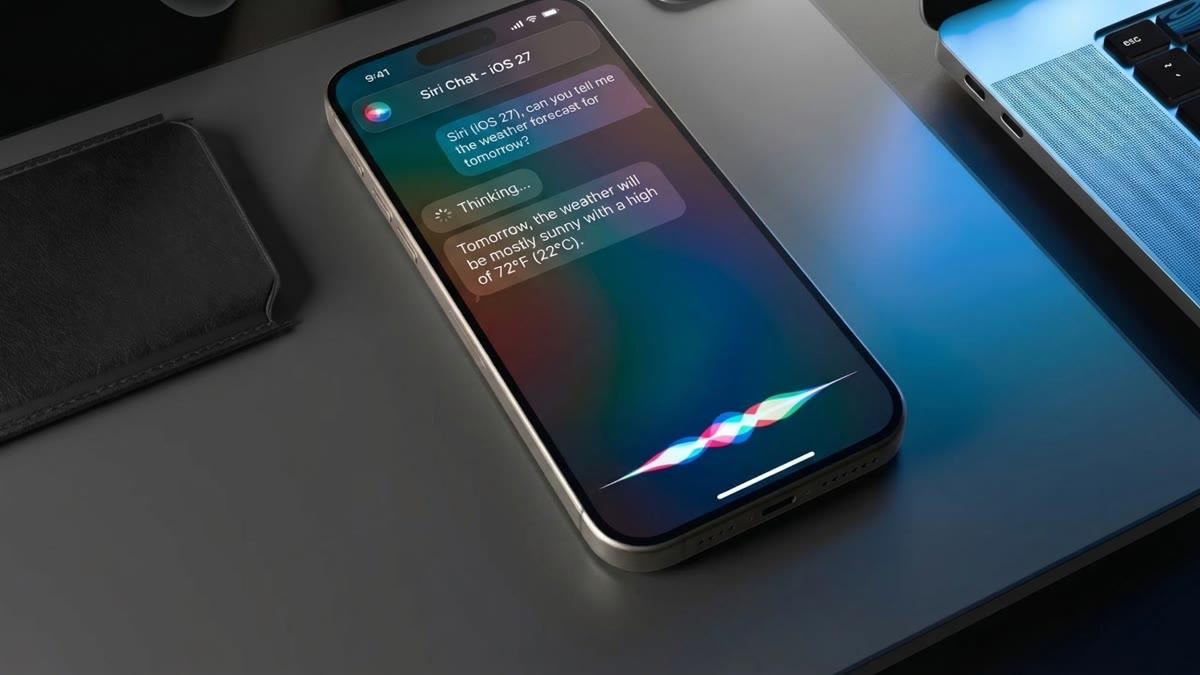
- The concept image's maker. Both outlets ran it uncredited; the 'Siri Chat' label doesn't match Apple's product name, which is why we call it a render.
- Dots and Spark user counts, which neither company has given; OpenAI's pages were unreachable, so Dots' plan details come from press.
- Whether Muse is live on Meta glasses as of today; Meta said 'starting next month' on October 21.
What to watch
- December: iOS 27.3 with Siri AI acting in Apple's apps; Muse Charm shipping; any Rockwell announcement.
- Spring 2027: third-party App Intents open in the App Store, the first day Siri AI can do what Muse does.
- WWDC, June 2027: the earliest plausible stage for an agent and for any new name. We'll update this piece the day either appears.
- Apple's Mac agent controls, promised in October's Full Disk Access note: the first sign of how Apple intends to treat other people's agents on its platforms.
Where these apps rank