
Signals
What Is Gemini 4 Hydrogen? Google's New Fast Model Beats Claude Sonnet 5.5 on 7 of 10 Tests in Google's Own Chart. We Read the Small Print, the Price List and the Free-Tier Rules
By the Top5Apps editorial team · Published November 12, 2026 · Updated November 12, 2026 · 18 min read
Short answer: Gemini 4 Hydrogen is Google's new fast, mid-priced model, and from today it is the Gemini most people will actually use. It answers in Google Search for everyone and is the everyday option in the paid Gemini app. It is good, it is quick, and per token it is twice the price of the Flash model it replaces. Google's chart has it beating Claude Sonnet 5.5 on seven of ten tests. That holds up better than most launch charts, with caveats in the small print and one outside ranking that doesn't check out.
We read Google's launch post, Search post, developer guide, pricing page, model card, the four-page methodology note and all six charts, then checked the outside leaderboards Google cites. We have not run the model ourselves yet. (Disclosure, per The Receipts Standard: this site is produced with Claude-family tools, and Claude Sonnet 5.5 is one of the two rivals in Google's chart.)
Logan Kilpatrick@OfficialLoganK
Introducing Gemini 4 Hydrogen, an extremely capable and fast model built to bring Gemini 4 to everyone! Available to all tiers of Google AI Studio, Gemini API, Gemini for business, the Gemini app, Google Search, and paid Google AI Pro + Ultra subscribers in Google Antigravity.
View original post ↗
The short version
- What it is: the fast, cheaper Gemini 4 model, released November 12. It takes over from Gemini 3.8 Flash and drops the Flash name.
- Who gets it: everyone in Google Search. Paid Gemini app plans from $4.99 in the model menu. Free app users only when Google's auto-selection picks it. Developers get a free, rate-limited API tier.
- Price: $1.50 in and $7.50 out per million tokens, with no launch discount. That is twice what 3.8 Flash costs per token until December 31.
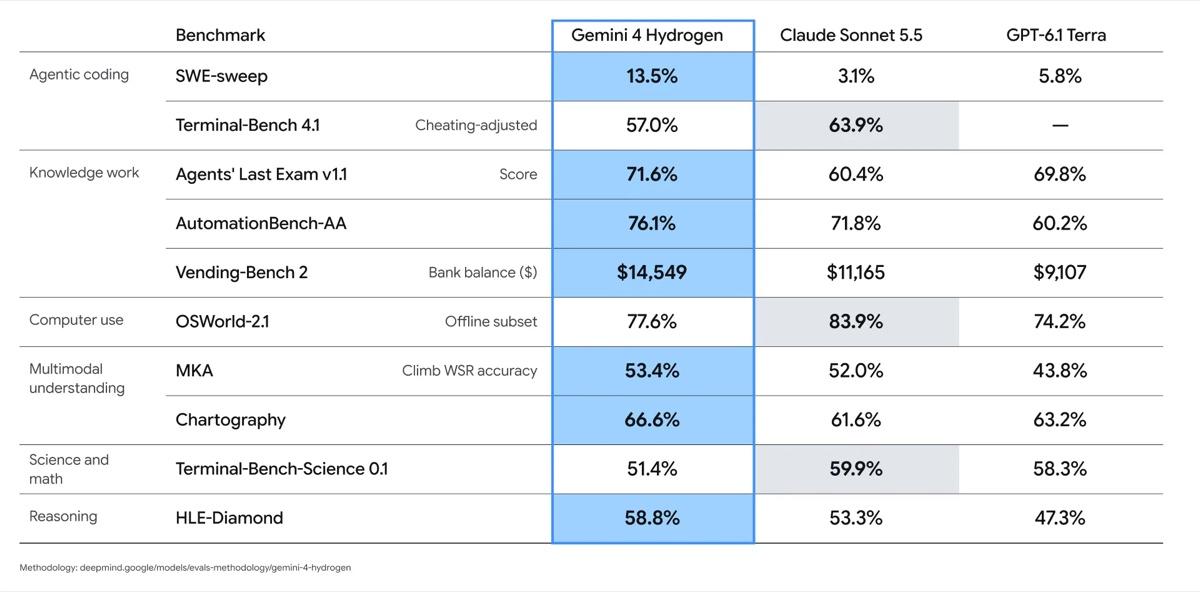
- Google's chart: Hydrogen leads seven of ten rows against Claude Sonnet 5.5 and GPT-6.1 Terra. Sonnet 5.5 leads the other three.
- The small print: the scores use Hydrogen's highest thinking setting, not the default, and Google ran seven of its ten numbers itself.
- What outsiders confirm: 51 at the default setting and 54 at the top one on the Artificial Analysis index, first on Vals's tax benchmark, fifth on Arena's agent board.
- What they don't: Google says Hydrogen ties for first on Vals's legal research test. Vals shows it sixth. And on the one benchmark Google helped design, the independent run puts Hydrogen behind Sonnet 5.5, not ahead.
- Cost per task: far cheaper than Sonnet 5.5 for the same score, about twice the cost of GPT-6.1 Terra for the same score, and faster than both by Google's chart.
- 'One million output tokens': 65,536 per call. More only as a background job, and the million is shared with your input.
- Our read: a strong everyday model and a real upgrade on Flash. Use the default setting, check the bill before you migrate, and don't read the chart as seven clean wins.
What Gemini 4 Hydrogen is
Gemini 4 Hydrogen is the fast, cheaper member of Google's Gemini 4 family, released on November 12, 2026. Carbon and Argon, the two models above it, are built to think for a long time about hard problems. Hydrogen is built to do ordinary work quickly: write the code, run the test, read the PDF, answer the question. Google's launch post calls it a model for 'rapid execution.'
It takes the job the Flash models used to do. Google's developer guide lists it as the 'recommended upgrade from Gemini 3.8 Flash and earlier Gemini 3 and 2.5 models,' and the Flash name is gone from it. The cheaper Flash-Lite stays on sale underneath for quick, high-volume jobs.
- Model ID: gemini-4-hydrogen. The model card says it is 'adapted from Gemini 4 Carbon.'
- What goes in: text, images, video, audio and PDFs. What comes out: text only. It doesn't make images or speech, and it isn't on the Live API.
- Memory: a 1,048,576-token window that the input, the model's thinking and the answer all share.
- Four thinking levels: low, medium, high and a new 'xhigh.' High is the default.
- Knowledge cutoff: March 2026, per the model card.
- Tools: search and maps grounding, code execution, file search, computer use, function calling and structured output are all supported.
Google's headline comparison is with the model it replaces. Against Gemini 3.8 Flash, the company says Hydrogen finishes tasks 2.5 times faster at its default setting, scores 57% where Flash scored 18.2% on the Terminal-Bench 4.1 coding test, and makes up claims less than a fifth as often. Those are Google's measurements of its own two models.
Who gets it, and what 'everyone' means
Kilpatrick's post says Hydrogen is 'built to bring Gemini 4 to everyone.' That is true in a narrower way than it sounds. Here is each place it shows up, from Google's own pages.
| Where | Who gets Hydrogen | The catch |
|---|---|---|
| Google Search | Everyone, in every language AI Mode supports | You don't pick it. Search does. Google's Search post calls this 'the biggest model upgrade to Search yet.' |
| Gemini app, no paid plan | Sometimes | Only through auto model selection. Google's help page says 'most prompts will use Flash-Lite' and prompts needing more reasoning 'may use Hydrogen.' Turn auto off and every answer comes from Flash-Lite. |
| Gemini app on Plus, Pro or Ultra | Yes, in the model picker | Three thinking levels in the app: low, medium and high. The help page doesn't list xhigh. |
| Google AI Studio and the Gemini API, free tier | Any developer | Rate-limited, and Google's pricing page says free-tier data is used to improve its products. |
| Gemini API, paid tier | Any developer | $1.50 in, $7.50 out per million tokens. Thinking is billed as output. |
| Google Antigravity | Paid AI Pro and Ultra subscribers | Not on the free plan. The new Orchestrator mode is Ultra only for now. |
| Gemini for business, Gemini in Sheets | Business customers; Sheets starts with AI Pro and Ultra | Rolling out. |
So the free route is real, but it is Google's choice when you get it. In Search you never choose. In the free Gemini app you get Hydrogen when Google's router decides your question is hard enough. If you want to pick Hydrogen yourself in the app, the cheapest way is the $4.99 Plus plan. According to 9to5Google, the picker labels it 'Everyday help,' between Flash-Lite for 'Quick answers' and Argon for 'Code & analysis.'
For developers the free tier is the generous part. Carbon and Argon have no free API tier at all. Hydrogen does, which makes it the only Gemini 4 model you can build against without a card. Don't send it anything private there.
What it costs
$1.50 per million input tokens and $7.50 per million output tokens, flat across the whole window, with thinking billed as output. There is no introductory discount. That last part is unusual for Google this autumn: Argon, Carbon and 3.8 Flash all launched at half their list price.
The result is an awkward comparison for anyone on Flash today. Gemini 3.8 Flash costs $0.75 and $3.75 until December 31, so Hydrogen is exactly twice the price per token of the model it replaces, for the next seven weeks. On January 1 Flash's discount ends and the two cost the same. (Per token is the key phrase. Independent testing below suggests Hydrogen finishes a job for less.) Further back the trend is plain. Gemini 2.5 Flash, still on Google's price list until its traffic is rerouted to Flash-Lite on December 1, is $0.30 in and $2.50 out. Google's fast tier now costs five times that to read and three times that to write.
| Model | Input | Output | Cached input | Free API tier |
|---|---|---|---|---|
| Gemini 3.5 Flash-Lite | $0.30 | $2.50 | $0.03 | Google's cheapest; free API tier |
| Gemini 3.8 Flash | $0.75 | $3.75 | $0.075 | Doubles to $1.50 and $7.50 on January 1 |
| GPT-6.1 Terra | $1.00 | $5.00 | $0.05 | Prompts over 272,000 tokens cost 2x in, 1.5x out |
| Gemini 4 Hydrogen | $1.50 | $7.50 | $0.075 | No introductory rate; free API tier |
| Claude Sonnet 5.5 | $2.00 | $10.00 | $0.10 | Flat across a million tokens |
| Gemini 4 Carbon | $2.00 | $10.00 | $0.10 | Doubles to $4 and $20 on December 1; no free tier |
Two things in that table are worth a second look.
- Until November 30, Carbon is only a third more. Google's strongest model is still on its launch rate of $2 and $10. For 18 more days the gap between the 'fast' model and the top one is 50 cents per million input tokens. On December 1 Carbon doubles and the gap becomes real.
- Hydrogen sits between its two rivals. It is a quarter cheaper per token than Sonnet 5.5 ($2 and $10) and half again dearer than GPT-6.1 Terra ($1 and $5). Per token is not per task, though. What a job costs depends on how many tokens the model spends getting there, and that is where Google's own charts get interesting.
Our Token Counter now has Hydrogen in it if you want to price your own prompts against the others.
Google's chart, row by row
The table in Kilpatrick's post has ten rows and three models: Hydrogen, Anthropic's Claude Sonnet 5.5 and OpenAI's GPT-6.1 Terra. Hydrogen has the best number in seven rows. Sonnet 5.5 has it in the other three, and Google shaded those cells grey, which is to its credit. Terra leads nothing.
The more useful column is one Google's chart doesn't have: who produced each number. That is in a four-page methodology document linked in small type under the table.
| Benchmark | Hydrogen | Sonnet 5.5 | GPT-6.1 Terra | Who ran Hydrogen's number |
|---|---|---|---|---|
| SWE-sweep (finding and fixing bugs) | 13.5% | 3.1% | 5.8% | Google, on its own Antigravity harness. Rivals from the public leaderboard. |
| Terminal-Bench 4.1 (cheating-adjusted) | 57.0% | 63.9% | no score | Google, at the high setting. Sonnet from the public leaderboard. |
| Agents' Last Exam v1.1 | 71.6% | 60.4% | 69.8% | Google ran both Hydrogen and Sonnet 5.5. Terra from the leaderboard. |
| AutomationBench-AA | 76.1% | 71.8% | 60.2% | Artificial Analysis. |
| Vending-Bench 2 (final bank balance) | $14,549 | $11,165 | $9,107 | Andon Labs. |
| OSWorld-2.1 (offline subset) | 77.6% | 83.9% | 74.2% | Google ran Hydrogen and Sonnet, best of three runs each. Terra from OpenAI's system card. |
| MKA (visual knowledge work) | 53.4% | 52.0% | 43.8% | Google. Rivals from Artificial Analysis, which runs this benchmark. |
| Chartography | 66.6% | 61.6% | 63.2% | Google ran Hydrogen and Terra. Sonnet from Anthropic's system card. |
| Terminal-Bench-Science 0.1 | 51.4% | 59.9% | 58.3% | Google. Rivals from the public leaderboard. |
| HLE-Diamond | 58.8% | 53.3% | 47.3% | Artificial Analysis. |
Read that way, the chart splits in two. On the three rows measured by someone else, Hydrogen leads all three, and by clear margins. We confirmed two of them, AutomationBench and HLE-Diamond, on Artificial Analysis's own site. That is the strongest evidence in the launch and Google undersells it. On the seven rows where Google produced Hydrogen's score itself, it leads four and trails three.
Four things the small print changes
- The scores are not at the default setting. The methodology says results use 'the highest thinking settings unless indicated otherwise.' So the 58.8% and the 76.1% are Hydrogen at xhigh, the new top level, which costs more and takes longer than the high setting you get by default. Google's cost charts show the default scoring about 55% on HLE-Diamond and about 74.5% on AutomationBench. Still ahead, by less.
- The one coding row it loses was run at a lower setting. Terminal-Bench 4.1 is the exception: Google ran it at high, not xhigh. Its own cost chart for the earlier 4.0 version of the test shows why that didn't matter. Hydrogen scores about 57% at high and about 57% at xhigh. The extra thinking bought nothing there. Artificial Analysis's run agrees: 54.0% at high, 53.5% at xhigh.
- MKA is Google's benchmark. Google built it with Artificial Analysis and announced it this week. Artificial Analysis runs the private test set for other models. Hydrogen's score is the one number in the row that Google computed itself, and it leads by 1.4 points. Artificial Analysis's own run of Hydrogen comes out lower, and behind Sonnet 5.5. More on that below.
- The Terminal-Bench chart is not the Terminal-Bench row. The table reports version 4.1. The cost chart reports version 4.0, 'because competitor data was not available for 4.1 across thinking levels.' On that 4.0 chart Sonnet 5.5 reaches about 70% at its top setting, 13 points clear of Hydrogen, at roughly $12.50 a task.
One more, on the rivals. Google says it reports Sonnet 5.5 and Terra at their maximum reasoning settings where the makers published them, and 'best available' results where they didn't. Two of Sonnet's ten numbers come from runs Google did itself. None of this is hidden and none of it is improper. It is what a vendor's launch table is: a fair-minded advertisement.
And one absence. The chart compares Hydrogen with two mid-priced rivals and nothing else. Carbon, Argon, Claude Fable 5.2 and Opus 5.5 are not on it, and neither is the Flash model it replaces. For where it stands against the top tier, see our Carbon and Fable 5.2 comparison: on the Artificial Analysis index Hydrogen's 51 to 54 sits against Carbon's 60 and Fable 5.2's 65.
The charts Google drew about cost
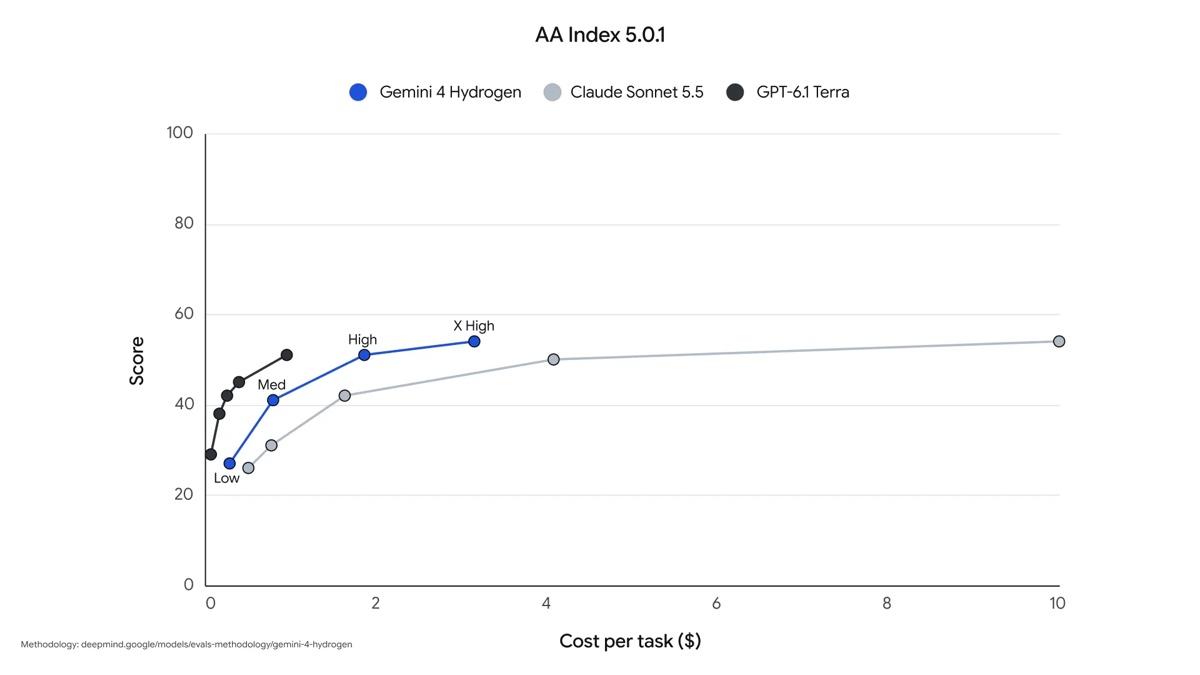
Google published four charts that plot score against cost per task, and a fifth against time. They are the best material in the launch, because they show every thinking level and both rivals, and because they don't all flatter Hydrogen.
- Against Sonnet 5.5, Hydrogen is far cheaper per task. To reach 54 on the Artificial Analysis index, Hydrogen at xhigh costs $3.16 a task. Sonnet 5.5 needs $10.02 to get there. On AutomationBench the picture is the same: Hydrogen's top score costs about 42 cents a task, Sonnet's lower one about a dollar.
- Against GPT-6.1 Terra, it is not. Terra's best setting scores 51.3 for $0.96 a task. Hydrogen's default scores 50.8 for $1.87, nearly twice the cost for half a point less. Terra has no setting that reaches 54, so Hydrogen goes higher. It doesn't go cheaper.
- Hydrogen is the fast one. On Google's time chart, Hydrogen's default reaches 51 in about 6 minutes a task. Terra takes about 14 minutes to get there and Sonnet 5.5 about 15 to reach 50. Artificial Analysis confirms the rivals' times and hasn't published Hydrogen's speed yet, so the 6 minutes is Google's figure for now.
- The last step up is expensive. Going from high to xhigh adds 3 index points for 69% more cost, about twice the time and nearly three times the output tokens (304 million against 110 million across the index). On HLE-Diamond it adds about 4 points and more than triples the cost per task. On Terminal-Bench 4.0 it adds nothing.
The index scores and costs above are Artificial Analysis's published figures, which match Google's chart. The times and the other benchmarks' costs are read off Google's charts by eye, so treat those as approximate. High is the setting to use. Xhigh is for the problem that high got wrong. That matches what Google's own guide tells developers.
What outside testers show on day one
Google's post cites four outside scoreboards by name. We opened each one on launch day. Most of what Google says about them is accurate. Two claims are not what the boards show.
| Google's claim | What the board shows | Verdict |
|---|---|---|
| 51 on the Artificial Analysis index at high, 54 at xhigh, ahead of Argon's 50 | Artificial Analysis lists 50.8 and 53.9. Argon is 50.4. | Confirmed |
| 'Leads its class' on HLE-Diamond at 58.8% | 58.8% at xhigh, 54.9% at the default. Sonnet 5.5 is 53.3%, Terra 47.3%. | Confirmed |
| 'Leads its class' on AutomationBench-AA | 76.1% at xhigh, against 71.8% and 60.2%. Carbon (77.8%) and Argon (77.5%) are higher, but they aren't its class. | Confirmed |
| '#1 overall' on Vals Tax Agent Bench at 52.3% | First of 85 at 52.30%. Carbon is second at 51.78%. | Confirmed |
| '#5 on Agent Arena' | Fifth, marked preliminary, at 14.80% plus or minus 2.23. Sonnet 5.5 is fourth at 16.07%. | Confirmed |
| 'Ties for #1' on Vals Legal Research Bench at 55.8% | Sixth of 94 at 53.85%. The 55.77% at the top of the board belongs to Gemini 4 Carbon. | Not what the board shows |
| 53.4% on MKA, ahead of Sonnet 5.5's 52.0% | Artificial Analysis, which runs MKA, has Hydrogen at 49.5% at xhigh and 47.5% at high. That is behind Sonnet 5.5. | Google's own run; the independent one disagrees |
| 57.0% on Terminal-Bench 4.1 | Hydrogen is not on the public leaderboard. Sonnet 5.5's 63.9% and 3.8 Flash's 18.2% are. | Google's run only |
| 71.6% on Agents' Last Exam | Hydrogen is not on the public leaderboard, and neither is Sonnet 5.5. Terra's 69.8 is. | Google's run only |
The Vals mismatch may have an innocent cause. Leaderboards get rerun, and Hydrogen's 53.85% is within two points of first place. But the figure in Google's post is Carbon's score, and on Vals's page today Hydrogen is not tied with it. We don't know why the two differ.
The MKA mismatch matters more, because it changes the count. Use Artificial Analysis's number for Hydrogen, the same source Google used for the two rivals in that row, and Sonnet 5.5 takes it. The chart then reads six rows to four, not seven to three.
The outside data also adds things Google left out, in both directions.
- The jump from Flash is real, and bigger per task than per token. Artificial Analysis has Gemini 3.8 Flash at 30.8 on its index and Hydrogen's default at 50.8. Its cost per task falls from $7.77 to $1.87, and Artificial Analysis prices Flash at today's discounted rate, so that is like for like. Twice the price per token, about a quarter of the cost per task. The only way both can be true is that Hydrogen gets the work done in far fewer tokens; that is our inference from the two figures. Your own workload may not behave like a benchmark suite, which is why it is worth measuring before you assume either number.
- It makes far fewer things up. On Artificial Analysis's non-hallucination rate, where higher is better, Hydrogen scores 91.5%, against 44.9% for 3.8 Flash, 65.5% for Terra and 56.7% for Sonnet 5.5. That supports Google's 'five times fewer fabricated claims' better than anything in Google's own post.
- In plain conversation it hasn't pulled ahead. On Arena's text board, where people vote on chat answers, Hydrogen is 15th at 1490. Gemini 3.8 Flash, the model it replaces, is 9th at 1497. The gap is inside the margin of error and Hydrogen's score is preliminary, but it is not the leap the coding numbers show.
- Coding is its middle, not its peak. Vals sums it up as 'mid-pack on coding': 11th of 64 on Terminal-Bench 4.0 at 54.04%. Artificial Analysis got 54.0% on the same test and has GPT-6.1 Terra slightly ahead at 55.6%. Google's chart, built from other sources, has Hydrogen well ahead of Terra there.
- Overall it lands just under the top tier. Sixth of 37 on the Vals Index at 68.49%, where Claude Fable 5.2 has 71.31%, and 16th of 78 on Artificial Analysis at its top setting.
Reaction from people who had used it was thin on day one. The Hacker News thread reached the front page within the hour, and the complaints were about price and names more than quality: several readers noted it costs what 3.8 Flash will cost without the discount, and the element names drew a pile-on. One early user reported the model doing more than asked in agent runs. Another praised Google for publishing cost and time charts against named rivals, which we'd second.
The 'one million output tokens' claim
Google's post says Hydrogen 'pairs native 1 million-token input with up to 1 million output tokens.' Both halves are true and they can't both happen at once.
- One window, shared. Input, thinking and output all come out of the same 1,048,576 tokens. Send in 900,000 tokens of documents and about 148,000 are left for thinking and the answer together.
- One call returns at most 65,536 tokens. That is the default and the cap for a normal request, streaming or not.
- Past that, you need background mode. Set 'background' to true and raise 'max_output_tokens', and Google's servers keep going in 64K hops, up to the window minus your input. Leave the limit unset and it stops at 65,536 anyway.
- The limit covers thinking too. The 'max_output_tokens' setting caps thinking and answer combined, so a low cap can cut an answer off before it starts.
None of this is hidden. It is all in the developer guide. But 'up to 1 million output tokens' in a headline means 'a long job you run in the background,' not 'a reply.' For most uses the working number is 65,536, which is the same as Gemini 3.8 Flash.
Moving from Gemini 3.8 Flash: what changes
Google wants Flash users to switch, and its guide is honest about what breaks. If you run 3.8 Flash in production, these are the lines to read before you change the model name.
- The default thinking level goes up. 3.8 Flash defaulted to medium. Hydrogen defaults to high, and thinking tokens are billed at the $7.50 output rate. Swap the model ID and change nothing else, and you are thinking harder at twice the price. The old 'minimal' level is rejected with an error.
- Temperature is gone. The temperature, top_p and top_k settings are ignored if you send them.
- Explicit caching is gone. You can't create a cache yourself. Caching happens automatically on prompts of 4,096 tokens or more, at a 95% discount ($0.075 per million).
- Tool calls must be declared. Asking the model in plain text to emit JSON tool calls, with no tools declared, can return a MALFORMED_FUNCTION_CALL error.
- Grounding costs more than the search fee. Google bills the internal instructions and function declarations it adds when you use search grounding, on top of the per-query charge.
- Batch and Flex are half price. $0.75 in and $3.75 out, if the work can wait. Priority is $2.70 and $13.50.
Google's own advice on the new top level is restrained: xhigh 'increases latency and token use and can cause overthinking on simpler prompts.' Its recommendation is to test all four levels and 'pick the lowest thinking level that meets your quality bar.' That is good advice, and its own charts back it up, as the next section shows.
What the model card adds
The launch post lists a run of safety figures: overreach in agent tasks down by up to 81%, misaligned actions down 12 times, a 96.7% score on an internal honesty test. All of them are Google's internal evaluations, most set against 3.8 Flash, and the document that would let anyone check them isn't out. The model card says the full Safety & Security Report 'will be available in the coming days.'
- It refuses more. The model card's own table shows unjustified refusals up 5.57 percentage points against 3.8 Flash, 'particularly for multimodal prompts.' The launch post highlights a different figure, false refusals under 0.4% on one health benchmark. Both can be true. Only one made the blog.
- It is safer with images. Image-to-text safety improved by 7 points on Google's automated test. Text and multilingual safety were roughly flat.
- It was not put through the full frontier test suite. Google judged it not materially more capable than Argon and ran targeted tests instead. It found Hydrogen below its critical thresholds for biological and cyber misuse, but past the 'alert' thresholds for both.
- It can still be slow. The card's limitations section warns of 'occasional slowness or timeout issues' and says the model 'may use more tokens to maximize performance, especially at higher thinking levels.'
Who should use it, and how
- You use the free Gemini app. Leave auto model selection on. That is the only way Hydrogen reaches you, and with it off you are on Flash-Lite for everything.
- You pay for Plus, Pro or Ultra. Hydrogen is the sensible everyday pick in the model menu. On Pro, keep Argon for code and long analysis. More thinking uses more of your allowance, so medium is a reasonable habit for ordinary questions.
- You run Gemini 3.8 Flash in production. Don't rush. Until December 31 Hydrogen costs twice as much per token and thinks harder by default. Artificial Analysis's numbers suggest it may still finish jobs for less, but that is a benchmark suite and not your workload. Run your own tasks at medium and high, set the thinking level yourself, and compare the bills. On January 1 the price argument for staying disappears either way.
- You are choosing a mid-priced model from scratch. Going by Google's own charts: Hydrogen if speed matters most, or the job involves video and audio, which it reads natively. GPT-6.1 Terra if cost per task matters most. Claude Sonnet 5.5 for terminal-style coding and computer use, the rows where it leads, if you can afford what its top setting costs.
- You want to build on Gemini 4 without paying yet. Hydrogen is the only one with a free API tier. Prototype there. Don't put customer data through it.
- You need Google's best and it is still November. Look at Carbon first. Until the 30th it is $2 and $10, a third more than Hydrogen.
Our read
Hydrogen may be the most consequential model Google ships this year, and it is the least glamorous. Carbon gets the benchmarks. Hydrogen gets the traffic: it now answers in Google Search for everyone, which puts a model that scores level with Argon, Google's flagship a month ago, in front of anyone who types a question into Google. For ordinary users that is the whole story, and it is a good one.
For developers the picture has more edges. It is faster than its rivals, much cheaper per task than Sonnet 5.5, and a large step up from Flash on every outside measure we could find except chat preference. It is also twice Flash's price per token for the next seven weeks, dearer per task than GPT-6.1 Terra for the same score, and still behind Sonnet 5.5 at terminal coding and computer use. The top thinking setting mostly buys a bigger bill.
On the chart: seven of ten is fair as Google drew it, and Google deserves credit for shading its losses and publishing its method. But the method is where the count comes from. The scores are at a setting most people won't use, most are Google's own runs, one benchmark is Google's own design, and one of the outside rankings it quotes doesn't match the board. Six of ten, with clear wins where outsiders did the measuring, is the more defensible reading. That is still a good result.
Rankings: no movement today. Gemini stays where it is; we have updated its review to reflect who gets Hydrogen and will re-score it at the weekly refresh, once we have used the model ourselves. We will update this page when Google publishes the safety report, when Artificial Analysis posts speed figures, if Vals or Google corrects the legal-research discrepancy, and on January 1 when 3.8 Flash's discount ends. If you are weighing it against the top tier instead, start with Carbon against Fable 5.2. Google's other launch this week, a model that only returns decisions, is explained here.
Where these apps rank