
Signals
What Is Personal Finance in Claude? Read-Only Bank Access Through Plaid, Explained: What Claude Can See (Two Years of Transactions), What It Can't Do, the One-Question Test to Run Before You Trust It, and the Privacy Boundaries the Announcement Blurs
By the Top5Apps editorial team · Published November 8, 2026 · Updated November 8, 2026 · 13 min read
Claude can read your bank data now, but it can't move your money. That is the whole product, and the boundary is the design story. Personal Finance in Claude, announced November 5 and rolling out in beta to Pro, Max and Ultra subscribers in the US, lets you connect bank, card, loan and investment accounts through Plaid and ask about them in plain English: what you spent on food, what's left before payday, whether a week in Rome fits. Anthropic's own words: 'Access is read-only, and Personal Finance can't move, manage, or invest your money.' The read-only token can leak what you have; it cannot drain it. What that token does expose, in Anthropic's list, is each connected account's name, type and last four digits, balances and credit limits, and up to 24 months of transactions with merchant, amount, date, category and the bank's description. Read-only is not the same as low-stakes.
This piece does three things. It draws the line between reading a transaction and authorizing one, because that line is what makes this safer than the agents that shop for you. It runs the test Anthropic itself recommends, asking one spending question of a statement and tracing the answer to the exact rows, on a synthetic statement we built, and then applies the same test to the numbers in Anthropic's own launch video, which do not reconcile. And it lays out the data and privacy boundaries you should understand before you sign in to your bank through Plaid: what Claude keeps, what it trains on (the exclusion is narrower than the headline), where the feature doesn't work, and what unlinking does and doesn't delete. Sources are Anthropic's announcement, its help article, Plaid's post, the launch post on X, and the competitors' own pages, read on November 8.

The short version
- What it is: a 'Personal Finance' hub in Claude's sidebar where you link US bank, credit-card, loan and investment accounts (up to 16 banks) through Plaid and ask money questions in chat, with a dashboard of budgets, categories and recurring charges. Beta, US only, Pro ($20), Max ($100) and Ultra ($200); not Free, Team or Enterprise. On claude.ai, Claude Desktop, iOS and Android, 'rolling out gradually, so you might not see it yet.'
- What it can do: read. Balances, credit limits, 24 months of transactions. For investments and loans it reads balances and limits only, 'not holdings, trades, rates, or terms.'
- What it can't do: 'move, manage, or invest your money.' It never sees your bank password; Plaid does the login. It also doesn't work in scheduled tasks, Cowork, Claude Code or Claude Duet, and 'may not be able to use them in a project.'
- The privacy line that matters: 'When you chat with Claude in the Personal Finance hub, those conversations aren't used to train our models. For anything you share with Claude outside the hub, your privacy settings apply.' The carve-out is the hub, not the data. By default Claude can read your linked accounts in any chat without asking each time.
- Anthropic's own warning: 'Claude can make mistakes in its answers, so ask which transactions are behind a number, and check important figures with your bank.' Balances can be 'a day or two old'; an account linked through two logins 'may be counted twice'; it 'isn't designed to give investment advice.' We ran that test on a synthetic statement and on Anthropic's launch frames; both are below.
- Against the field: ChatGPT launched 'Finances' with Plaid in May and has opened it to all plans, but per Engadget its finance chats follow your general training setting. Gemini reads Plaid-linked accounts via Google Wallet. Meta's Muse connects Plaid too and is the one that also shops; Grok Bot added read-only Plaid in September. Claude is the last of the four to arrive and the most conservative about what it will do with the access.
Claude@claudeai
Introducing Personal Finance in Claude, in beta in the US. Connect the accounts you choose, and Claude answers your money questions in everyday language, from your own balances and transactions. Access is read-only, and Claude can't move, manage, or invest your money.
View original post ↗
The launch post, with a 91-second video, had 11.2 million views, 45,900 likes and 20,000 bookmarks by November 8. The frames in this piece are from that video. The announcement itself lives on claude.com, not on Anthropic's newsroom, and names no bank partner; PYMNTS noted it arrived ten days after Anthropic filed to list on Nasdaq, and Reuters tied the launch to the IPO in its first line. TechCrunch's framing was that Claude is 'playing catch-up' to ChatGPT's May tools, which is fair on the calendar and, as the privacy section shows, not quite fair on the terms.
Beat one: reading a transaction is not authorizing a payment
Every AI agent that touches money sits on one side of this line or the other, and the side decides what a wrong answer costs. Meta's Muse, our top-ranked personal agent, connects to Plaid and also browses to checkout pages and buys; our safety guide exists because a mistaken purchase there is your money gone and, per Meta's own fine print, your problem. Claude's Personal Finance is built so the wrong answer is a wrong number on a screen. Plaid's chief technology officer put it in one sentence in Plaid's post: 'Claude's access to connected accounts is read-only, so it can't move money.' Anthropic says the same thing twice in its help article and once more in the announcement, and the plan for 'life's bigger money decisions' is explicitly to work 'alongside the licensed professionals and regulated firms they trust,' not to replace them.
Two consequences follow. First, the feature is useful in exactly the way a good spreadsheet is useful, and no more: it can tell you that your fixed costs are $4,089 and your flexible spending is where the room is, which is the example in the video, but it cannot cancel the subscription it found or move the surplus to savings. Second, the thing you are protecting when you connect is not your money but your picture: two years of where you were, what you bought, who you paid, how much you owe and to whom. That is the most sensitive dataset most people have, and it is why the rest of this piece is about what happens to it.
How to turn it on, with Anthropic's exact labels
- 1. Open 'Personal Finance' in Claude's side menu. 'If you don't see it, hover over More.' If it isn't there at all, you're on the wrong plan, outside the US, or the rollout hasn't reached you.
- 2. 'Get started', then choose goals or skip, then 'Continue'.
- 3. 'Link accounts with Plaid'. On the 'Connect Plaid to Claude' screen, review what Claude will be able to access, then 'Continue'. Plaid opens in a new window on the web, your default browser on Claude Desktop, inside the app on iOS, or a browser tab on Android; Anthropic says to finish within ten minutes.
- 4. In Plaid, choose your bank, sign in there (Claude never sees the password), and choose which accounts to share. US banks only, up to 16.
- 5. Back in Claude, 'Link another account' or 'Done'. Transactions 'can take a few minutes to sync.'
- To unlink: Personal Finance › the '…' menu (gear icon on mobile) › 'Manage linked accounts' › 'Unlink', then 'Unlink' again. Unlinking removes every account under that bank login; 'you can't unlink a single account.' You can also cut Claude off from Plaid's side at my.plaid.com.
- To stop Claude reading accounts in ordinary chats: the '+' menu › 'Connectors' › turn Plaid off. By default it 'reads your linked accounts without asking each time.'
Beat two: one question, every row behind the answer
Anthropic's advice is the right test: 'ask which transactions are behind a number.' We don't have the beta, so we built a statement to run it on: 86 synthetic transactions over September and October 2026 for an invented household (two paychecks a month, rent, utilities, four subscriptions, and the usual groceries, dining, transport and shopping), with every row labeled by us. The question was 'How much did I spend on groceries in October?' The correct answer is eight transactions totaling $515.13, and here they are:
The arithmetic is trivial. The judgment is not, and it lives in five places a chat answer can hide. Row count: an answer that says '$515' without saying 'across eight transactions' cannot be audited. Category: 'Whole Foods' is groceries on our statement because we said so; on a real one, Plaid's category or your bank's description decides, and a lunch bought there becomes groceries. Dates: calendar October or 'the last 30 days' change the answer by a weekend. Pending charges: Anthropic says transactions can take minutes to sync and balances can be 'a day or two old,' so the two most recent rows may be missing. Refunds: a $49.14 return would appear as a negative row and a careless sum would miss it. A good answer lists its rows; a bad one gives you a confident number. Ask for the rows every time until you've seen it get them right.
Then we applied the same test to Anthropic's launch video. Two frames carry numbers, captured by us and shown here editorially:
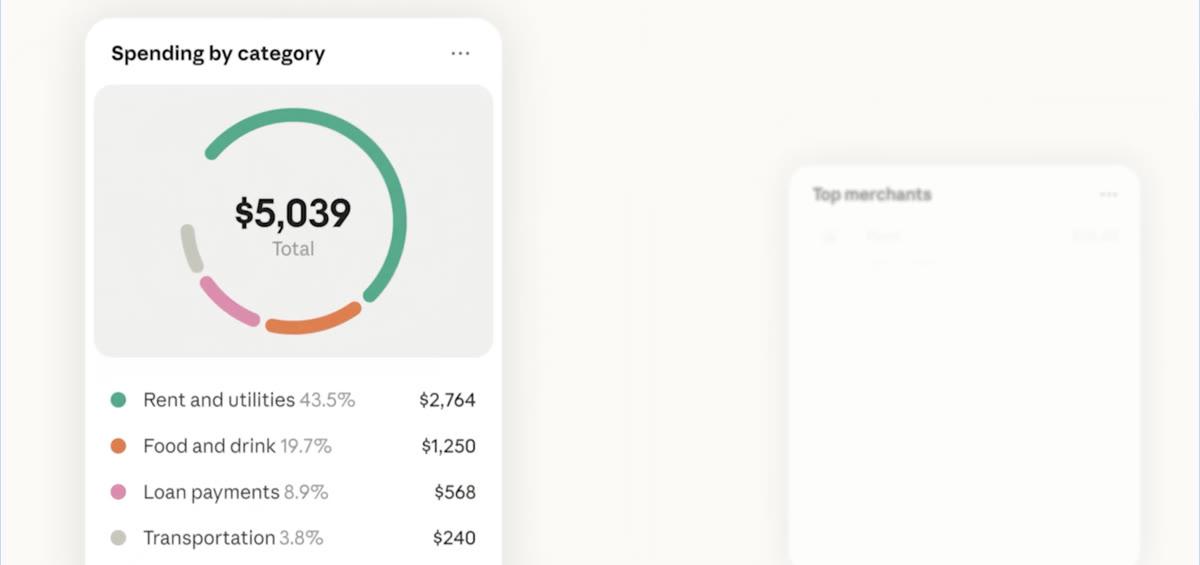
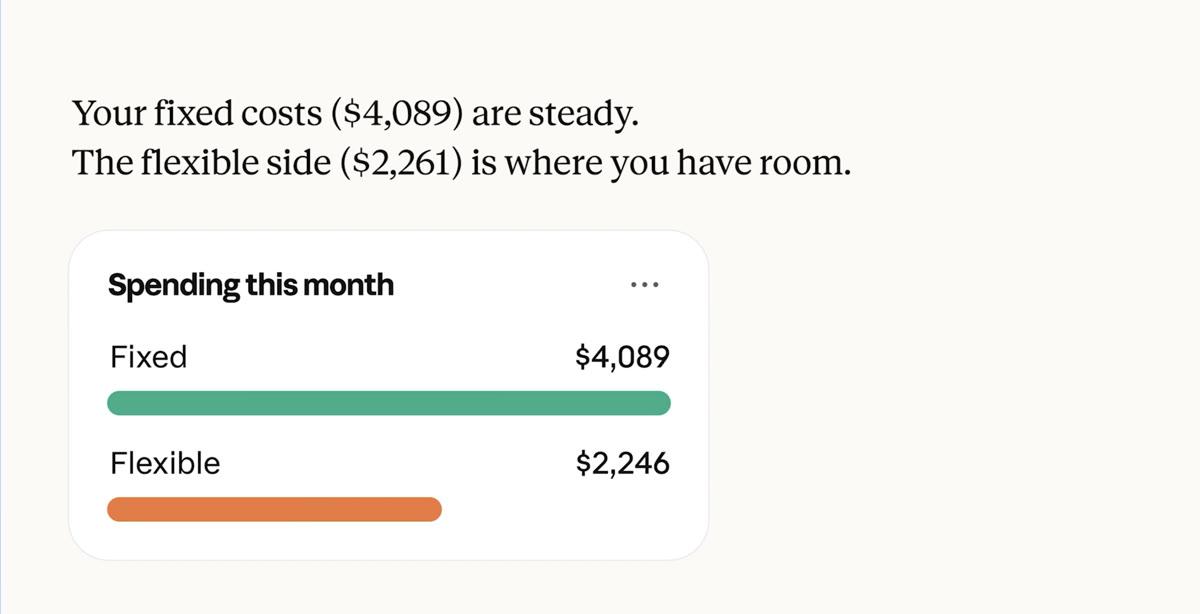
In the frames we captured, the numbers don't agree with each other. On the category card, $2,764 is 54.9% of the $5,039 shown in the donut, not the 43.5% printed beside it; all four percentages are consistent with a base of about $6,335, which is exactly what the second card's fixed and flexible lines add up to ($4,089 plus $2,246). And the sentence above that card gives flexible spending as $2,261 while the card beneath it reads $2,246, a $15 gap. The charitable reading, and probably the true one, is that these are animated graphics whose counters were still moving when the frame was captured, and that the donut's 'Total' and the list's percentages describe different scopes. We are not suggesting the product miscounts; we had no account to test. We are suggesting that the launch video is a perfect demonstration of Anthropic's own advice: a number on a card is not an audit, and the sentence and the card can disagree by a lunch. The worked example in the written announcement uses different figures entirely ($4,309.37 spent this month, $1,024.51 on food and drink, $1,393.22 left before payday), which reconcile fine.
Beat three: the boundaries to understand before you connect
- What Claude receives, in Anthropic's list: bank names; account names, types and last four digits; balances and credit limits; 'up to 24 months of transactions, including the amount, date, merchant, category, and your bank's description.' Not full account numbers, not your password, and for investments and loans 'not holdings, trades, rates, or terms.'
- Training, precisely: chats inside the Personal Finance hub are not used to train models. Chats outside the hub follow your privacy settings, and by default Claude can pull your linked accounts into any chat. If model training is on in your settings and you ask about your balance in an ordinary conversation, nothing in Anthropic's text excludes that conversation. The mitigation Anthropic offers instead: once Claude has used your accounts in a chat, 'it's designed not to save anything from that chat to memory or search that chat later,' and it leaves it out of your monthly recap. The simplest control is to ask money questions in the hub, or to turn the Plaid connector off in the '+' menu for everything else.
- Retention: the data 'appears in your conversation and stays in your chat history until you delete the chat,' subject to Anthropic's retention practices. Unlinking a bank stops future reads but 'what Claude already said stays in your chats, and in any artifacts or shared links until you remove them.' There is no stated deletion window for synced data; ChatGPT, by contrast, says synced data is deleted 30 days after disconnecting. Delete the chats and artifacts yourself.
- Three parties: 'The service providers that host Claude for us also handle bank data. Plaid handles it under its own terms and privacy policy.' Plaid's end-user policy and its my.plaid.com portal are where you see and revoke what Plaid holds. If you've connected Muse, Grok Bot or ChatGPT through Plaid before, the same portal lists them.
- Where it doesn't work: scheduled tasks, Cowork tasks, Claude Code, Claude Duet, possibly projects. Data exports 'don't yet include your saved Personal Finance dashboard.'
- When you stop paying: 'you can't open Personal Finance, and Claude can't read your accounts in chats. Your banks stay linked until you unlink them.' Deleting your Claude account unlinks them automatically. Unlinking the last bank wipes the dashboard, budgets and setup answers, 'and this can't be undone.'
- No Privacy Center article yet. The announcement links to the consumer privacy collection, and none of its 28 articles, the data-retention article (dated July 1), the training article (March 16) or the privacy policy (effective September 10) mentions Plaid or financial accounts. Everything above comes from the announcement and the help article, which was 'updated this week' with no date shown.
Claude vs ChatGPT Finances vs Gemini vs Muse vs Grok Bot
| Claude Personal Finance | ChatGPT Finances | Gemini (Google Wallet) | Meta Muse | Grok Bot | |
|---|---|---|---|---|---|
| Launched | Nov 5, 2026 (beta) | May 15, 2026 | Sept 2026 | Sept 2026 (Plaid) | Sept 26, 2026 |
| Plans | Pro, Max, Ultra; US | All plans incl. Free, per press; US | US, 18+, 'Keep Activity' on | Free and paid; US | Grok Bot plans |
| Aggregator | Plaid | Plaid | Plaid-linked via Wallet | Plaid | Plaid |
| Can move money or buy | No, by design | No ('cannot make any changes') | No ('make transactions' excluded) | Yes: browses and buys with confirmation | No, 'read-only' |
| Sees your bank password | No (Plaid login) | No | No | No | No ('never sees your logins') |
| Training on finance chats | Excluded inside the hub; settings apply outside | Follows your general training setting (Engadget) | Per Google's activity settings | Opt-out toggle covers all interactions | Not stated |
| Data deletion after disconnect | No stated window; chats persist | 30 days after disconnecting (TechCrunch) | Not stated | Reset Muse; 'may still remember' | Not stated |
| Credit score | No | Yes (since Sept) | Experian (Sept 23) | No | No |
The comparison most people will make is with ChatGPT, which did this first and has opened it to free users, added credit scores and, as of this week, voice. Engadget's November 7 head-to-head lands on the same point we do: the core function is similar; the defaults differ. ChatGPT's finance conversations follow whatever training setting you chose for ChatGPT as a whole, default on; Claude carves out the hub regardless of your setting and declines to remember the chats. The comparison that matters for risk is with Muse, which pairs Plaid with an agent that spends. One caution about our own earlier coverage: we have described Muse's Plaid access as read-only; Plaid's post on Muse lists what's shared (balances, transactions, investment holdings, mortgage data) without using those words, and Meta's page is unreadable to our tools, so treat 'read-only' there as Meta's claim pending re-verification, and read our Muse guide for what the buying side can do.
Our read
Anthropic shipped the boring half on purpose, and the boring half is the one you'd want from a company about to list on Nasdaq. A read-only connection, a hub whose chats are excluded from training, a refusal to remember the conversations, no ads, no products of its own, and a sentence in the launch copy telling you to check the figures with your bank. That is a product built by people who assume the model will sometimes be wrong, and the launch video proved them right in the gentlest possible way. What it isn't yet is an agent: it can see the subscription you forgot but not cancel it, see the surplus but not move it, and it is walled off from Duet and Cowork, the parts of Claude that act. The useful way to use it this month is the way we tested it: one question, ask for the rows, check the arithmetic, and only then ask the bigger one about Rome. We'll rank it when we can run it; Claude is fifth among personal agents precisely because it is the most conservative, and this launch is more of the same.
What we could not verify
- The product itself. None of our accounts had the beta on November 8, so the synthetic test is a method, not a result, and the launch-video discrepancies are observations about animated frames, not about the shipping product.
- In-product text, including the 'Connect Plaid to Claude' review screen and any in-chat disclaimer; Anthropic's help article names the screen but doesn't publish its wording.
- Refresh cadence. Anthropic gives none beyond 'a few minutes to sync' and balances 'a day or two old'; Plaid says it refreshes 'when needed.'
- OpenAI's primary pages for ChatGPT Finances were unreachable; its plan expansion, credit-score and training details are from TechCrunch, American Banker and Engadget.
- Meta's own read-only statement for Muse's Plaid connection, as noted above.
- The help article's date; it shows only 'Updated this week.'
What to watch
- Rollout breadth: whether 'gradually' means days or weeks, and whether Team plans follow. The help article currently excludes Free, Team and Enterprise.
- A Privacy Center article for Personal Finance, and whether Anthropic adds a deletion window for synced data to match ChatGPT's 30 days.
- Duet and Cowork: the day the read-only data meets the parts of Claude that act is the day the design story changes. Today it is explicitly walled off.
- The S-1 angle: Anthropic's filing lists regulatory risk; a consumer finance feature ten days later invites the question of whether it will stay read-only. We'll update the IPO explainer if the prospectus addresses it.
Where these apps rank