
Guides
How to Make the Stromae 'Alors on Danse' AI Video (Altman and Amodei in the Studio — and What That Clip Actually Is)
By the Top5Apps editorial team · Published October 3, 2026 · Updated October 3, 2026 · 5 min read
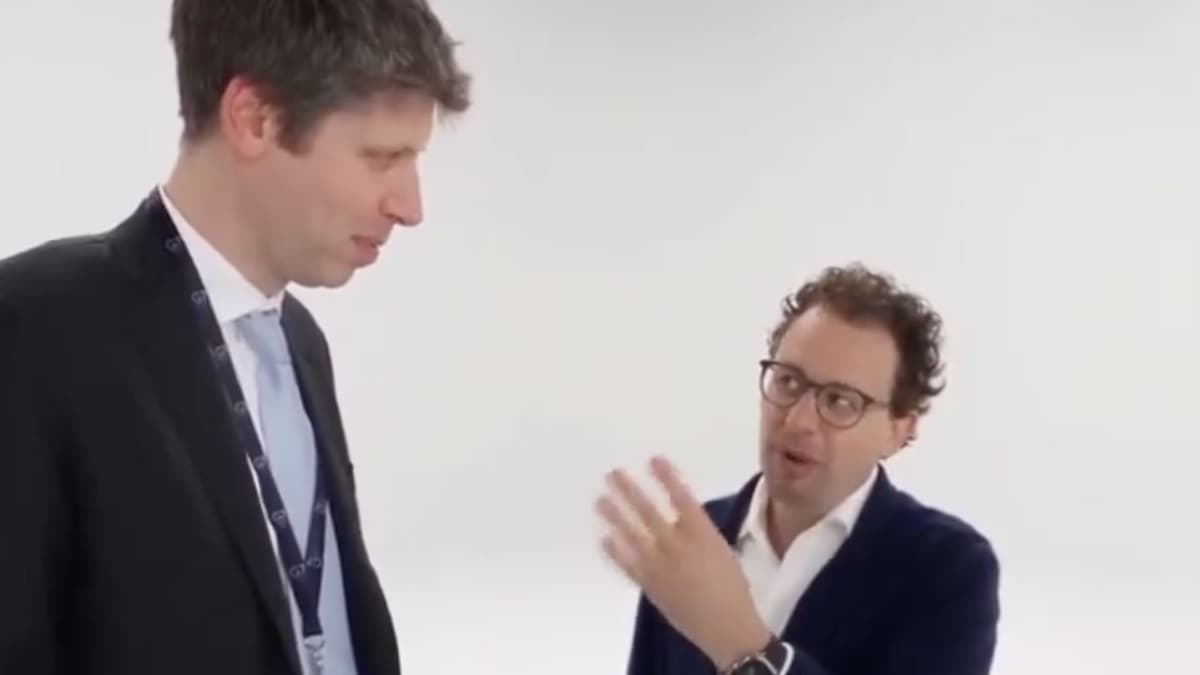
Short answer: it's the same two-person reference swap as Hotel Lobby and White Chicks — a famous two-shot where the room, the props, the timing, and the track stay, and the two faces change. This weekend's version puts Sam Altman standing at the left, in Stromae's spot, and Dario Amodei at the laptop and mini keyboard on the right, building the hook of 'Alors on danse' and jogging toward the camera; the first copy, from @spydenator, hit 198,000 views in a day. Neither poster shared a tool or a prompt, so the method below is a reconstruction. And the clip you're copying isn't what the captions say. It isn't a making-of or a studio session: it's a scripted comedy sketch from Jamel Debbouze's 2010 DVD Made in Jamel, in which Jamel pretends to teach Stromae his own song. That changes who owns it, and it's the best joke in the whole trend.
What the clip actually is
Stromae released 'Alors on danse' in September 2009 — written and composed by him alone, co-produced with Dimitri Borrey — and it went to No. 1 in nineteen countries; the official video is past 567 million views and the song crossed a billion Spotify streams this August. Stromae did make real how-I-built-it videos, his Leçons: Leçon n°8 is 'Alors on danse,' uploaded May 2009, and it's a live performance at a microphone. The white-cyclorama clip with the laptop is something else. It's from Made in Jamel, a DVD of sketches released December 1, 2010 (Kissman Productions), in which Jamel Debbouze, in a beige cardigan at a MacBook, 'gives Stromae a little push' toward the hit — the French Wikipedia entry on the song notes the sketch is written to suggest Jamel was its author. Jamel, on the DVD: 'On donne l'impression d'improviser mais tout est écrit, sinon on court à la catastrophe' — we make it look improvised, but everything is written. Stromae's label, Mosaert, calls it 'the playful moment with Jamel Debbouze, who cheekily pretended he'd composed the hit himself.' So: a comedian pretending to be the genius behind a pop song, now replayed with two AI CEOs. The format was already a parody; the swap just changed who's claiming credit.
What stays, what changes
- Stays: the white studio, the desk, the laptop and mini keyboard, the pointing and clapping on the beat, the jog toward camera, and the track.
- Changes: the two faces and the clothes. Any two photos work the same way; the pairing is the joke.
- Length: both viral copies are exactly 30 seconds — a single Seedance 2.5 or Genjutsu pass — cut from a six-minute sketch.
How to make it (reconstructed — nobody published this one)
- 1. Trim the source to the 20–30 seconds you want. The segment that works has one beat per shot: keys, clap-and-point, close-up, jog.
- 2. Two reference photos, front-facing, even light, one person each. Left is the standing man, right is the one at the keyboard.
- 3. Pick a two-person-capable tool. Seedance 2.5 with references (the trimmed clip as @Video1, the photos as @Image1 and @Image2) or Higgsfield Genjutsu Motion Transfer. Not Kling Motion Control on its own: Kling's guide says to 'upload a single character motion reference' — with two people 'the motion of the character occupying the largest portion of the frame will be used' — so it only works one shot at a time.
- 4. Prompt (ours, not the posters'):
Replace the two men in @Video1 with the people in the reference images. @Image1 replaces the man standing on the LEFT; @Image2 replaces the man at the laptop on the RIGHT. Take only each person's face, hair, and body from the images; dress them as they appear in their photos. Keep everything else from @Video1 exactly: the white studio, desk, laptop, keyboard, camera, cuts, timing, gestures, and audio. Do not change the room, add anyone, or swap sides.
- 5. Generate three to five times and keep the one where nobody changed sides and the keyboard didn't grow keys.
- 6. Cut in CapCut, label it AI, and read the next section before you leave the original audio under it.
Rights: three real people in the source, two more in the swap
This one stacks more likenesses than any trend we've covered. The footage is Kissman Productions', not Stromae's; the song's master is Mosaert's ('2009 © & ℗ Mosaert'), with its publishing administered by Warner Chappell under a deal renewed this March; Stromae and Jamel Debbouze are real people in the original; Altman and Amodei are real people in the copy who performed none of it. A 30-second clip with the track underneath is not licensed by anyone's template, and Stromae has shown he'll act when the song is used in ways he doesn't like — in 2019 he reportedly threatened legal action over a Belgian political rally's use of it, per the Brussels Times. On AI specifically, Stromae has said nothing, and that silence is itself part of the story: the reply 'Stromae about to fall victim again to another ai trend' refers to the AI 'Papaoutai' cover that went viral in January — 14 million Spotify streams in its first month, No. 2 on Billboard's World Digital Song Sales chart, 235,000 TikTok posts within weeks — on which Stromae 'has not publicly commented' and Universal Music France declined to; Universal now distributes it, with Mosaert credited. Aron Ottignon, who co-composed the original 'Papaoutai,' called AI 'just a new instrument.' Take that as tolerance, not permission.
- Make it a parody, label it AI, don't post it as a real session. Two tech CEOs 'inventing' a Belgian pop hit reads as a joke to everyone; the frame where it stops being funny is a caption that implies it happened.
- Public figures in parody is the most defensible version of a face swap; your friends, with their permission, is the safest. Private people who didn't agree is neither.
- The track is the exposure. If you need it to survive on a platform that fingerprints audio, expect a claim; if you're doing anything commercial, you need a license from Mosaert and nothing here is one.
- Credit the actual source: 'Re-creation of the Alors on danse sketch from Made in Jamel (2010) with Jamel Debbouze and Stromae.' Most captions call it a making-of; be the one that gets it right.
Our read
The best AI swaps are of scenes that were already performances, and this is the purest case yet. The 'making of' everyone thinks they're remixing was a comedian's bit about taking credit for someone else's genius — which is also, if you squint, what the Altman-and-Amodei version is about. That's why it lands harder than a random celebrity pairing would. Technically it's a solved problem: a two-person reference swap, 30 seconds, one pass, the same stack as Hotel Lobby. Editorially the lesson is to know your source — the footage owner, the real people in it, and the fact that Stromae's hit now lives a second life in AI covers he hasn't blessed. Our White Chicks guide shows what it looks like when the original performers have embraced it; this one shows the more common silence. Our AI video ranking covers the tools for everything that isn't a two-shot.
Where these apps rank