
Signals
Why Is AI Bringing Down Design Jobs While PM Jobs Explode? We Checked Lenny's Numbers. Design Openings Did Hit a Record Low, PM Hiring Isn't Growing, and the Count Changed Since March
By the Top5Apps editorial team · Published November 13, 2026 · Updated November 13, 2026 · 17 min read
Short answer: AI is part of the reason design openings fell, and the popular version of the story overstates both halves of it. Open design roles at tech companies fell by about a third this year, and the engineering roles that build screens fell even faster, which points to AI tools. PM jobs aren't exploding, though. Companies listed about the same number of PM roles in October as in March, and US employers are hiring slightly fewer PMs than they did two years ago.
We read the free part of Lenny Rachitsky's report and all 17 charts in it, his report from March, the two data providers' own pages, and nine outside sources. One finding surprised us: the design count in the famous ratio was redefined between Lenny's last report and this one. (Disclosure, per The Receipts Standard: this site is produced with Claude-family tools, and Claude appears in this data as the second most-requested design skill.)
Lenny Rachitsky@lennysan
STATE OF THE TECH JOB MARKET IN 2026 Twice a year, I dig into trends in hiring and job openings. This is the fifth report I've done, and the most surprising yet: 1. PMs are winning in the AI era 2. Engineering demand has stalled 3. Design openings are at a record low 4. Every role now requires AI skills 5. Tech jobs are concentrating in the Bay Area 6. Remote roles are at a record low 7. The tech job market is growing fast, but mostly outside of software (gasp!)
View original post ↗
The short version
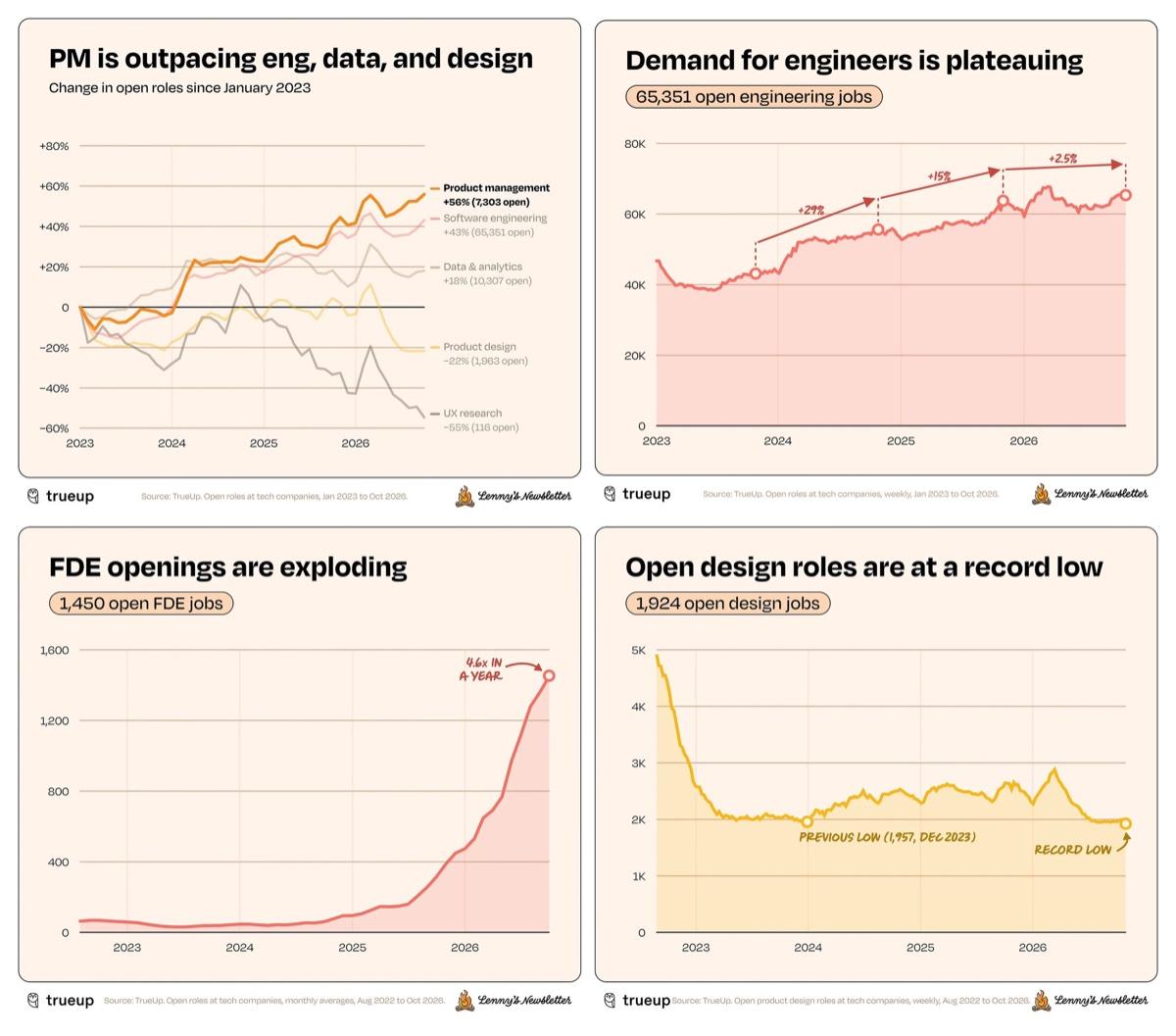
- Lenny Rachitsky's report is accurate on its headline numbers. Tech companies list about 1,900 open product design roles, a record low and 28% fewer than a year ago, against 7,303 open PM roles.
- PM jobs aren't exploding. Companies listed about the same number of PM roles in October as in March, and US employers hired 4% fewer PMs than they did at the start of 2024. PMs are losing the least, and hiring is growing only for PM roles with AI in the title.
- Design fell twice. Most of the long decline happened in 2022 and 2023, before AI design tools worked. The second fall, of about a third, happened between March and October of this year.
- The count changed. TrueUp reclassified its design category after March. Lenny's March report showed 5,716 design jobs and a ratio of 1.27. Nobody should compare those figures with November's 1,924 and 3.8.
- The best evidence for an AI effect is in engineering. Front-end openings fell 51% in a year and mobile openings fell 39% to 47%. The roles that draw and build screens shrank together.
- PMs and engineers are doing more design. In one survey, 40% of designers said PMs and engineers at their company now do more design work.
- Other sources are calmer. The US government still projects 6% growth for digital designers by 2035, and 82% of design hiring managers told Figma their need for designers rose or held steady.
- Our read for designers: show the decisions behind your screens, keep a log of them, learn to ship a prototype, and search outside tech.
What Lenny's report says
Lenny Rachitsky publishes a job-market report twice a year, and his late-2026 edition came out on November 10. His post about it has passed 1.5 million views. The report draws on two datasets that measure different things, and the difference between them matters for everything that follows.
- TrueUp counts open roles. TrueUp tracks job postings at more than 9,000 tech companies worldwide. Its numbers show how many people companies say they want to hire.
- Live Data Technologies counts hires. The company tracks job changes for 124 million professionals, and the report uses its US figures. Its numbers show how many people actually started a job at a new employer, in any industry. Its method leaves out contractors, freelancers and internal moves.
| Role | Open roles worldwide | Change in open roles | US hires, past 12 months | Change in hires since January 2024 |
|---|---|---|---|---|
| Product management | 7,303 | Up 75% from the March 2023 low | 32,600 | Down 4% |
| Software engineering | 65,351 | Up 2.5% in a year | 113,000 | Down 17% |
| Product design | 1,924 | Down 28% in a year, a record low | 12,600 | Down 26% |
| User research | 108 | Down 86% since 2022, a record low | 1,800 | Down 36% |
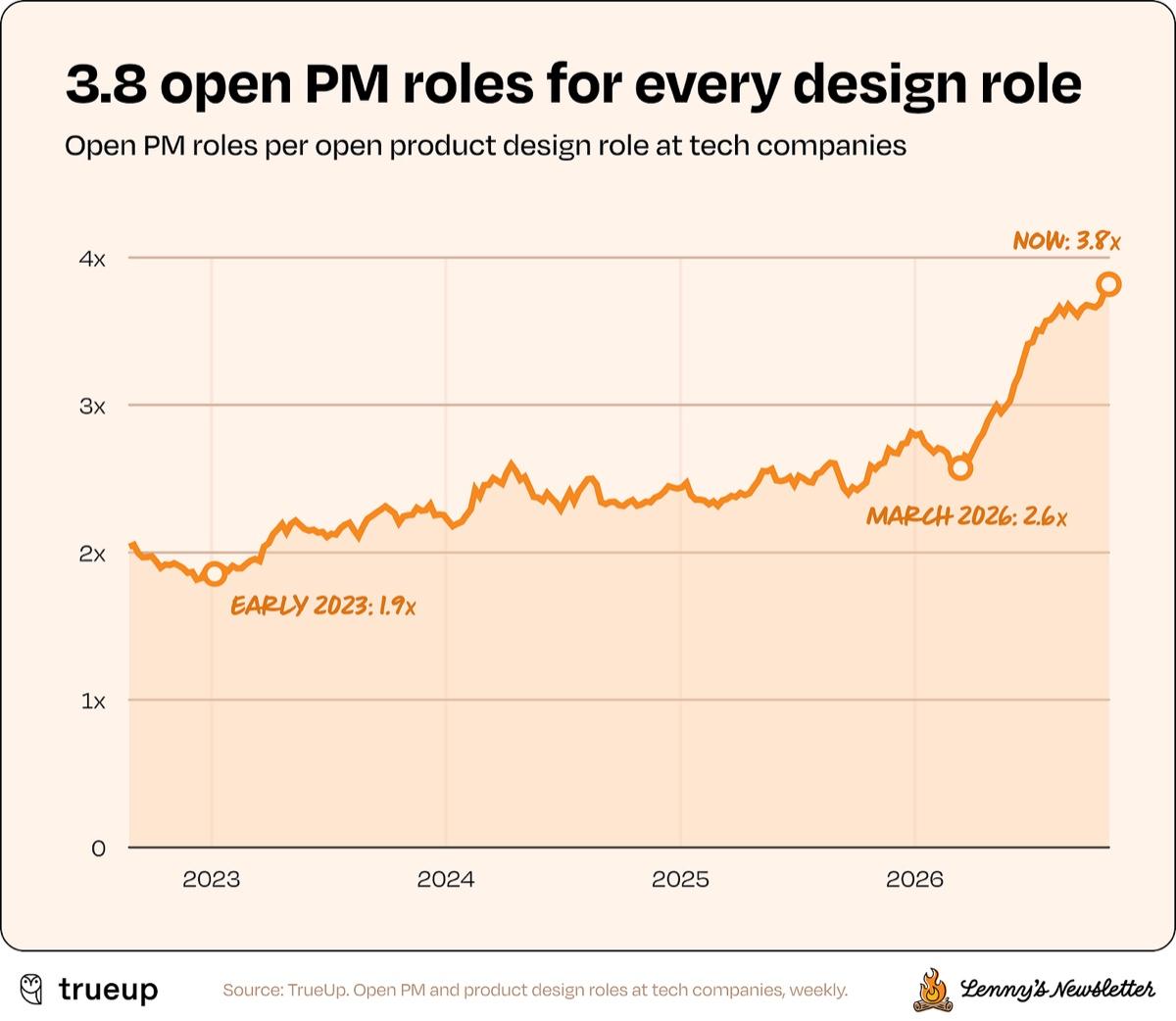
The number that travelled furthest is the ratio. Tech companies now list 3.8 open PM roles for every open design role. On TrueUp's current count, the ratio was 1.9 in early 2023 and 2.6 as recently as March, so most of the widening happened in the last seven months.
The hiring data points the same way with smaller numbers. US employers hired about 2.9 PMs for every designer over the past year, up from 1.9 in 2022. Designers made up 9% of hires across the five core product roles in 2021, and they make up 7% now. PMs went from 16% to 21%.
Lenny offers a theory for the design numbers. He thinks product teams now move too fast for the traditional design and research process, and that teams have grown comfortable shipping early and learning after launch. He's also hopeful that the trend reverses once companies see design as a way to stand out from AI-generated sameness.
Four things the headline leaves out
The numbers above are accurate as far as we can check them. The popular summary of them, that AI is killing design while PM jobs explode, claims more than the data shows in four places.
1. Companies aren't hiring more PMs
PM openings are up 75% from their low point, and that low point was the bottom of the 2023 tech layoffs. Lenny's own chart starts in August 2022 with about 10,000 open PM roles, so today's 7,303 is still roughly a quarter below where the chart begins. We read that starting figure off the chart, so it's approximate.
The hiring data is flatter still. US companies hired 32,600 PMs over the past 12 months, which is 4% fewer than the pace in January 2024. Calendar-year PM hiring in 2025 was 34,000, down 35% from 2022. PMs are holding up better than every other product role, and they're still being hired in smaller numbers than four years ago.
PM openings haven't grown since the spring either. Lenny's March report showed 7,379 open PM roles, and the November report shows 7,303. The ratio climbed from 2.6 to 3.8 over those months because design openings fell by about a third while PM openings stayed flat.
Live Data Technologies published its own PM analysis in October, and it's blunter than the report. US employers hired about nine PMs from outside for every ten PMs who left in 2025, against 1.15 hires per departure in 2022. From February to June 2026, outside PM hiring ran 7% to 10% below the same months of 2025. Hiring grew in one corner only: PM roles with AI or machine learning in the title ran 11% higher.
Lenny reads the gap between rising openings and flat hiring as a sign that good PMs are getting harder to find. That's one reading. A posting that stays open for months also counts as an opening every week it's listed, so slow hiring can inflate the openings number by itself. The data in the report can't separate those two explanations.
2. Design fell twice, and the first fall wasn't about AI
The design chart has two drops in it. Open design roles fell from about 4,900 in August 2022 to about 2,000 by early 2023. That drop tracked the wider tech layoffs, and it happened before any AI tool could produce a usable interface.
Design openings then moved sideways for three years. They sat between 2,000 and 2,900 from 2023 through early 2026, while PM and engineering openings climbed back. The second drop is recent. Design openings peaked near 2,900 in early 2026 and fell to 1,924 by late October, which took them just under the previous low of 1,957.
So the fair question about AI concerns two periods. Design never got the recovery that PM and engineering got from 2023 to 2025, and then design fell again in 2026. AI is a reasonable suspect for both, and the next section weighs the evidence. The 60% collapse that makes the long-run chart look so dramatic belongs to 2022.
3. TrueUp changed what it counts as a design job
Readers who remember Lenny's last report will notice a mismatch. In March, the same data source showed 5,716 open design jobs, up 32% from the low, under the chart title 'Design roles have plateaued.' The PM-to-design ratio in that report was 1.27. The November report shows 1,924 design roles and gives the March ratio as 2.6.
TrueUp reclassified its design category between the two reports. TrueUp's design report now carries the note 'Historical estimates adjusted for consistent job classification,' and Lenny's November charts label the series 'product design.' A footnote in his report probably explains the change, but the footnote sits behind the paywall and we couldn't read it.
The old category was broader. TrueUp's March list of the twenty companies with the most open design jobs included the chipmakers AMD, Qualcomm and Analog Devices and the game makers Ubisoft, Epic Games, 2K and CD Projekt. None of those seven companies appears on the November list. We infer that the old count included chip designers and game designers, and that the new count is a cleaner measure of product design.
The reclassification matters for two reasons. Nobody should compare March's 5,716 with November's 1,924 and conclude that two-thirds of design jobs vanished in eight months. And every earlier point on the November design chart is TrueUp's estimate under the new definition. TrueUp measured the 28% fall consistently within that revised series, so we treat the fall as real, with the caution that it rests on a restated history.
4. Openings aren't jobs
Every figure in the headline counts job postings at tech companies. None of them counts how many designers are employed. A company that stops posting design roles but keeps its design team shows up in this data as a decline.
The openings data also covers tech companies only. Lenny's follow-up on user researchers shows why that limit matters. Almost half of the researchers who took another research job moved to a company outside tech, and banks, financial firms and insurers hired about one in seven of them.
The hiring data is the better guide to real employment, because it counts US hires by employers in every industry. It confirms the direction and softens the scale. US employers hired 12,600 product designers in the past year. That's less than half the 27,600 of 2022, and it still means about 240 designers started a new job every week.
One gap remains in the hiring data. Live Data Technologies leaves out contractors and freelancers, so a designer who leaves a staff job to freelance or to work on contract drops out of the count. Nobody in this report measures how much design work moved to that kind of arrangement.
So why did design fall while PM held up? Five explanations, weighed
With those corrections made, a real gap remains. Design openings fell by about a third between March and October while PM openings held steady, and designers' share of hiring across the core product roles has slipped from 9% to 7% since 2021. We found five explanations with evidence behind them. They aren't rivals, and we think most of them are partly true.
1. AI tools made screens cheap to produce
The strongest evidence for an AI effect sits in the engineering half of Lenny's report. Front-end engineer openings fell 51% in a year. Android, iOS and mobile engineer openings fell between 39% and 47%. Those are the engineers who build what designers draw, and their openings fell faster than design openings did. Backend, platform and security openings grew over the same year.
We read that pattern as companies hiring fewer people whose main output is an interface, which fits what AI tools became good at in 2026. Anthropic launched Claude Design on April 17 for designers and for people without design training, and named founders, product managers and marketers as the audience. TrueUp's revised design series peaked in early 2026 and fell through the months that followed.
Companies' own job descriptions support the same reading. 'Claude' became the second most-mentioned skill in design job descriptions this spring, and 'Cursor' passed CSS. Companies are asking the designers they do hire to produce more with AI tools, which lets a smaller design team cover the same product.
The evidence against a pure AI story is Figma. Figma reported third-quarter revenue of $391 million, up 43% in a year, and said about two-thirds of its larger customers added full seats when they renewed. Those results don't fit a picture of companies shedding designers in large numbers, although Figma also sells seats to people who aren't designers. Claude Design's launch and the drop in design openings also happened in the same months, and nobody has shown that one caused the other.
2. PMs and engineers now do the first draft of the design
A survey of designers run in early 2026 by Designer Fund and Foundation Capital asked how AI had changed their teams. Forty percent said PMs and engineers at their company now do more design work, and 65% said they themselves do more work that used to belong to a PM or an engineer.
That finding would explain how PM demand can hold up while design demand falls. We read it this way: a PM who can produce a working prototype with an AI tool brings a designer in later and for less of the project. Companies' PM job descriptions point the same way, because 'LLM' is now the most-mentioned skill and Claude and Cursor both appear in the top eight.
The same survey limits how far this explanation goes. Only 8% of designers said the ratio of designers to engineers or PMs had shifted at their company, and half said their teams had made no significant structural change. Nineteen percent said their company had cut headcount while expecting the same output or more. So far, people are trading tasks across roles more often than companies are restructuring their teams.
3. Teams ship first and test later
This explanation is Lenny's own. He argues that AI lets engineers build so quickly that teams have less time, and less appetite, for a design phase and a research phase before launch. Teams release earlier and learn from real usage.
User research is the evidence. US employers hired about 1,800 user researchers in the past year, down 66% from 2022, and tech companies worldwide list only 108 open research roles. Research hiring fell further than hiring for any other role in the report. We can't test Lenny's explanation directly, because nobody in this data measures how long teams spend on design before they ship.
4. Design never recovered from 2022, and AI didn't cause 2022
Most of the long decline came before generative AI was useful. Indeed's Hiring Lab studied the wider tech market in July 2025 and found tech job postings 36% below their February 2020 level. Its economist Brendon Bernard wrote that nearly half of the decline from the peak happened before ChatGPT's public release, and that he found no 'smoking gun' linking the drop to AI.
Bernard did allow that AI might explain why tech postings hadn't bounced back. That distinction fits the design chart well. The 2022 crash hit every role. PM and engineering openings then recovered, and design openings didn't. AI is a candidate for the missing recovery. The crash that came first had ordinary causes, and the usual two are the end of near-zero interest rates and the unwinding of a pandemic hiring boom.
5. The count misses where designers are hired
Part of the gap may be measurement. TrueUp reads public job postings, and design roles may be posted less often than other roles. Lena Kul, a former design recruiter, wrote this week that only one of the 17 clients she worked with last year posted its design role online. The rest hired through recruiters and referrals because public postings drew hundreds of applications that took weeks to sort.
Kul's experience is one recruiter's, and it doesn't explain a change over time unless companies stopped posting design roles more than they stopped posting PM roles. The hiring data, which doesn't depend on postings, still shows design hires falling. We think off-board hiring softens the openings number without reversing the trend.
Titles are the other measurement problem. A company that hires a 'design engineer' or a 'product builder' is hiring for design work under a title that a design category may not catch. We couldn't find out how TrueUp classifies those titles.
What other sources show
Lenny's report is one view of the market, built on two private datasets. We looked for independent numbers that could confirm or contradict it. The public data is thin, and what exists is less alarming than a record-low headline.
| Source | What it measures | What it shows |
|---|---|---|
| US Bureau of Labor Statistics | US employment of web and digital interface designers | 132,700 jobs in 2025, projected to reach 140,800 by 2035, a 6% rise. The bureau adds that AI 'may soften' that growth. |
| Figma, March 2026 | A survey of design hiring managers | 82% said their need for designers had increased or held steady. Only 20% said the industry is improving. |
| Designer Fund and Foundation Capital, early 2026 | Design leaders' hiring plans for the next 12 months | 28% plan to grow their teams, 32% expect to stay flat, 10% expect to cut and 21% aren't sure. |
| Live Data Technologies, October 2026 | US PM hires against PM departures | 0.89 outside hires per departure in 2025, down from 1.15 in 2022. |
| AcademyUX, November 9 | A tracker of design job postings | 20,726 product design postings, up 22.8% in three months. The page states no source or method, so we give it little weight. |
These sources don't agree on the size of the problem, and none of them shows design employment collapsing. The surveys show design leaders who mostly plan to hold or grow their teams and who also feel that the industry is getting harder. That combination matches a market where the work continues and the open seats are scarce.
What designers can do about it
Tech companies in this data want fewer people to produce screens, and they still need people who can decide which screens are worth producing. A designer can't change that market, but a designer can change what a hiring manager sees. These five moves follow from the numbers above.
- Show the decision behind each screen. A portfolio of finished screens proves a skill that AI tools now imitate. A portfolio that explains what the team had to decide, which options you weighed and why you chose one proves judgment. Add a short paragraph on the decision to every case study.
- Keep a decisions log on every project. Write four lines each time you make a real call: the question, the options, your choice and the reason, and what happened after launch. Keeping the log takes you a few minutes a week, and you'll draw on it for your next portfolio and your next interview.
- Learn to ship a working prototype. Companies now name Claude and Cursor next to Figma in their design job descriptions. A designer who can turn a concept into something clickable in an afternoon covers part of the front-end work that companies have stopped hiring for. Our guides to AI code editors and AI website builders compare the tools, and our Figma credits guide explains what Figma's own AI features cost.
- Look beyond tech companies. TrueUp tracks about 9,000 tech companies and nothing else. Among user researchers who moved to another research job, almost half joined an employer outside tech, and banks, financial firms and insurers hired about one in seven. Designers should search those employers too.
- Take location seriously. One in four open design roles is now in the Bay Area, and only 19% of open design roles offer remote work, down from 34% earlier in Lenny's data. A remote-only search now reaches about a fifth of a market that's already small.
A move into product management looks like the obvious response to these numbers, and the one piece of evidence in the report says it's uncommon. Of 2,779 US user researchers who changed jobs in 2024 and 2025, about 2% became PMs, while 17% moved into design. The report has no equivalent figure for designers. We'd treat a PM switch as possible for a designer who already runs discovery and writes specs, and as a long shot for anyone who would be starting from zero.
What PMs should take from it
PMs have the best numbers in the report, and a PM job is still harder to land than those numbers suggest. Companies posted more PM roles while they hired about the same number of PMs, so the longer list of openings hasn't turned into more offers.
- The job description changed. 'LLM' is now the most-mentioned skill in PM job descriptions, at 11% of postings, ahead of SQL at 9%. Claude appears in 5% and Cursor in 3%. Two years ago, the top four were SQL, Jira, AWS and Python.
- Companies expect PMs to build. We read a posting that names Cursor as a request for a PM who can prototype an idea without waiting for a designer or an engineer. If that reading is right, the same expectation helps explain why PM openings can rise while design and front-end openings fall.
- Evaluation is the next skill on the list. Lenny notes that 'evals', the practice of testing an AI feature's answers systematically, has reached the top ten PM skills and expects it to keep climbing.
- Remote PM roles held steady. About 21% of open PM roles offer remote work, a share that hasn't moved in two years, while remote design and engineering roles kept shrinking.
A PM who reads this report as proof of safety is reading only the openings chart. A PM team that now does first-draft design and research work without designers and researchers also carries the risk of shipping products that nobody tested with a real user.
Our read
AI is bringing down one kind of design job, and the claim that PM jobs are exploding doesn't survive a look at the hiring data. Companies are hiring fewer people to produce interfaces, whether those people are called designers or front-end engineers. Companies are hiring about as many PMs as before, and the growth sits in roles that work on AI products.
We think the most useful way to read the 3.8 ratio is as a measure of which work companies still pay a new person to do. AI tools can now produce a usable first screen quickly, so fewer companies open a role for that task. Nobody has automated the decision about what to build and for whom, and companies keep the role that carries that decision. Designers make those decisions every day, and a designer who can show them on the page is competing for the work that's growing.
We'd also keep the numbers in proportion. TrueUp tracks openings at about 9,000 tech companies, it redefined design this year, and Lenny's count is 33 roles below the previous low. US employers still hired 12,600 product designers in the past twelve months. The design job market is smaller and harder than it was, and designers are still getting hired every week.
The data also carries a risk for the companies doing the cutting. A team that ships without a designer and without user research will learn about its mistakes from customers. Lenny says he's hopeful that design becomes a differentiator again as AI-made products start to look alike, and we agree that the companies cutting deepest are the ones most likely to prove him right.
We'll update this page when Lenny or TrueUp explains the reclassification publicly, and when the next edition of the report arrives in the spring. We cover the tools named in these job descriptions in our guides to AI code editors and AI website builders, and we looked at how Claude is moving into office work in Claude Sheets vs Excel.
Where these apps rank