
Guides
How to Make an AI 'Drama Ad' Like Koriderm's — the Beat Sheet, the Pipeline, and the Half of It You Shouldn't Copy
By the Top5Apps editorial team · Published October 7, 2026 · Updated October 7, 2026 · 9 min read
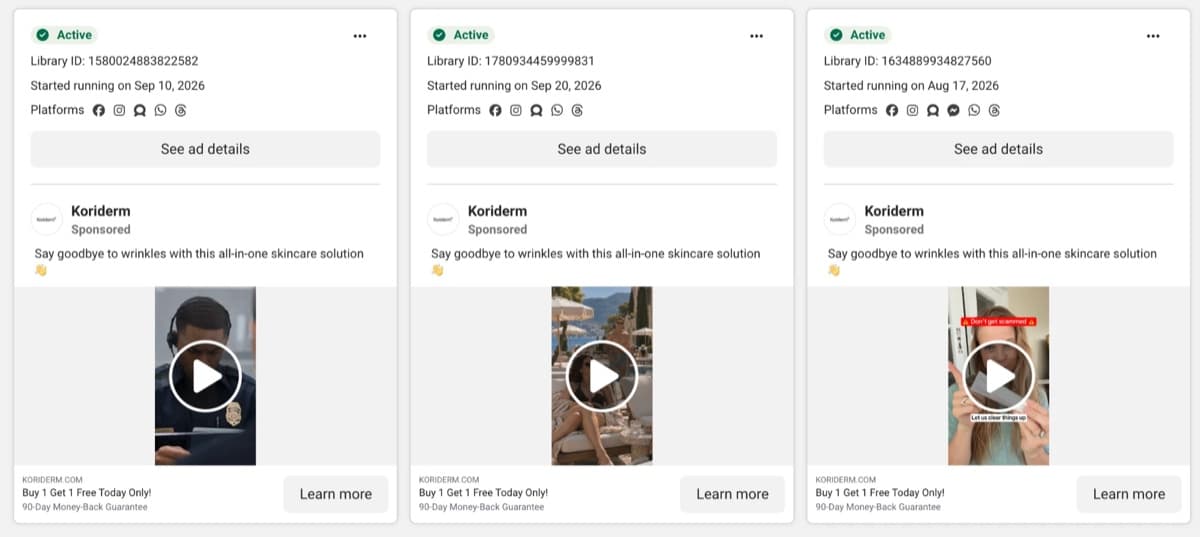
Short answer: write a story with a deadline that isn't the sale, lock two faces on character sheets, generate it in five-to-eight-second beats with a video model that does dialogue, lay a recorded voice under it, burn captions, and put the product in a hand only after the viewer is invested. That's the structure behind the ads growth marketer Dennis Willeboordse flagged on October 6 — 'Koriderm is crushing it with these drama ads… over 1,500+ active ads… How far are we off from short form Hollywood films being used as ads?' The count is real: Meta's Ad Library shows roughly 1,600 active Koriderm ads worldwide and 340 inactive, with drama-length videos running 4:07, 4:32, 7:44, and 8:17. Koriderm hasn't said what it uses, so the pipeline below is a reconstruction. But the beats aren't — we pulled the poolside ad and checked every line of the breakdown against it. The part this guide spends as much time on: the brand behind the format is a two-year-old Wyoming LLC with a 3.8 Trustpilot, subscription-cancellation complaints, and sales figures that contradict each other across its own ads. Copy the structure. Don't copy the claims.

What the ads are
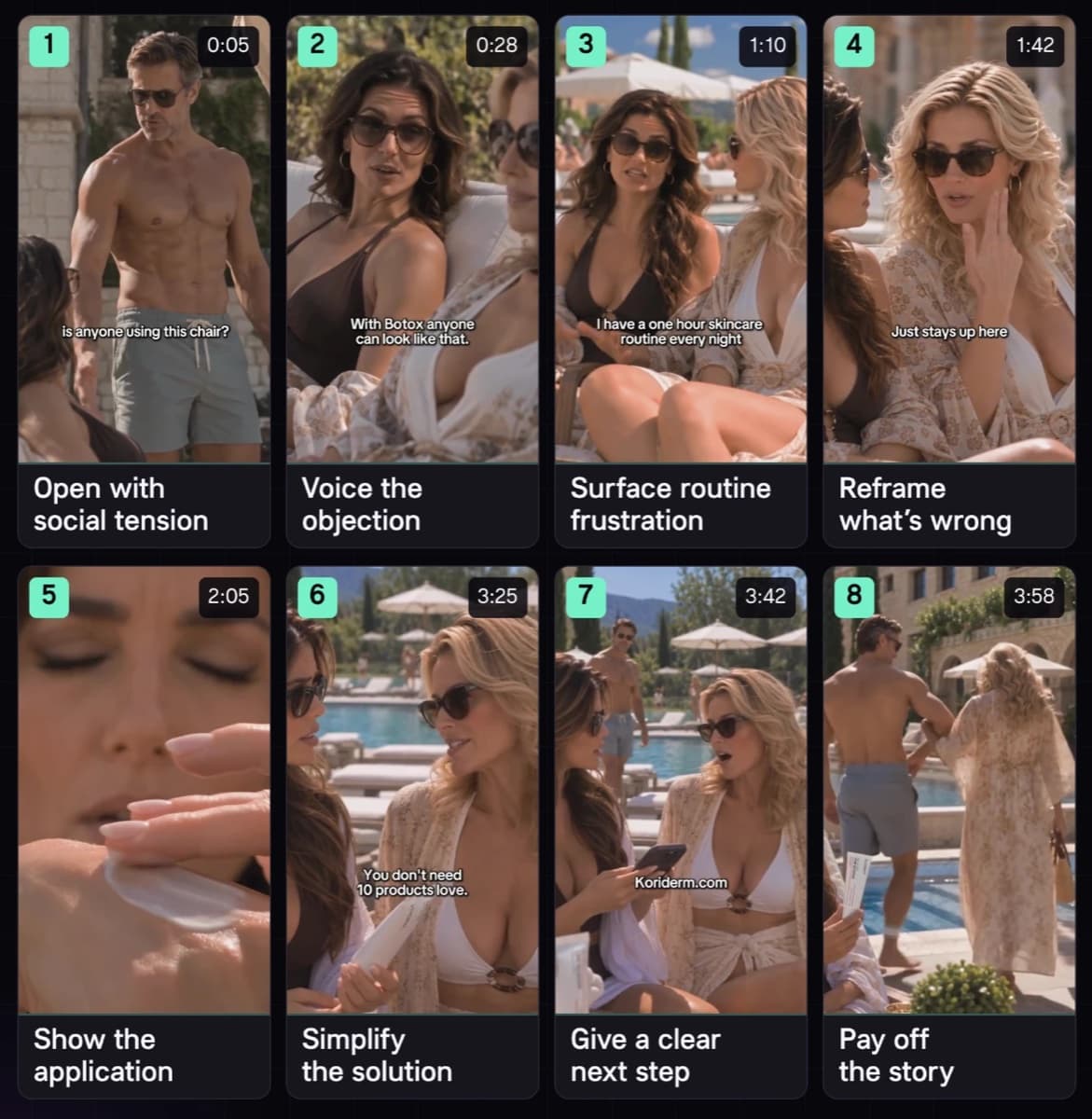
Koriderm sells one product — a $89 'Time Reverse Cream (All-In-One),' usually bundled — and runs at least four distinct AI story ads alongside conventional discount creative. The poolside drama (4:07, running since September 20): a shirtless man asks two women if a chair is free, one says 'With Botox anyone can look like that,' the other admits to an hour-long nightly routine, a close-up shows cream going on, 'You don't need 10 products love,' a phone screen reads 'Koriderm.com,' and the couple walks off together. The passport ad (1:00, since September 10): a 63-year-old is told her passport photo 'doesn't look like you,' she's about to miss a flight with a reunion three weeks away, and the cream enters only after that — ad-intelligence firm Atria's breakdown calls it 'Story → curiosity → tension → product → offer. Old-school direct response. Just disguised as entertainment for the Meta feed.' An office-counter drama (about 4:32), and a 3:18 Pixar-style animation with no human actors, in which a store employee confesses she pushed a $300 jar for commission, then is caught recommending the cheap tube. Atria's wider point, from a September 14 post: Koriderm's four best ads 'look like they came from 4 completely different brands' — a story, a 50%-off static, a 'last day' video, a Vogue-style static — 'testing different psychological reasons for why someone should care.'
The beat sheet, verified
- 0:05 — Open with social tension. 'Is anyone using this chair?' A line a person would say out loud, not a benefit. The hook is under three seconds.
- 0:28 — Voice the objection. 'With Botox anyone can look like that.' The skeptic says what the viewer is thinking.
- 1:10 — Surface the frustration. 'I have a one hour skincare routine every night.' The problem is effort, not aging.
- 1:42 — Reframe what's wrong. 'Just stays up here' — the mechanism, in a gesture.
- 2:05 — Show the application. A fingertip and cream, once. The first product shot is two minutes in.
- 3:25 — Simplify. 'You don't need 10 products love.'
- 3:42 — One next step. A phone screen reading 'Koriderm.com.' No price in the dialogue.
- 3:58 — Pay off the story. The couple walks off. The end card: 'Your future face starts now.'
The passport ad compresses the same shape into a minute: hook ('this passport photo doesn't look like you'), pressure (a flight, a reunion), escalation ('I look like my mother'), one mechanism line ('Korean peptide complex… its own collagen again'), product, then the end card — 'BUY ONE GET ONE FREE / TWO TUBES FOR $79 / 90 DAY MONEY BACK GUARANTEE.' The invariant across both: the deadline is never the sale. It's a chair, a flight, a photo.
How to make one (reconstructed)
- 1. Script first, dialogue only. 45–90 seconds for live-action drama; two to three minutes for an animated narrator. Write it in Claude or ChatGPT as dialogue with no camera directions, and make every beat carry a line — the ad has to work on mute, because captions are the ad. Beat sheet: hook under three seconds; a deadline that isn't the sale; the obvious fix fails; one mechanism sentence that is true of your product; the product once, in a hand; one-line CTA.
- 2. Lock two faces. A character sheet per person — front, three-quarter, profile, same clothes — from GPT Image or Nano Banana 2.1; reject any sheet where the face changes between panels. The product is a photo of your real bottle, not a generated jar. (Our Jean Phil guide covers sheets.)
- 3. Generate in beats of five to eight seconds. Seedance 2.5 or Kling 3.0 with the sheet as image reference; both now generate dialogue with lip-sync, and Veo 3.1 added 'richer dialogue and storytelling' plus native 9:16 in January. One shot is the chair, one the lounger, one the phone, one the cream. Don't ask for the whole ad in one generation — dialogue shots drift; keep them short and cover with the voice.
- 4. Voice and cut. Record the script or use a voice tool, lay it under the picture, burn captions, cut 9:16 in CapCut. The product shot is the last new image, not the first.
- 5. Variations are a new hook, not a new film. Same footage, new first line, new voiceover — that's how one set of generations becomes twenty ads, and it's consistent with Ad Library entries showing '8 ads use this creative and text.'
Now the half you shouldn't copy
The brand. Koriderm is JPCommerce LLC of Cheyenne, Wyoming — a Shopify store whose BBB record starts May 20, 2024. Its About page describes 'a fascination for the Korean approach to skincare' and partnering with 'established manufacturers,' naming none; the product page says 'FORMULATED IN KOREA.' Its Trustpilot is 3.8 from 340 reviews, 22 percent one-star, with two themes: subscriptions people say they didn't knowingly join ('linked to a subscription impossible to cancel') and origin ('claimed to be from Korea but appeared to be from China'). A verified Threads post in September called it 'brands posing as Korean Beauty.' Koriderm's own 'Don't get scammed' ad (1:31, since August 17) is about counterfeits on Amazon and Temu, not these complaints. The claims. The Pixar ad says 'Over 2 million tubes sold in Korea'; the landing page says 10 million. The landing page's '137% reduction in wrinkle depth' and 'absorbs 251% faster' carry a disclaimer that they're 'based on internal consumer perception studies and individual testimonials.' The Meta ad card says 'Buy 1 Get 1 Free Today Only!'; the site says buy one get two. None of this is illegal on its face, and we found no FTC or NAD action. But a format this persuasive attached to numbers this loose is the thing regulators eventually notice.
What Meta actually does about AI in ads
Less than the discourse suggests, and more than nothing. There is no rule requiring advertisers to disclose AI in ordinary commercial ads. The disclosure requirement applies to social-issue, electoral, and political ads — where an advertiser must disclose media that would 'depict a realistic-looking person that does not exist.' For everything else Meta labels automatically: since February 2025 it applies an 'AI info' label when its own generative tools make 'a significant edit,' and since June 1, 2026 it says it will 'begin automatically detecting ads created or edited using third-party AI tools through industry-standard signals' — meaning C2PA metadata. When an ad contains an AI-generated photorealistic human, the label appears next to 'Sponsored'; otherwise it's in the three-dot menu. Two practical consequences. Video that passes through a generator and then an editor often carries no C2PA, so detection isn't guaranteed — the Ad Library entries for Koriderm's ads show no AI label at all, though the in-feed menu is a different surface we couldn't check. And a label is a label, not a prohibition: an AI drama ad is allowed. What isn't allowed is in the Health and Wellness standard — 'statements of inferiority about physical appearance,' 'sensational language with exaggerated or extreme claims, or promises of specific outcomes within a set time frame without disclaimers,' and cosmetic ads must target 18-plus — and in the FTC's consumer-review rule, effective October 21, 2024, which covers testimonials 'by someone who does not exist, such as AI-generated fake reviews.' A scripted drama isn't a testimonial. A scripted drama whose 'customer' recites the before-and-after is getting close.
- Label it yourself. Put the disclosure on the video. Meta's detection may not catch you; a reader will, and the FTC's view of undisclosed synthetic people in commercial speech is moving in one direction.
- Fictional characters, true mechanism. The story can be invented; the one sentence about what the product does cannot.
- No synthetic testimonials. 'She's 63 and it changed her life' from a person who doesn't exist is the exact thing the 2024 rule describes.
- Keep the offer consistent across the ad, the card, and the site. 'Today only' that runs for a month is a claim, not a hook.
- Make cancellation as easy as the ad. The complaints that follow a format like this aren't about the ad.
How far are we from short-form Hollywood films as ads?
Closer than the budgets suggest and further than the hype does. The ingredients are in place: Meta said in July that 'over 9 million small businesses' now use at least one of its AI creative tools; IAB projected a year ago that generative creative would reach 40 percent of all ads by 2026, led by small and mid-tier brands; and Kalshi's Veo-made NBA Finals spot cost around $2,000 for 300–400 generated clips cut to fifteen. Branded microdramas are already a format without AI — Marketing Brew documented MCoBeauty's seven-parter and Crocs' five-episode series in May — and Koriderm is what happens when the two meet: a microdrama with no cast, no crew, and twenty variants by Friday. The ceiling is reception. Coca-Cola's AI holiday ad was made by about 100 people refining 70,000 clips, and tracked positive sentiment fell from 23.8 to 10.2 percent; Svedka's 'primarily' AI Super Bowl spot in February was, per TechCrunch, 'polarizing.' The gap between those and Koriderm is that nobody expects a skincare ad in a Reels feed to be art. At four minutes, with real dialogue, it's already a short film; what it isn't yet is a short film you'd trust.
Our read
The structure is the real innovation, and it's older than AI: a deadline that isn't the sale, a skeptic who voices the objection, the product two minutes in. What AI changed is the cost of a four-minute two-hander with a pool, a villa, and three actors — effectively zero, which is why one small brand can run 1,600 of them. Learn the beat sheet; it works for any product with a mechanism you can say in a sentence. Then look hard at who's teaching it: a brand whose own assets disagree about how many tubes it sold, whose reviews are about cancellations, and whose claims rest on 'internal consumer perception studies.' The format will outlive the brand. Make sure the version you ship is the one that would survive a reporter pulling your Ad Library. Our AI video ranking covers which models handle dialogue shots, and our image ranking covers the character-sheet step.
Where these apps rank