
Guides
How Was the 'Girl Plays Chess With Death' AI Short Made? Guardian Angel, Who Made It, the Tools They Named and How to Make One Like It
By the Top5Apps editorial team · Published November 26, 2026 · Updated November 26, 2026 · 9 min read
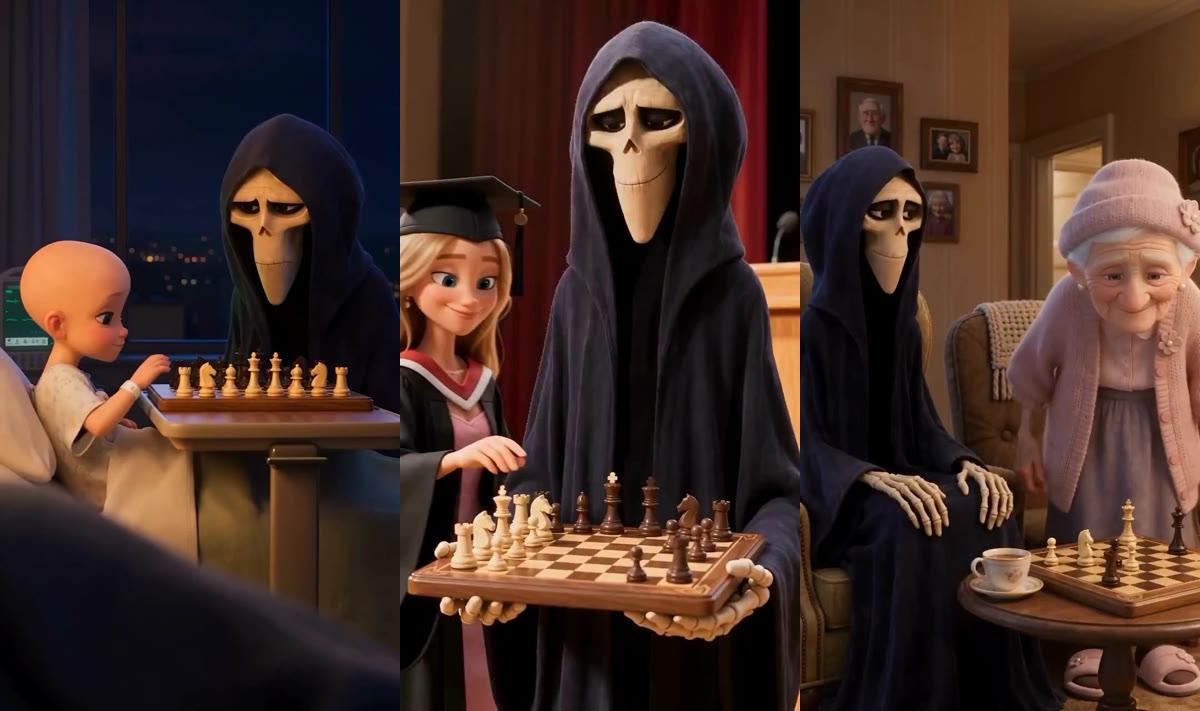
Short answer: the film is called Guardian Angel, and a group called The AI Creator Community made it. The makers say they generated the video with Seedance 2.5 on Higgsfield, and built the characters with Seedream 5 Pro and GPT Image. They haven't published their prompts. Those sit inside a paid community, so the step-by-step method in this guide is partly our reconstruction, and we label it that way.
The short follows a sick girl who starts a chess game with Death in her hospital room. The game continues through her recovery, school, marriage, children and old age. Two reposts on X carried it to tens of millions of people without naming who made it. The credit was in the video all along, on a title card in its last six seconds.
Many viewers describe it as a film without words, and that idea deserves a test, because a film with almost no speech is easy to carry into other languages. We checked it against the frames. The film runs 166 seconds and uses 29 words.
Who made it?
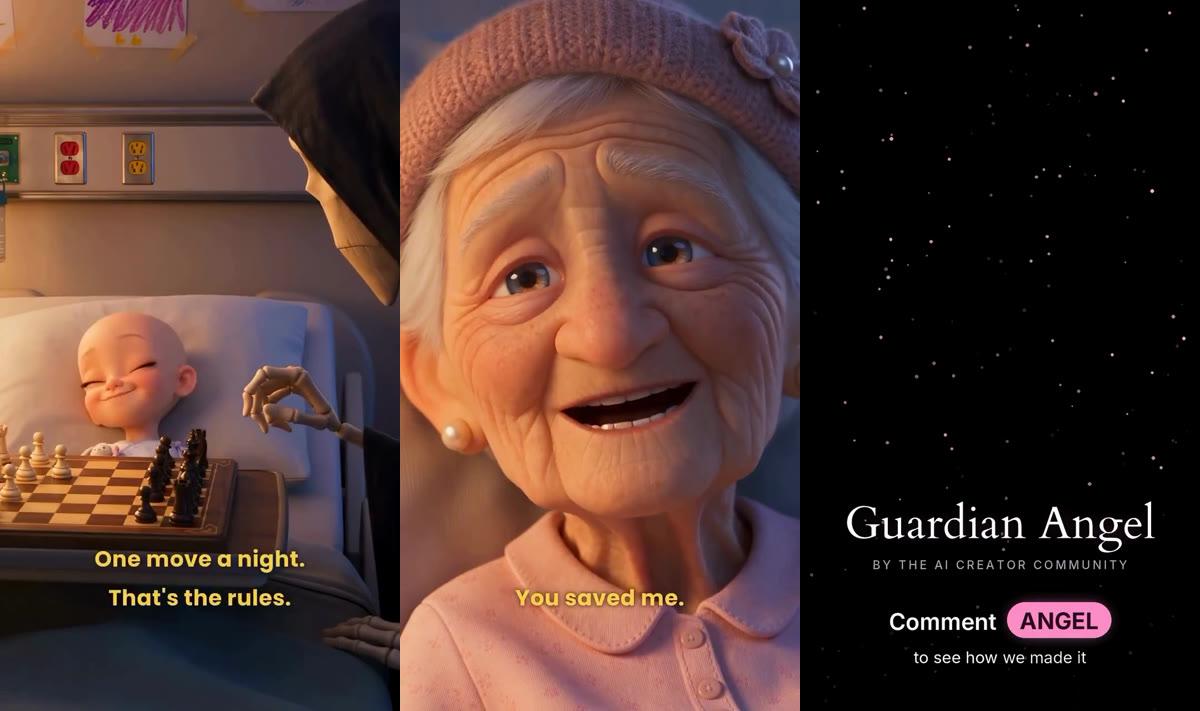
The film ends on a card that reads 'Guardian Angel' and 'By the AI Creator Community,' followed by 'Comment ANGEL to see how we made it.' That call to action points to the original upload, an Instagram reel dated November 25, 2026.
The group's Instagram profile showed 180,000 followers when we checked, and its bio says 'Creative partner @higgsfield.ai.' The reel's caption ends 'Made with @higgsfield.ai,' and Higgsfield's creator account is tagged as a collaborator. Higgsfield is a paid platform for AI video tools, so this film is partner content as well as a personal project.
The group's Skool page, a paid membership site, lists the community as 'By Joshua Whiting.' It advertises 'downloadable prompt sheets from our viral videos.'
| Upload | Posted (UTC) | Credit given? | What we read |
|---|---|---|---|
| Instagram reel by The AI Creator Community | November 25 | Original | 7.5 million likes and 92,000 comments |
| X post by @Raclure03 | November 25, 12:50 | No | 19.4 million views |
| X post by the makers | November 25, 13:38 | Original | 54,000 views, from an account with 135 followers |
| X post by @MarOliveira13 | November 25, 15:10 | No | 10 million views |
| YouTube Short by Josh Creatives | November 26 | Describes the film as its own | Lists the tools used |
The makers spent the next day asking for credit. One of their replies reads: 'Hundreds of people stealing my video, please credit me, it's not cool!' They also replied to the largest repost in French to say the video was theirs.
The account that posted that repost asked Grok to find the author. Grok's reply named The AI Creator Community and Joshua Whiting. That answer comes from an AI system, and it matches what the film's end card and the Skool page say.
The makers claimed '57M views in 15 hours' across platforms. That figure is their own and we can't check it.
What is in the film?
We split the copy from X into frames and counted. These numbers are ours.
| Measure | What we found |
|---|---|
| Length | 166 seconds |
| Shape | Vertical, 720 by 1,280 pixels, 24 frames a second |
| Shots | About 55, by automatic cut detection |
| Average shot | About 3 seconds |
| Captioned lines | 8 |
| Words in those lines | 29 |
| Time with a caption on screen | About 15 seconds |
| Credit | A title card in the last 6 seconds |
The eight lines are short. The first is 'Do you play?' The makers' own summary says the girl asks Death to play. The terms follow: 'One move a night. That's the rules.' The third line, 'I'm leaving today,' comes as she goes home from the hospital. Decades later, in the scene with her newborn, the captions read 'Come on' and 'I'd let you hold her, but...' The last three lines come at the end of her life: 'You won.' 'Don't be sad.' 'You saved me.'
The structure is one idea repeated. Death appears in the background of each milestone, holding the same chessboard, and waits. Near the end, a burst of 13 very short shots replays earlier scenes in about four seconds. Those shots appear to reuse earlier footage, which costs nothing extra to make.
How was it made?
The makers have confirmed the tools in public and kept the method private.
On X, the makers wrote: 'Ai video made with Seedance 2.5 on @higgsfield_ai.' The YouTube upload adds detail: 'Every shot was generated with AI: Seedance 2.5 for the video, Seedream 5 Pro and GPT Image for the characters.' It also says the full prompt guide is inside the paid community.
Seedance and Seedream are ByteDance's video and image models, and GPT Image is OpenAI's image model. The film's frames fit that split. The girl stays recognizable from childhood to old age, and Death looks the same in every scene, which is what you get when you design characters as still images first and then animate them.
The likely workflow, reconstructed
The steps below are our reconstruction from the frames and from the tools the makers named. The makers haven't confirmed them.
- They wrote the idea as a list of moments. The film has about a dozen scenes, each one a life event with Death somewhere in the frame.
- They designed two characters as images. An image model can produce the girl at each stage of life and one fixed design for Death. The makers name Seedream 5 Pro and GPT Image for this step.
- They made a starting image for each shot. Each of the roughly 55 shots needs a frame that sets the place, the light and where the characters stand.
- They animated each image for a few seconds. The makers name Seedance 2.5 for this step. An average shot of three seconds means every clip was trimmed short, which hides the moments where AI video drifts.
- They edited to one piece of music and added captions. The eight lines appear as yellow captions in the same font, which points to an editing app.
- They added an end card with a call to action. 'Comment ANGEL' is a standard way to turn viewers into followers and customers.
How do you make a short like it?
You can follow the same six steps with tools you may already pay for. The order matters more than the brand.
Step 1: Write the premise in one sentence
Guardian Angel fits in one line: Death agrees to one move a night, and the game lasts a lifetime. If your idea needs a paragraph of explanation, it will need dialogue too.
Step 2: List 10 to 14 moments, with no dialogue yet
Write each scene as a picture someone could understand with the sound off. Add a line of speech only where the picture can't carry the meaning. This film needed eight.
Step 3: Lock your characters before you animate
Generate a reference image of each character, then generate the age or outfit changes from that reference. Keep one fixed design for any character who doesn't age.
Step 4: Make one still per shot, then animate it
Give the video model your still as the first frame and ask for one simple action. Keep each clip to a few seconds after trimming.
Step 5: Edit to music you have the right to use
Cut on the beat, keep captions as a separate layer, and export a version with no captions burned in. That clean version is what you translate.
Step 6: Put your name at the start and the end
This film's credit sat in the last six seconds, and the reposts that traveled furthest carried no mention of the makers. One reply to the makers gave the practical fix: 'Put your watermark and credits at the BEGINNING of the video as well.'
Tools for each step
The models the makers named, and two alternatives we rank
- 01Seedance4.4
#4 in AI Video Generators
The makers say Seedance 2.5 generated every shot. Our review rates it best for multi-shot stories, with consistent characters across cuts.
The makers used it through Higgsfield, a separate paid platform. Our review covers Seedance through Dreamina.
Read our Seedance review → - 02

#2 in AI Image Generators
The makers name GPT Image as one of two tools for the characters. They don't say which version.
The other tool they name, Seedream 5 Pro, isn't in our ranking.
Read our GPT Image 2 (ChatGPT) review → - 03

#1 in AI Video Generators
Our top-ranked video generator keeps a character consistent across shots when you give it reference images, which is the skill this kind of film depends on.
Our review found that paid plans meter generations tightly, so plan your shot list first.
Read our Google Veo 3.1 review → - 04

#1 in AI Image Generators
Our top-ranked image generator is strong at keeping a face consistent across edits, which helps when one character has to age across a whole life.
The makers didn't use it. This is our suggestion for the character step.
Read our Nano Banana Pro review →
Why did it work?
The writing did the work. The premise gives Death a reason to wait, and each scene pays that off with a picture. The last line, 'You saved me,' turns the whole film around: the girl has been keeping Death company, and he has been keeping her alive. A viewer needs no knowledge of chess, and no shared language, to follow that.
The numbers support your point about speech. The two biggest reposts were captioned in French and Spanish, and the film's captions are in English. Only 29 words stood between the film and any viewer, and they were on screen for about 15 seconds out of 166.
- Few words mean cheap translation. Translating 29 words into ten languages is an afternoon's work. Re-voicing a dialogue scene in ten languages is a production.
- Pictures carry the same meaning everywhere. A graduation, a wedding and a newborn need no subtitles.
- Silence avoids AI's weakest area. Generated speech and lip movement are where viewers most often notice that something is off. A film with eight short lines gives them little to notice.
The lesson for anyone making AI films is to spend the time on the idea. The rendering here is good, and it is also the part any paying user of the same tools can match.
What about rights, credit and the chess?
- We found no statement about a music license. Grok's reply names the song as How to Save a Life by The Fray, and the makers' follow-up reel carries that track's audio tag. A well-known song can get a video muted or removed on some platforms.
- The look is close to big-studio animation. That style drives the emotional response, and it is also the kind of resemblance that studios have challenged in court. Design characters that are clearly your own.
- A brand-style logo appears. In the soccer scene the girl's jersey shows a swoosh-shaped mark. AI models add logos they have seen in training, so check every frame before you publish.
- The chess isn't real chess. David Llada, a well-known chess photographer, called it 'the only chess content that has ever almost made me tear up,' then added: 'If you pay attention to the positions on the board you will definitely cry, so better don't.'
- The credit failed where it mattered. The makers' own X post had 54,000 views when we read it. The uncredited repost had 19.4 million.
Our read
Guardian Angel shows where AI film is strong right now. One person or a small group with a clear idea can make two and a half minutes that move millions of people, using tools sold by monthly subscription. The film also shows what the tools don't supply: the premise, the restraint with words and the pacing all came from the makers.
The film is also an advertisement. It was made with a platform partner, and it ends by sending viewers toward a paid community that sells the prompts. That doesn't weaken the story. It does explain why the method isn't public.
What we still don't know
- The prompts aren't public. The makers say the full guide is inside their paid community, and we haven't seen it.
- We don't know the cost or the time. The makers haven't said how many clips they generated or how long the film took.
- We don't know how many people worked on it. The posts switch between 'we' and 'my video.'
- The view totals are the makers' own. We verified the counts on individual posts and can't verify a total across platforms.
- We haven't confirmed the music license. The makers haven't addressed it in the posts we read.
The short answers
- What is the AI short where a girl plays chess with Death? It is called Guardian Angel, by The AI Creator Community, first posted on Instagram on November 25, 2026.
- What tools made it? The makers name Seedance 2.5 on Higgsfield for the video, and Seedream 5 Pro and GPT Image for the characters.
- Are the prompts available? The makers haven't published them. They say the prompt guide is inside their paid community.
- How long is it, and how many shots? The copy on X runs 166 seconds with about 55 shots, by our count.
- Does it have dialogue? It has eight short captioned lines, 29 words in total.
We'll update this guide if the makers publish their workflow, and when we run our own test of the six steps.
Where these apps rank