
Signals
Is Fable 5.2 'Ultra' Worth It? We Checked the $642 Iceberg: There Is No Ultra Effort Level, the Run Times Don't Fit the Launch, the Video Contradicts the Caption, and What High, Extra High and Max Actually Buy
By the Top5Apps editorial team · Published November 10, 2026 · Updated November 10, 2026 · 17 min read
Short answer: no, and the post that asked the question doesn't quite show what it says it shows. Claude Fable 5.2, released November 9, has five effort levels: low, medium, high, extra high and max. None of them is called Ultra. The nearest thing Anthropic ships is Ultracode, a Claude Code toggle that turns one agent into a managed crowd of them. It isn't the $200 Ultra plan either: a subscription sets how much you can run, not how hard the model works on one prompt. So when Rhino (@0xRhinoX) wrote 'Same model. Same prompt. Only the effort changes' above a bill that ran from $24.31 to $642.42, the last step almost certainly changed something else. And the three steps that are effort levels say what Anthropic's own documentation says, what Artificial Analysis measured, and what Rhino himself concluded fifteen minutes later: the money stops buying much above high.
The post is worth taking seriously anyway. It reached about 86,000 views from an account with 302 followers, because it asks the question every team with a Fable 5.2 key is asking this week, and it is the first widely seen attempt to put dollars on it. We read the post, the thread, his site, the 25-second video frame by frame, and Anthropic's documentation for every setting involved. Four things in the post don't hold up. One thing does, and it is the useful one. (Disclosure, per The Receipts Standard: this site is produced with Claude-family tools, including the model this post assesses.)
Rhino@0xRhinoX
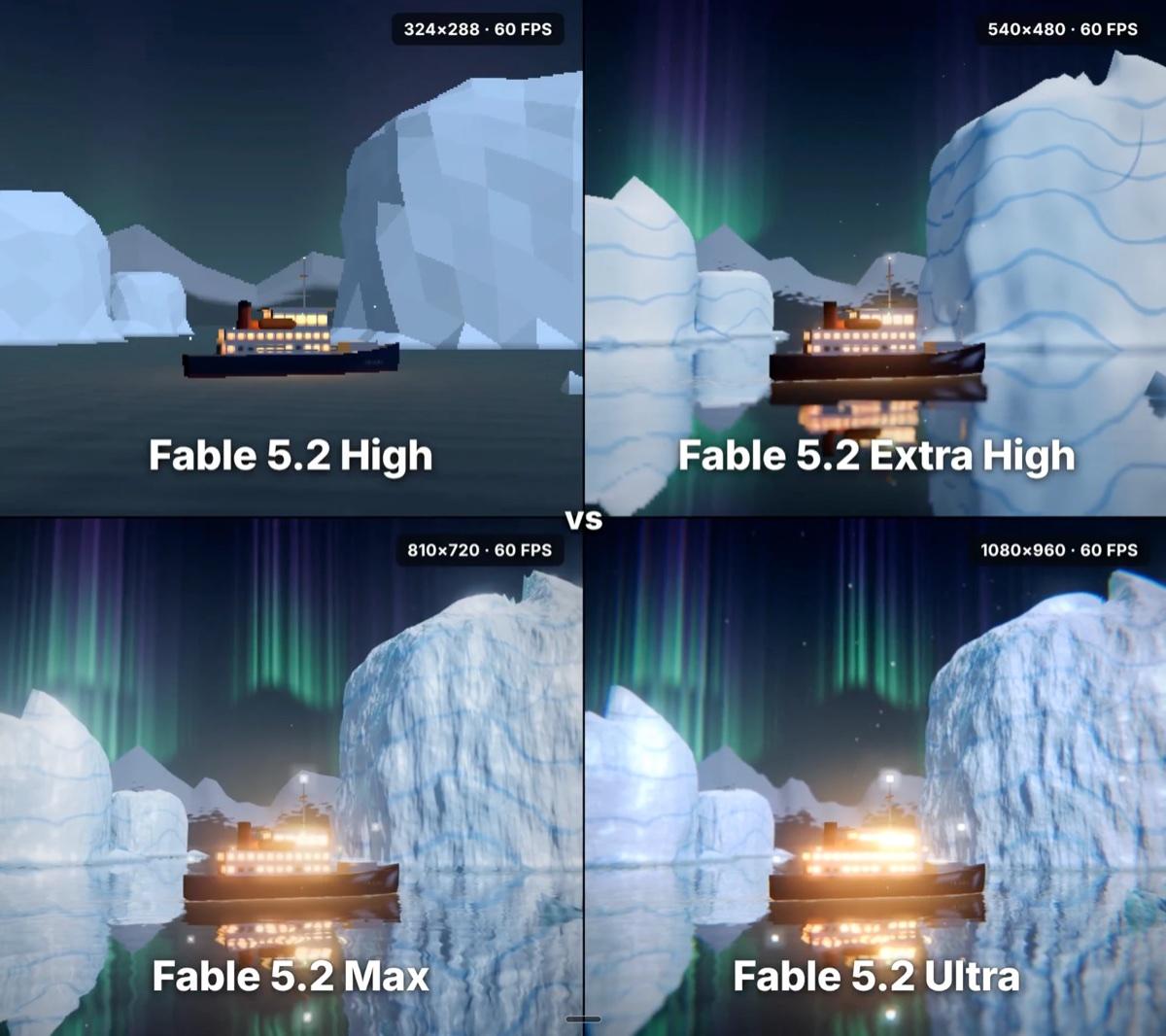
I paid $642 for a f*cking iceberg. Fable 5.2 High vs Ultra Same model. Same prompt. Only the effort changes. Fable 5.2 High - $24.31, 1h 05m Fable 5.2 Extra High - $43.79, 3h 09m Fable 5.2 Max - $87.99, 3h 28m Fable 5.2 Ultra - $642.42, 10h 21m High forgot the aurora. Ultra made the ice glow and dove under the water. 26x the price. Is it 26x better?
View original post ↗
The short version
- The claim: one prompt, four runs of Fable 5.2, costs of $24.31, $43.79, $87.99 and $642.42, and times from 1 hour 5 minutes to 10 hours 21 minutes. The arithmetic is right: the top run is 26.4 times the bottom one. The figures are his own. No usage screenshot, log, prompt or build link was published.
- There is no Ultra effort level. Anthropic's API and Claude Code both list low, medium, high, xhigh and max for Fable models. 'Ultra' is most likely Ultracode, which Anthropic describes as 'a Claude Code setting rather than a model effort level.' Rhino builds in Claude Code and used the label 'Opus 5.5 ultra' in October. He hasn't said which setting he used.
- It isn't the Ultra plan, though the plan may be part of the story. Anthropic renamed its $200 Max 20x subscription to Ultra on October 30 and removed the five-hour limit for verified accounts. A plan changes how much you can run, not what a single run does, and Rhino was writing 'Opus 5.5 ultra' two weeks before the plan had that name. If he ran on it, the plan explains how a ten-hour job could finish, and it makes '$642' a list-price figure against a flat fee.
- The clock doesn't fit. Anthropic announced Fable 5.2 at 18:57 UTC. Rhino posted at 22:08 UTC, 3 hours 11 minutes later, with runs he timed at 3 hours 28 minutes and 10 hours 21 minutes.
- The video contradicts the caption twice. The High panel has an aurora, a flat green and violet glow without the curtains. All four panels dive underwater on the same camera path, not just the top one.
- The panels aren't the same size. They are rendered at 30%, 50%, 75% and 100% of full resolution, so the High panel is drawn with 9% of the pixels of the top one. Some of what looks like quality is resolution.
- What holds: his first three cost ratios match independent data. Artificial Analysis has Fable 5.2 scoring 62 at high for $9.08 a task, 62 at extra high for $14.83, and 65 at max for $26.54. Anthropic's effort page says 'Start with high.' Rhino's own reply: 'Max was the sweet spot.'
- Our read: run high, read the result against your prompt, and send a note. Step up only where you have measured a gain. Keep Ultracode for jobs that split across many files, which a single-file 3D scene does not.
What the post claims, to scale
Put the four numbers on one line and the shape is obvious. High to extra high adds $19.48 and two hours. Extra high to max adds $44.20 and 19 minutes. Max to the top run adds $554.43 and nearly seven hours. The first two steps are the same kind of thing getting more expensive. The third is a different order of magnitude, which is the first hint that it is a different kind of thing.
| Step | Extra cost | Extra time | What the video shows it bought |
|---|---|---|---|
| High (baseline) | $24.31 | 1h 05m | The whole scene and all six shots: ship, faceted low-poly ice, flat aurora glow, dive, orcas, cross-section. No reflections on the water. |
| High to Extra High | +$19.48 | +2h 04m | Reflections on the water, aurora curtains, banding on the ice, a lit underwater cross-section. The biggest visible jump. |
| Extra High to Max | +$44.20 | +19m | Finer ice surface, brighter ship lights, denser particles underwater. |
| Max to 'Ultra' | +$554.43 | +6h 53m | A glow inside the smaller iceberg. Otherwise close to Max in every shot we compared. |
For scale, Anthropic's cost documentation puts Claude Code at 'around $13 per developer per active day,' with 90% of users under $30. The high run alone is a heavy day. The top run is 49 average developer-days spent on one HTML file. At Fable 5.2's list price of $8 per million input tokens and $40 per million output, $642 is what about 16 million output tokens cost, before any cached input. Our Token Counter now carries the 5.2 rates if you want to price your own prompts.
There is no 'Ultra' effort level
Anthropic's effort page is plain about it: 'Claude Fable 5.2 supports all five effort levels. The API default is high.' The Claude Code model documentation lists the same five for Fable models and gives the default there as medium. The word 'ultra' appears in Anthropic's products four times, and none of them is a sixth level.
| Name | What it is | What it costs |
|---|---|---|
| Ultracode | A toggle in Claude Code's effort slider. With it on, Claude 'orchestrates dynamic workflows for substantive tasks, at whichever effort level the session runs at.' Starting a session with the --effort ultracode flag also sets extra high. | 'Each request uses more tokens and takes longer than the same request without a workflow.' |
| ultrathink | A keyword you type in a prompt to ask for deeper reasoning on that one turn. It 'can also raise that turn to xhigh effort.' | One turn at extra high. |
| Ultrareview | A cloud code review started with the /code-review ultra command: 'a fleet of reviewer agents in a cloud sandbox.' | Three free runs, then 'typically $5 to $25' a review. |
| Ultra plan | The top individual subscription, renamed on October 30: 'The Max 20x plan is now called the Ultra plan.' It raises how much you can use in a week and drops the five-hour limit for verified accounts. It adds no setting. | $200 a month. |
Ultracode is the only one of the four that sits next to High, Extra High and Max in a menu, and it is the only one that could turn an $88 job into a $642 one. A dynamic workflow is a script that runs 'dozens to hundreds of agents per run,' up to 16 at a time by default and capped at 1,000. Claude Code normally warns when a workflow passes 25 agents or 1.5 million projected tokens; the documentation notes that warning is switched off while Ultracode is on, 'because turning ultracode on already opts you in to large runs.' With it on, 'a single request can turn into several workflows in a row: one to understand the code, one to make the change, and one to verify it.'
Is that what Rhino ran? He hasn't said, and nobody in the thread got an answer. The evidence is circumstantial but it lines up. His earlier replies say he builds with 'Opus 5.5 in Claude Code' and compares models with the 'same prompt, same Claude Code setup'. He used the label 'Opus 5.5 ultra' on October 16, three weeks before Fable 5.2 existed. And the burn rate changes character at the last step: the first three runs cost between $14 and $25 an hour of claimed time, and the fourth costs $62 an hour, which is what several agents working at once looks like on a bill. If that reading is right, 'only the effort changes' is wrong for the one comparison in the headline. The top run changed the effort level and the number of workers.
Could 'Ultra' mean the $200 Ultra plan?
It is the first thing many readers will think, and for good reason. On October 30, ten days before Rhino's post, Anthropic renamed its subscriptions: 'Max 20x → Ultra,' still $200 a month. That announcement has 7.4 million views. For most people the plan is the only 'Ultra' Anthropic sells, so 'Fable 5.2 Ultra' reads like 'Fable 5.2 on the Ultra plan.'
It can't be the fourth run on its own, for three reasons.
- A plan is how you pay, not how the model works. Anthropic's Ultra plan page lists ten times the Pro plan's weekly usage, no five-hour limit for verified accounts, priority access and monthly API credits. It names no effort level or mode. The Claude Code documentation reserves none for a plan either, and says dynamic workflows are 'available on all paid plans.' The same prompt at the same setting is the same job on the $100 plan and the $200 one. The cheaper account just runs out sooner.
- The label is older than the plan. Rhino captioned a build 'Opus 5.5 ultra' on October 16. No Anthropic plan was called Ultra until two weeks later.
- His own caption rules it out. 'Only the effort changes,' with Ultra listed as the rung above Max. A subscription tier isn't a rung on that ladder, and you don't change plans between runs of one test.
But the plan may well be how the run happened. The same October 30 announcement said: 'We're also removing the 5-hour limit for verified Ultra accounts.' Before that, a $200 subscriber worked inside an allowance that reset every five hours. Since then, a verified Ultra account has only the weekly limits. A single job that runs for ten hours is the kind of thing that change made practical on a subscription. Ultracode is what would make one prompt run that long. The Ultra plan is what would let it finish. The two readings fit together, and if both are true the fourth run was 'Ultra' twice over.
If he was on the plan, two things in the post read differently. First, '$642' was not money out of his pocket. On a subscription, Claude Code's cost line is a list-price estimate and the bill is $200 a month whatever the run. Second, the real price moves to the weekly limit. Ultra has one limit across all models and a separate one for Fable, and Anthropic's workflow documentation warns that 'a session with ultracode on reaches a session or weekly limit sooner than the same work with it off.' The fourth run would have come out of his week's Fable allowance, not his card.
How much of it? Anthropic caps Fable at half the weekly limit on Max and Ultra, and one developer's logs, which we checked separately, put a full Fable 5.2 week on Ultra at about $705 at list price. On that measure the $642 run alone would be 91% of the week's Fable, and all four runs, $798.51 together, would be more than one week holds.
Against that, Rhino's site says 'every build costs real API money,' which points to an API key and a real $642. He hasn't said which. For a subscriber the question changes from 'is it worth $554 more?' to 'is it worth that much of my week?' The answer for a one-file scene is the same.
The clock doesn't add up
Anthropic's announcement post is stamped 18:57:59 UTC on November 9. Rhino's comparison is stamped 22:08:45 UTC. That is 3 hours, 10 minutes and 46 seconds. His extra-high run would just fit in that window if he started it the minute the model appeared. His max run, at 3 hours 28 minutes, would not. His top run, at 10 hours 21 minutes, is more than three times too long. One reply made the point less politely: 'fable wasn't even out for 5 hours.' Rhino didn't respond to it.
There are innocent explanations, and we can't tell which applies. He may have had early access; he doesn't claim it. The time may not be wall-clock time: Claude Code's usage screen reports 'Total duration (API)' and 'Total duration (wall)' as separate lines, and with many agents running in parallel the time summed across them can exceed the time on the wall. That would also fit the Ultracode reading. Or the label is loose. Thirty-one minutes before Fable 5.2 was announced, the same account posted a different build credited to 'Claude Fable 5.5 - $83.00, 2h 10m,' a model Anthropic doesn't list. What we can say is that the times as written are not four stopwatch readings taken after launch.
The dollars carry a smaller caveat of the same kind. His site, Pokeable, says 'every build costs real API money,' and we have no reason to doubt it. But Claude Code's session cost is, in Anthropic's words, 'an estimate' computed 'locally from token counts at list price,' and on a subscription plan it isn't a bill at all. 'I paid $642' may be exact or may be list-price equivalent. The post doesn't say.
What the video actually shows
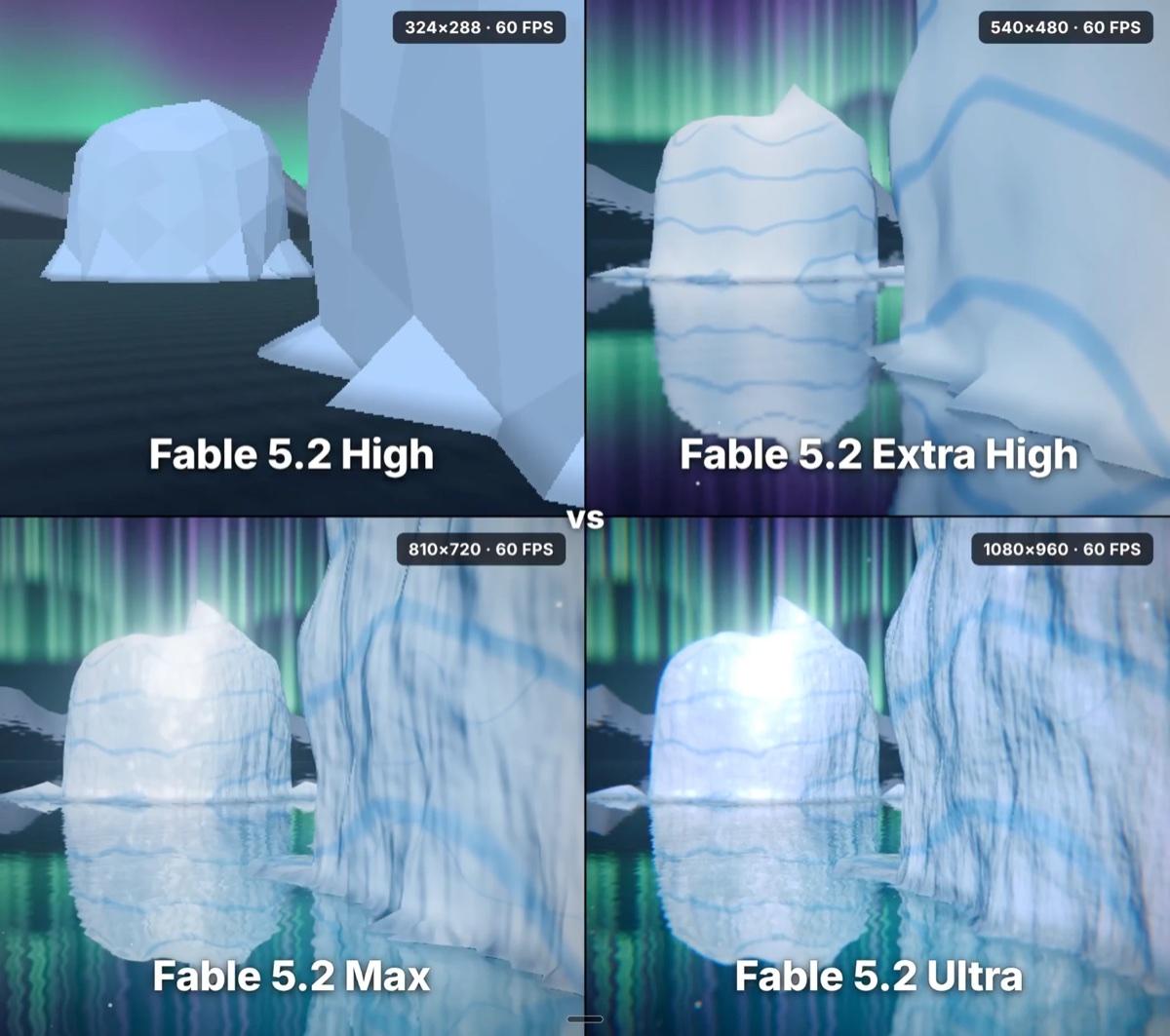
'High forgot the aurora' is the line that made the post travel, and the video doesn't support it. In the orbit shot the High panel has a green and violet sky behind the iceberg. It is a cruder aurora, a gradient where the other three runs drew vertical curtains, and in the opening shot it barely reads. But it is there. 'High drew a worse aurora' is a different finding from 'High forgot a requirement,' and it leads to a different fix.
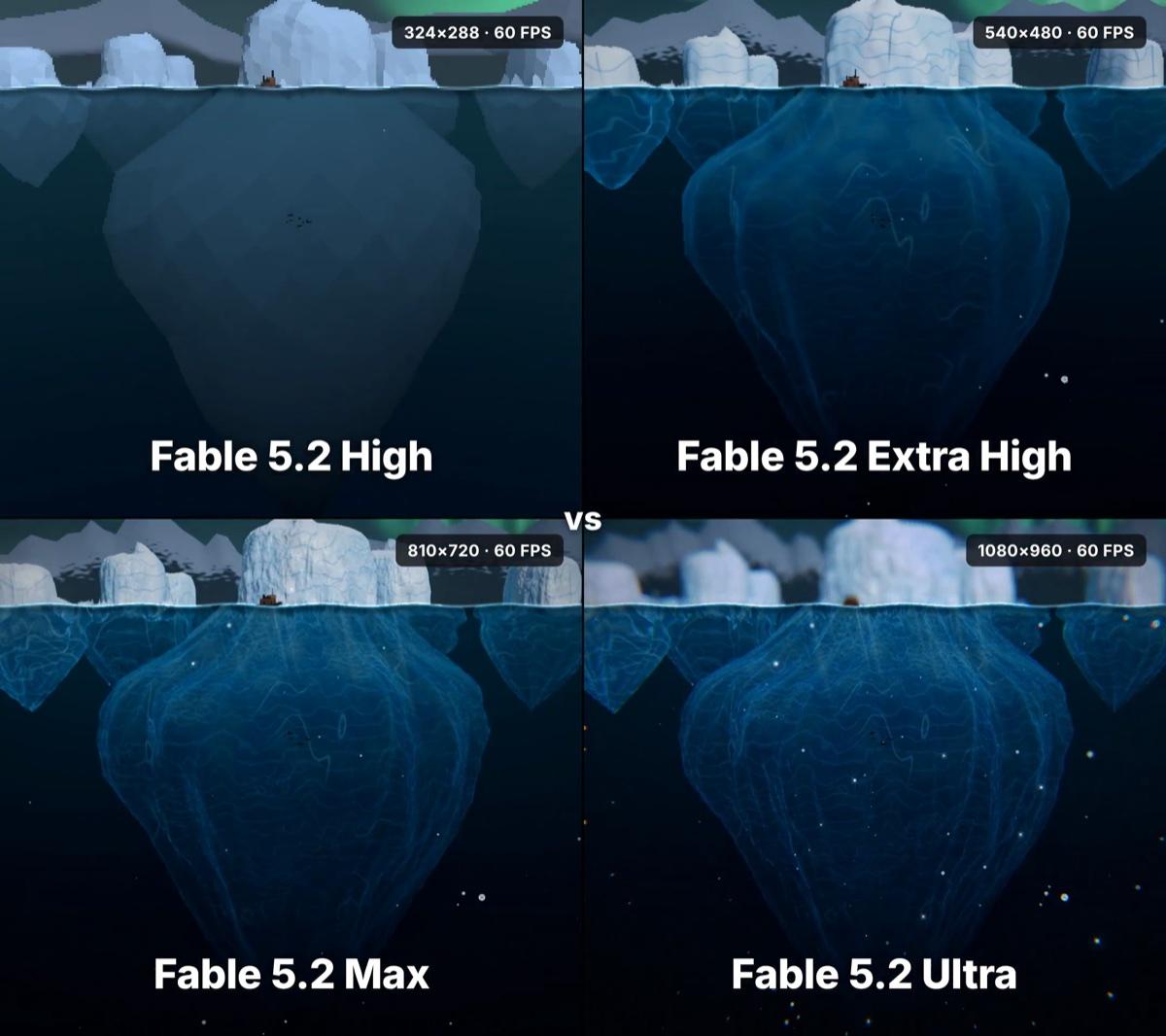
'Ultra made the ice glow and dove under the water' is half right. The glow is real: the smaller iceberg is lit from within in the top run and in no other. The dive is in all four. Every panel follows the same six-shot path: the ship on the surface, an orbit of the ice, the plunge, the hull from below, a pod of orcas, and the cross-section that gives the iceberg its meaning. That sequence is evidently in the prompt, and every effort level delivered it.
Then there are the badges. Each panel carries a size in its corner: 324×288, 540×480, 810×720, 1080×960. Those are 30%, 50%, 75% and 100% of a full panel, so the High run is shown with 9% of the pixels of the top run. Pokeable's about page says the site adds 'a small script that caps each build at 60 frames per second and limits its resolution.' It doesn't say how the limit is chosen, and Rhino didn't explain it. One reply, from Jeff Graw, read it as the highest resolution each build could hold at 60 frames a second. If so, the higher-effort builds are faster code, which would be a real and interesting result. If not, a good share of the visible gap is the player, not the model. Either way the panels aren't a like-for-like picture.
It is also one run per setting. Models vary from run to run on the same prompt, and a second high run might have drawn the curtains. A four-way comparison with one sample each tells you what happened once.
What survives: the first three steps match the data
Here is the part worth keeping. Strip out the top run and Rhino's numbers say high to extra high costs 1.8 times as much and high to max costs 3.6 times as much. Artificial Analysis, which runs its Intelligence Index separately at every effort level, measured 1.6 times and 2.9 times. One hobbyist's iceberg and a benchmark lab's full suite landed in the same place.
And the lab's scores say what the money buys. Fable 5.2 scores 62 at high for $9.08 a task. At extra high it scores 62 again, for $14.83, using 144 million output tokens where high used 85 million. At max it scores 65 for $26.54. Three points of index for three times the cost, and nothing at all for the step in between. Swyx's Latent Space roundup put it as 'multiple evals show max/xhigh underperforming high,' and quoted Artificial Analysis's own summary: at max, cost per task is 'roughly 2.6× Opus 5.5.' Simon Willison ran his pelican test at all five levels and found that 'max failed to return an image at all, running out of tokens after spending 128,000 thinking about them.'
Start with high. Most of the gain in capability is already present at high, and above it, gains are uneven and depend on the task. Step up to xhigh for your hardest long-running coding and agentic work, where you've measured a gain... Reserve max for measuring the model's ceiling and for the rare task where time and tokens don't matter. — Anthropic, effort documentation for Claude Fable 5.2
Anthropic doesn't oversell the upper levels either. Its effort page says of max that it 'runs slower and costs more than at xhigh, often for only a small gain.' The Claude Code docs say max 'may show diminishing returns and is prone to overthinking, so test before adopting it broadly.' The launch post makes its efficiency case at the other end of the dial: on the FrontierCode benchmark, 'at High effort, Fable 5.2 scores about the same as Opus 5.5's best score (45.3% vs. 45.5%).' The vendor's pitch for this model is that the middle settings are now good enough. The $642 run is a test of the opposite idea.
Rhino@0xRhinoX
@0chob Max to Ultra only added about 7 hours and a lot of dollars. Max was the sweet spot
View original post ↗
Rhino got there himself. Fifteen minutes after posting he replied that 'Max was the sweet spot,' and moments later agreed with another reader that 'Extra High did most of the work for way less.' The headline asks whether 26 times the price is 26 times better. His own answer, in the replies, is no.
So is it worth it?
Take the four settings one at a time.
- High, $24: yes, as the starting point. It delivered every shot in the brief. Its failures were of finish, not of scope: flat ice, a gradient for an aurora, no reflections.
- Extra high, $44: worth it here, on the evidence of the video. Reflections, curtains and ice banding are the difference between a demo and something you would show. That is one task, though, and Artificial Analysis found no score gain across its suite. Anthropic's rule is the right one: use it 'where you've measured a gain.'
- Max, $88: marginal. It took 19 more minutes and twice the money to refine what extra high had already done. Fine for a showpiece. Hard to justify as a default.
- 'Ultra,' $642: no, for this job. A glow in one iceberg is not worth $554. And if the run was Ultracode, the job was the wrong shape for it.
That last point matters more than the price. Anthropic's documentation says to reach for a workflow 'when a task needs more agents than one conversation can coordinate,' and its examples are 'a codebase-wide bug sweep, a 500-file migration, a research question that needs sources cross-checked.' Work like that splits into pieces, and many agents finish it faster and check each other. A Pokeable build is, by the site's own rule, 'one self-contained HTML file.' One file doesn't split. A crowd of agents pointed at it can only draft the same thing several ways and review each other's drafts, which is the expensive part of a workflow without the part that pays for it. Ultracode on a single-file scene is the worst case for the feature, and judging it there is like timing a moving crew carrying one box. On a real migration the same setting might earn its bill. Anthropic's advice for finding out is to 'run the workflow on a small slice first.'
The cheaper way to get the aurora
The framing of the test hides the best option. All four runs were one-shot: a prompt goes in, a file comes out, nobody speaks in between. That is a fair way to compare models and a strange way to work. If the high run draws a weak aurora, you say so, and the model fixes it for the price of one more turn.
Prakhar Gupta@_prxmy
@0xRhinoX high forgot the aurora, ultra cost 26x. i'd try high plus a second pass that checks the output against every line of the prompt ('aurora present?'). three high runs is ~$73, under 1/8 of ultra. missing requirements is a checklist problem more than an effort one.
View original post ↗
The best reply in the thread says it in three sentences, and the arithmetic checks: three high passes at Rhino's price come to $72.93. We made the same argument yesterday about a viral animation clip: a finished one-shot proves what a tool can produce unattended, and real work is the note that comes after. Higher effort buys the model more of its own checking. A human reading the output against the brief is cheaper, and knows what the brief meant.
In Claude Code, the whole method is four commands and a habit:
Claude Code
# 1. run the task here first
/effort high

# 2. read the session cost and both durations
/usage

# 3. step up only if a note didn't fix it
/effort xhigh

# 4. make sure the workflow toggle isn't left on
/effort ultracode off
Check that last one. Ultracode set with the slider lasts for the session, and set in a settings file it lasts until you remove it. A toggle left on from a migration will plan workflows for whatever you ask next.
Our read
Fable 5.2's top settings are real, expensive, and mostly not for you. The post that made the point got its details wrong in ways that matter: the top run isn't an effort level, the times can't be what they appear to be, the High run didn't forget the aurora, and the panels aren't the same size. We would not cite its numbers as measurements. But its instinct was right and the independent data backs it. High is where the value is. Extra high is a judgment call you settle by testing. Max is for finding the ceiling. Ultracode is a different tool for a different shape of job, and a single file isn't it.
Rhino deserves credit for spending his own money to ask the question in public and for answering it honestly in the replies. He could settle the rest in one post: the prompt, the usage screen for each run, which setting 'Ultra' was, and whether he ran on a plan or an API key. We will update this page if he does. Rankings: no movement. Claude and Claude Code keep their places; both reviews will pick up Fable 5.2 at the next scheduled refresh.
Where these apps rank