
Comparisons
Is Gemini Better Than Claude and ChatGPT Going Into 2027? What Gemini 4 Neon Changes, What the Scores Say, and What Google Still Has to Fix
By the Top5Apps editorial team · Published November 20, 2026 · Updated November 20, 2026 · 8 min read
Short answer: Gemini is the best value near the top, and it isn't the top model. Independent tests put Gemini 4 Neon third overall, behind Claude Fable 5.2 and GPT-6.2 Astra, while it matches Claude on coding at less than half the cost per task. What changed this week is how it feels to use. Reviewers who panned OpenAI's new models three days earlier are praising Neon. Google's remaining problem is access: a Gemini subscription works only inside Google's own tools.
(Disclosure, per The Receipts Standard: this site is produced with Claude-family tools, and Claude is one of the three products compared here. Every score below comes from a third party or from the vendor named.)
Google announced Neon on Wednesday, November 18. We read the announcement, the launch-day results from Artificial Analysis and Vals, and two days of public reaction from developers. We haven't tested Neon ourselves yet.
The short version
- Neon is third on the broadest index. Artificial Analysis scores it 61. Claude Fable 5.2 has 65 and GPT-6.2 Astra has 62.
- On coding it's level with Claude. Neon scores 59 on Artificial Analysis's coding index, one point above Fable 5.2 and Opus 5.5, at $6.86 a task against $15.47 for Fable.
- It's priced below both rivals' top models. Neon costs $3 in and $15 out per million tokens. Fable 5.2 and GPT-6.2 Astra each cost $8 and $40.
- Reviewers like working with it. Theo, who called GPT-6.2 Astra the worst model OpenAI has released, says Neon is far more pleasant to use.
- Google's chart compares Neon with second-tier rivals. It sets Neon against Claude Opus 5.5 and GPT-6.2 Sol and leaves out Fable 5.2 and GPT-6.2 Astra.
- A Gemini subscription stays inside Google's tools. A Google staffer replied 'December 2nd we take the first step' when a developer asked for that to change. Google hasn't said what the step is.
- You need a paid plan to use Neon in the Gemini app. Free users get Gemini 4 Hydrogen.
What Gemini 4 Neon is
Neon is the middle model in Google's Gemini 4 line. Carbon is the largest and slowest, Hydrogen is the fast free one, and Neon sits between them. Google's announcement says Neon delivers 'frontier-level reasoning' for demanding work 'faster and more cost efficiently.'
| Gemini 4 Carbon | Gemini 4 Neon | Gemini 4 Hydrogen | |
|---|---|---|---|
| Artificial Analysis index | 60 | 61 | 54 |
| API price per million tokens | $4 in, $20 out from December 1 | $3 in, $15 out | $1.50 in, $7.50 out |
| In the Gemini app | Google AI Ultra | Google AI Pro and Ultra | Everyone |
| Thinking levels | Low, medium, high | Low, medium, high, extra high | Low, medium, high, extra high |
The surprising line in that table is the first one. The cheaper model outscores the larger one. Artificial Analysis confirms it: Neon at its highest setting scores 61, one point above Carbon, at about 17% lower cost per task and in about 40% less time. It also counts Neon as Google's fourth model in seven weeks.
Developers reach Neon through the Gemini API. Subscribers to Google AI Pro and Ultra get it in the Gemini app, in Google AI Studio and in Antigravity, Google's coding tool. We've added Neon to our Token Counter.
The scoreboard: Gemini, Claude and ChatGPT
Each company now has a flagship that launched in November. Claude Fable 5.2 came out on November 9, GPT-6.2 Astra on November 17 and Gemini 4 Neon on November 18. These are the independent numbers we could verify for all three.
| Measure | Gemini 4 Neon | Claude Fable 5.2 | GPT-6.2 Astra |
|---|---|---|---|
| Artificial Analysis Intelligence Index | 61 | 65 | 62 |
| Artificial Analysis Coding Agent Index | 59 | 58 | 53 |
| Coding cost per task, same index | $6.86 | $15.47 | About $5 |
| Vals Index | 70.9%, 2nd | 71.3%, 1st | 67.7% |
| API price per million tokens | $3 in, $15 out | $8 in, $40 out | $8 in, $40 out |
| Design benchmark (Contra Labs) | Not tested yet | 1,713 Elo, top public model | Not tested yet |
Read across the first row and Gemini is third. Read down the cost row and the picture changes. Neon gets within four points of the leader on the broad index and ties it on coding, and it does so for less than half the money. Vals found the same thing: Neon is 0.4 points behind Fable 5.2 on its index 'at less than half the cost per task,' and first on its finance and legal tests.
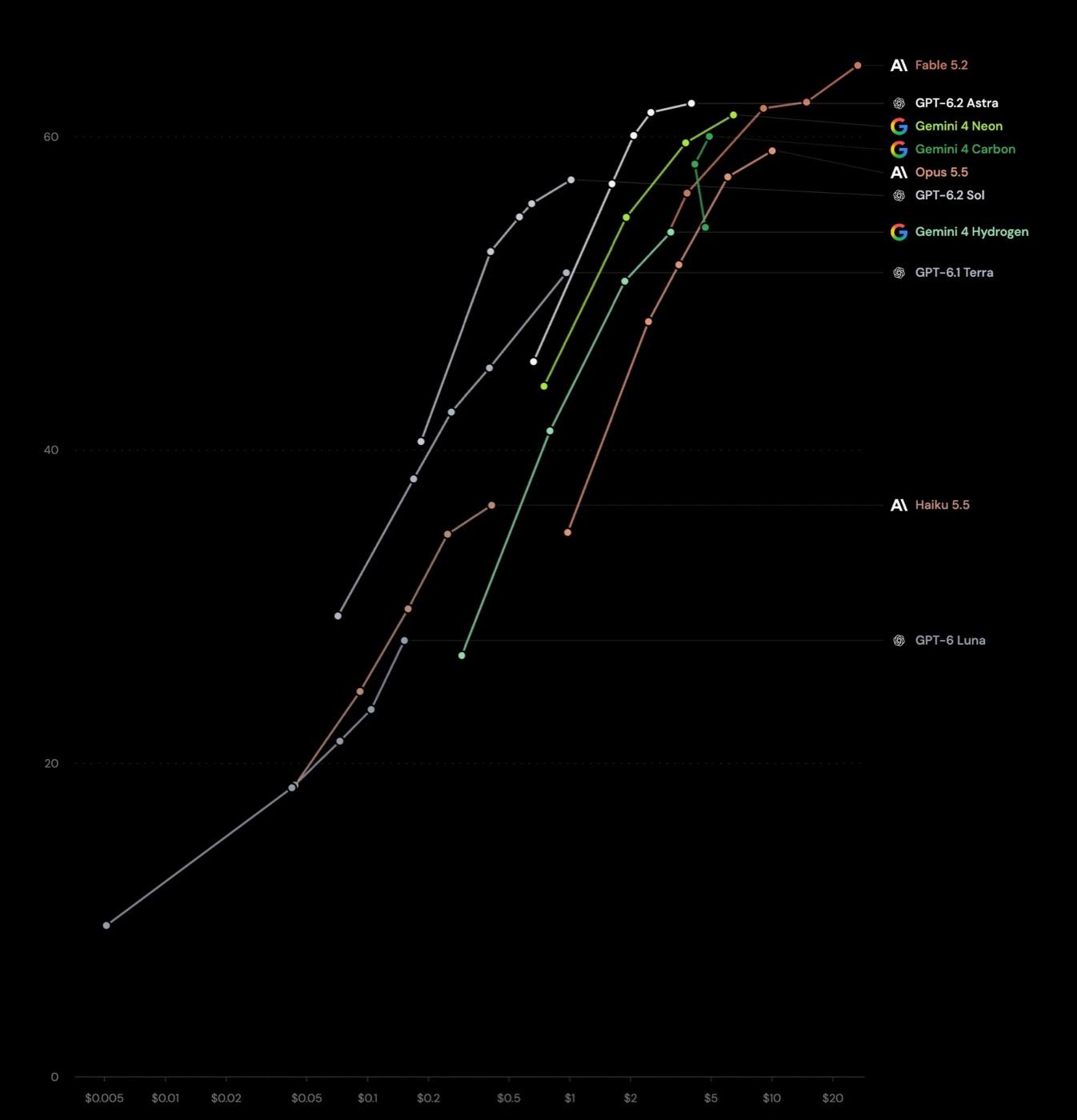
OpenAI's model has the best cost position of the three on these charts. GPT-6.2 Astra reaches 62 for about $4 a task, a figure we read from the chart, against $6.44 for Neon. Its weakness is coding, where it scores 53, and the working experience we covered in our GPT-6.2 post.
Google's chart picks its opponents
Google's announcement says Neon 'ranks ahead of comparable models' and is third overall, 'just behind larger, slower models.' Its benchmark table follows that framing. It compares Neon with Claude Opus 5.5 and GPT-6.2 Sol, which are each lab's second model, and Fable 5.2 and GPT-6.2 Astra don't appear in it.
Neon has the best score in 16 of the table's 19 rows. Opus 5.5 leads two coding rows, and GPT-6.2 Sol leads one on reading charts. The comparison is fair on price, since Opus 5.5 costs $4 and $20 and Sol costs $2 and $10. It's also the comparison that makes Neon look best, and a reader who sees only that table would miss that two models score higher.
One number in the table shows how much the tool around a model matters. On a test called SWE-sweep, Neon scores 12.8% in a plain test setup and 39.0% inside Google's Antigravity. Google presents that as what Antigravity adds. It also means scores from a vendor's own tool don't transfer to other tools.
Why the mood changed
Numbers alone don't explain this week's reaction. Neon's scores are a small step up from Carbon's. The change is in what developers say about using it.
The clearest example is Theo, who runs T3 Chat and T3 Code. On November 17 Theo called GPT-6.2 Astra the worst model OpenAI has released. Two days later Theo wrote that Neon 'feels like a weirdly perfect counter balance to GPT-6.2 Astra' and is much more pleasant to work with.
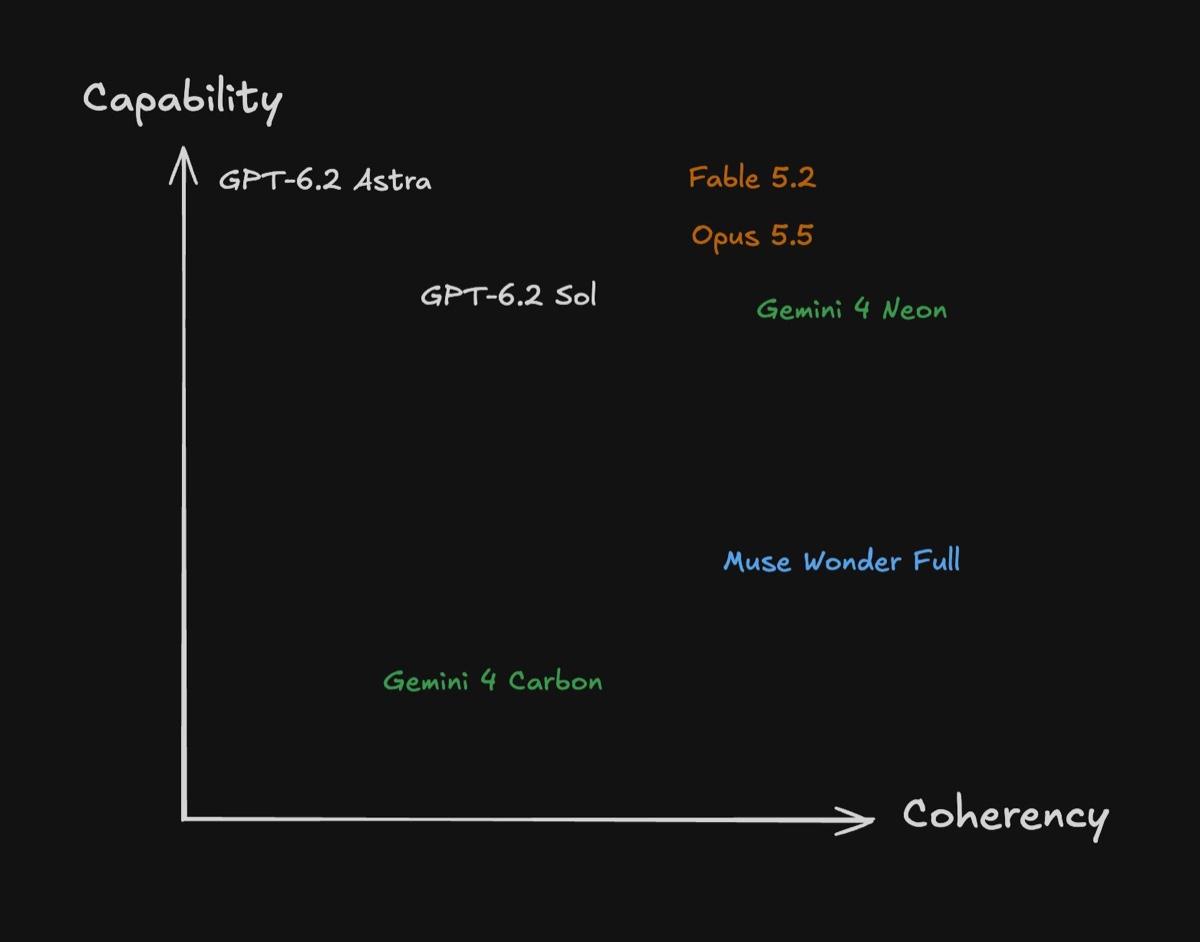
Theo's sketch puts the idea in two words. Capability is what a model can do at its best, and coherency is whether it understands what it's doing. On that drawing GPT-6.2 Astra is the most capable and the least coherent, and Neon is the most coherent of the top group. It's an opinion drawn by hand. It does line up with OpenAI's own system card, which reported that Astra leaves problems out of its reports more often than the model it replaced.
- Writers noticed too. Katie Parrott, a staff writer at Every, called Neon 'an amazing writer.' She added two caveats: it resists adopting a set voice, and it leans on a few stock AI phrasings.
- OpenAI answered its critics. An OpenAI staffer who works on Codex and ChatGPT said early testers had used builds that changed a lot in the last days before launch. The same person later said the team is working on Astra's communication style.
- The praise is two days old. Theo used the phrase 'honeymoon phase' about it. Opinions on GPT-6.2 moved within a day of launch, and these could move as well.
- Reviewers have their own stakes. Theo sells a coding app that now supports Google's Antigravity. That doesn't make the praise wrong, and readers should know it.
What Google still has to fix
The complaint we saw most often is about where a Gemini subscription works. A model runs inside a tool, often called a harness, that gives it files, a terminal and a way to act. Google includes Neon in its own harness, Antigravity, for subscribers. Anyone who wants Neon in a different tool pays by the token through the API, on top of their plan.
A developer named Kun Chen put it this way on November 20: all Google needs to do now is 'allow gemini subscription in any harness.' Logan Kilpatrick, who works on Gemini and the Gemini API at Google, replied: 'December 2nd we take the first step.' That reply had about 357,000 views when we checked.
That sentence is all Google has said. Kilpatrick didn't say which tools, which plans, or what the first step includes. We'd treat December 2 as a date to watch and nothing more until Google publishes details.
- Antigravity's limits run out fast. One developer reported that Neon uses up Antigravity's limits about three times faster than expected and that caching rarely works. Theo replied that Neon is the first Gemini model good enough to deserve a working platform. We haven't verified the figures.
- Design is a weak spot. Google's models finished 12th and 16th on Contra Labs' design benchmark this week, far behind Claude's and OpenAI's. Neon hasn't been tested there.
- Europe is left out. Google's free agent, Tasks in Gemini, still isn't available in the EEA, the UK or Switzerland.
- The best model costs extra in the app. Neon needs a Google AI Pro or Ultra plan in the Gemini app. Free users get Hydrogen, which scores 54.
So who is ahead, by what you need
| If you care most about | Ahead right now | Why |
|---|---|---|
| The highest score on hard problems | Claude Fable 5.2 | 65 on the Artificial Analysis index, three points clear |
| Coding results per dollar | Gemini 4 Neon | Ties Claude's coding score at less than half the cost per task |
| The lowest cost near the top | GPT-6.2 Astra | 62 on the same index for about $4 a task |
| Finance, tax and legal work | Gemini 4 Neon | First on Vals's finance and legal tests |
| Web and app design | Claude Fable 5.2 | Top public model on Contra's benchmark; Neon is untested |
| How it feels to work with | Gemini 4 Neon | Early reviewers' opinion, two days after launch |
| A free agent for errands | Gemini | Tasks is free in six countries |
No company wins every row. Each of the three leads at least one, which is a closer race than any of them had a year ago.
Which one to use
- You pay by the token for coding agents. Try Neon first. It matches the best coding score for much less, and you can run it in your own tool with an API key.
- You already pay for Claude or ChatGPT and you're happy. Nothing here forces a change. Neon is close to both, and it doesn't clearly beat either.
- You want the strongest model and cost matters less. Fable 5.2 still has the highest scores on the broad index and on Vals.
- You live in Gmail, Docs and Calendar. Gemini's advantage is the data it already has. A Pro plan gets you Neon and higher limits on Tasks.
- You want to use a subscription in Cursor, T3 Code or another tool. Watch December 2. Today a Gemini plan covers Google's own tools only.
- You write for a living. Try Neon on a real draft. Reviewers at Every praise its prose and warn that it's hard to steer into a set voice.
What we haven't tested
We haven't run Neon, GPT-6.2 or the December 2 change ourselves. Every score in this post comes from Artificial Analysis, Vals, Contra Labs or the vendor, and every opinion is attributed to the person who gave it. Our chatbot ranking currently has ChatGPT at 4.9 and Gemini and Claude at 4.8 each. Those scores predate all three November flagships, and we'll re-score them after we've used the new models.
Our read
The claim going around is that Google is back on top. The measurements say something narrower and still impressive. Google is third on raw scores by a single point, first on value, and first in the opinion of several demanding reviewers. Seven weeks ago it had no Gemini 4 model on sale.
Going into 2027, the question that matters more than any single score is which company keeps shipping at this pace. Google has released four Gemini 4 models since late September and made its agent free in six countries. Anthropic still holds the highest scores. OpenAI has the cheapest route to a top score and a model whose communication style its own staff say they're fixing.
If Google opens its subscription to other tools on December 2, the last practical reason to skip Gemini for coding goes away, and the answer to this post's question gets closer to yes. Today the honest answer is that Gemini is the best deal of the three and Claude Fable 5.2 is still the best model on the tests we can check.
Where these apps rank