
Guides
How to Make the ROSÉ & Bruno Mars 'APT.' AI Video (Altman and Amodei in the Pink Room — and Why the Viral Version Is an Ad)
By the Top5Apps editorial team · Published October 4, 2026 · Updated October 4, 2026 · 8 min read
Short answer: two photos — one drummer, one singer — into a template, or two photos plus a trimmed clip into Seedance 2.5 or MiniMax H3 with a prompt that says 'copy video 1 exactly.' The 'APT.' AI video is the third two-person swap in a week, after White Chicks and the Stromae sketch, and it's the biggest source yet: ROSÉ and Bruno Mars' pink-room video has 2.7 billion views, and the song was IFPI's biggest-selling single in the world in 2025. The copy you've seen puts Sam Altman on his knees at the mic in ROSÉ's spot and Dario Amodei on the drums in Bruno's, in their own clothes instead of leather jackets, and it's at 645,000 views. One thing to know before you copy the caption: that post is an advertisement. It comes from a 157-follower account, quote-tweets a 'how an AI series makes $24,689 a month' guide, tags @Picsart as the tool, and claims '917K views in 2 days' for a clip we can't find anywhere. The swap itself is real and easy; the hype around it is sponsored.
Why this video — and why it was always going to get swapped
'APT.' is a garage-band performance in a loud pink room: two singers in matching studded black leather jackets over white tees, trading the drums and the microphone, playing the Korean 'apartment' drinking game on the floor over a red cup, star sunglasses, a jacket spun overhead, old-TV letterbox inserts, a fisheye from above. It was released October 18, 2024 on The Black Label and Atlantic, peaked at No. 3 on the Hot 100, hit a billion Spotify streams in 100 days — a Guinness record for a K-pop track — and in February IFPI named it the Biggest-Selling Global Single of the Year 2025 at 2.06 billion units, the first winner from outside North America or Europe and the first with non-English lyrics. For a swap, that matters twice. Everyone knows the beats, so a new face at the mic is instantly legible — and the video is a two-shot on a plain colored set with repeatable moves, which is exactly what reference-to-video models are good at. It was a meme before AI, too: a deepfake parody with Kim Jong-un passed a million views in a day in November 2024, and no one at the label responded.
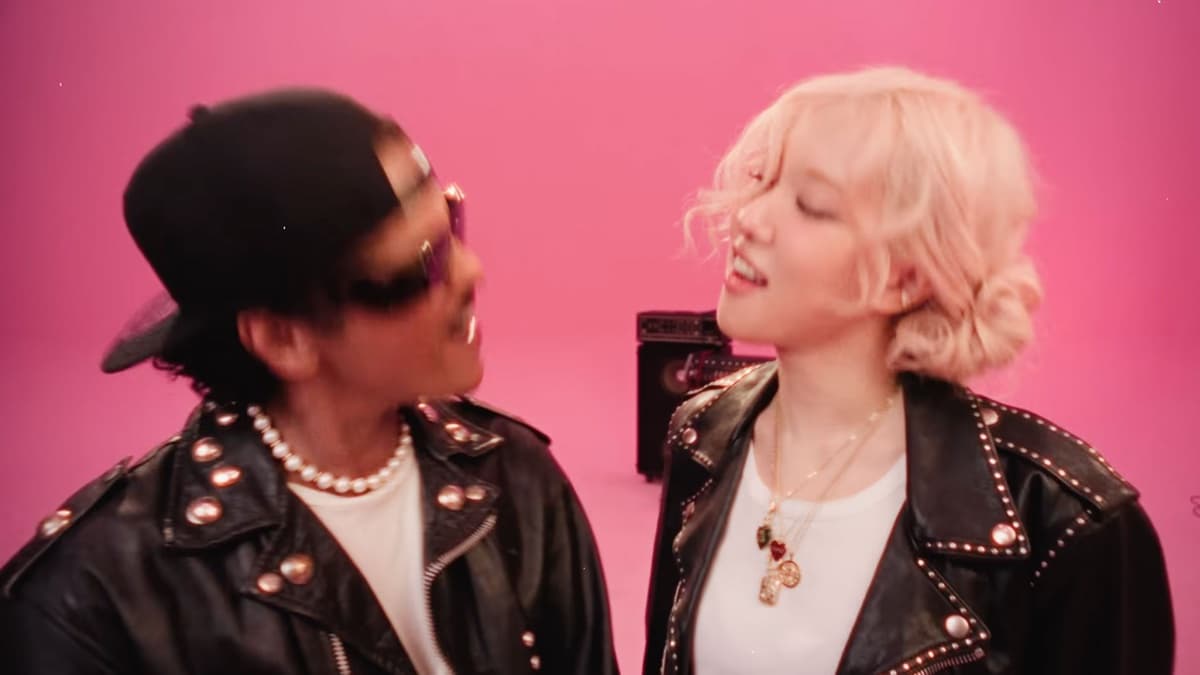
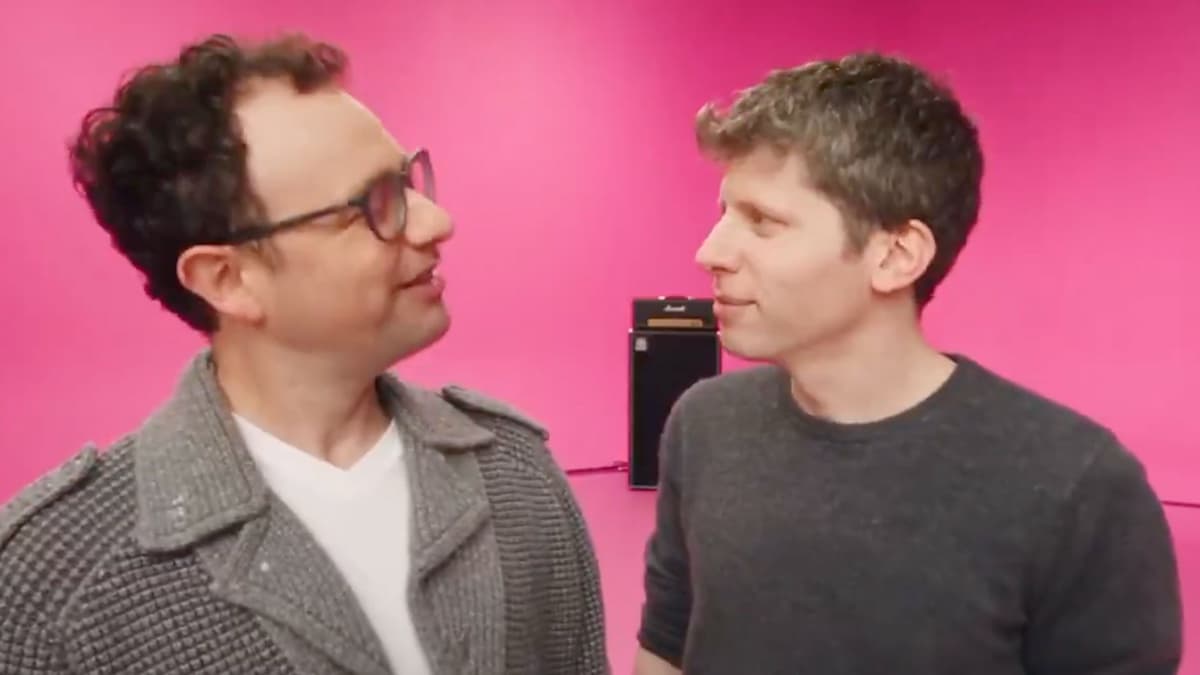
What the viral post actually is
The post went up October 1 and runs 26 seconds split-screen — real video on top, AI redo underneath, shot-matched throughout: Altman kneeling at the mic in front of the lightning-bolt kick drum, Amodei with the sticks inside the TV frame, the floor game over the red cup, the star glasses, the jacket spin, the face-off at the amp. The craft is genuinely good; the caption is copy. It opens 'THE CEOS OF CHATGPT AND CLAUDE JUST RELEASED THEIR FIRST JOINT PRODUCT,' claims '917K views in 2 days' (we found no clip with that count), describes a shirtless beat that isn't in the video, and closes with '@Picsart needs one portrait photo of each and a song everyone can sing along to.' The account has 157 followers; the post it quotes is a Picsart-workflow money guide with 5.6 million views that never mentions 'APT.' Picsart doesn't have an 'APT.' template. What it has is Seedance 2.5 Video Edit and Kling Motion Control inside its AI video tools (Pro from $10.50 a month billed yearly), and its own August blog describes the move: 'Describe the replacement first, then pin the performance, because the movement belongs to the original footage.' So the Picsart route is the manual route below, inside Picsart.
What stays, what changes
- Stays: the pink set, the fisheye from above, the TV-frame insert, the clap sequence, who's on drums versus mic, the red cup, the cut timing, and the track.
- Changes: the two people. In the Altman/Amodei version even the wardrobe changes — dark sweater and grey knit jacket instead of leather — which is what the model does when you don't tell it otherwise. Templates generally keep your clothes too; the leather is in the original, not in the output.
- Who's who: two of the three templates publish it — photo 1 is the drummer, photo 2 is the singer — and the third doesn't say. Check before you generate, because swapping the slots swaps the roles.
Method A: templates (two photos, no prompt)
- Summrs, published September 30, has two: Rosé APT ('the hook, the clap sequence, the pink studio. Fits a Reel or TikTok without trimming') and Rosé APT Extended ('more choreography, more camera angles, more of the song'). Two photos, 'clear face, even lighting, upper body visible'; its tips are 'wear something that contrasts with pink,' 'crop closer to the face,' 'pick two people who look distinct.' It doesn't publish which photo is which role or the per-template price; plans start at $15 a month for 300 credits, with 50 free on signup.
- aptvideoai.com is a single-purpose site: 'Photo 1 is always the drummer and Photo 2 is always the singer,' about 26 seconds across the same shots, 20 credits at 480p or 45 at 720p, with a 90-credit Pro tier. It doesn't name its operator or its model, and its own page cites the Altman/Amodei clips while disclaiming any link to OpenAI, Anthropic, ROSÉ, Mars, or the labels. Treat it accordingly.
- Noiz has a 15-second version — 'Still 1 sits on the left drummer stool. Still 2 takes the right singer mark.'
- Not Starrd, not CapCut. Starrd has no 'APT.' template; the CapCut 'APT ROSÉ' template with 22,000 uses is a one-photo 2024 edit, not an AI swap.
Method B: do it yourself (Seedance 2.5 or MiniMax H3)
Both models take images and a video as references, which is the whole trick. Trim the official video to the 15–26 seconds you want — the floor game at about 0:50, the jacket spin at 0:56, the amp two-shot around 1:20 are the beats every copy keeps. Two waist-up photos, even light, one person each. Then the prompt. A Russian-language guide published September 30 gives the cleanest version; translated, its core instruction is to have the people in image 1 and image 2 'precisely reproduce the movements of the two people from video 1, observing the timing and rhythm of each action,' keeping the lighting, the pink background, and the camera work. Our fuller version:
The two people in @Image1 and @Image2 precisely reproduce the two performers in @Video1 — @Image1 is the drummer, @Image2 is the singer. Match every movement, the timing and rhythm of each action, the cuts, and the camera exactly. Keep the pink studio, the drum kit, the microphone, the red cup, the lighting, and the audio from @Video1 unchanged. Keep each person's own face, hair, and clothing from their photo. Do not add anyone, change sides, or alter the set.
- Seedance 2.5 generates up to 30 seconds a pass, enough for the full byMirum cut in one go. Start at 768p and check credit cost first; expect three to five takes before both faces hold.
- MiniMax H3 (released July 31) tops out at 15 seconds and accepts up to three reference clips, each 2–15 seconds, plus up to nine images — so it's two generations for a 26-second cut, stitched in CapCut. Its own example prompt is the same idea: 'Reference the Hitchcock camera movement from Video 1, have the character in Image 2 sing.'
- Kling Motion Control: one person at a time. Kling's guide: 'Upload a single character motion reference. For motion reference with two or more characters, the motion of the character occupying the largest portion of the frame will be used.' Fine for the solo mic or drum close-ups, wrong for the two-shots. Higgsfield Genjutsu takes 4–30-second references and up to 30 images if you'd rather stay in one tool.
- If faces drift, cut by beat: one generation for the drums, one for the mic, one for the floor game, assembled in an editor.
Rights: a studio video, a Warner song, and four real people
The video and the recording belong to The Black Label and Atlantic (a Warner Music label); the song has eleven credited writers; ROSÉ and Bruno Mars are real people in the original, and Altman and Amodei are real people in the copy who performed none of it. No template that keeps the audio is a license, and this is the one trend in the series owned by a major that has said precisely what it wants: Warner's CEO, announcing its Suno settlement last November, said AI 'becomes pro-artist when it adheres to our principles' including 'an opt-in for the use of their name, image, likeness, voice and compositions in new AI songs.' Nobody opted in here. No reaction from ROSÉ, Mars, either label, Altman, or Amodei has surfaced, and the 2024 Kim Jong-un deepfake went unanswered too — which is tolerance, not permission.
- Label it AI and keep it a parody. The byMirum caption's own joke — 'their first joint product' — works because no one thinks it's real. A version captioned as if it were is the problem.
- Public figures in obvious parody is the most defensible swap; your friends, with permission, is the safest. Same rule as every guide in this series.
- The track is the exposure. Expect a claim on any platform that fingerprints audio; anything commercial needs a license from the labels, and no template is one.
- Don't launder an ad. If a post tags a tool and quote-tweets a money guide, say 'sponsored-looking' when you share it, or don't share the caption at all.
Our read
'APT.' is the most swap-ready music video ever made — two people, one color, repeatable moves, a song two billion people know — and the first viral copy of it is a commercial. That's the state of the trend: the technique is a solved, two-photo problem, so the competition has moved to who can attach a product to it fastest. Use the method, skip the caption. Technically, the thing to learn is the same one as Hotel Lobby and the Stromae sketch: two-person scenes want a model that holds both identities at once — Seedance 2.5 or MiniMax H3 — and single-character motion tools need the work split by shot. Editorially, the thing to remember is that this is a Warner video, and Warner has written down the rule it expects people to follow. Our AI video ranking covers where these models stand for everything that isn't a pink room.
Where these apps rank