
Guides
How to Make the 'MOAT' Pitch-Deck Video: Scenario MCP + Claude Code, One Prompt, About $100 — and the Open-Source Skill Behind It
By the Top5Apps editorial team · Published October 6, 2026 · Updated October 6, 2026 · 7 min read
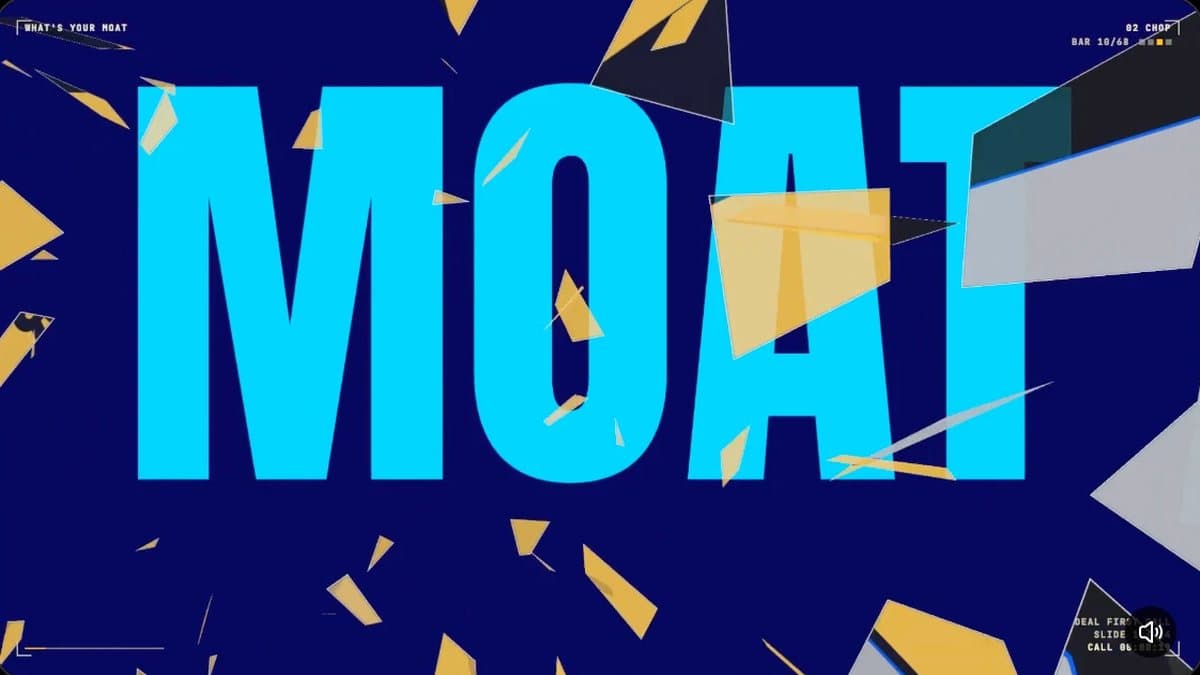
Short answer: connect Claude Code to Scenario's MCP server, install the scenario-kinetic-music-video skill, and give it a song plus a brief — the skill generates the footage on Scenario and draws the typography in code, one agent per section. The video everyone's sharing is a post from Emmanuel de Maistre, Scenario's co-founder and CEO: 'I'm not sending my deck anymore 😂' over a 2:10 clip in which 'WHAT'S YOUR MOAT' smashes through the frame in giant type with a HUD counting bars and slides. It's at 300,000 views, 2,370 likes, and 1,630 bookmarks. In a reply he said the video 'was entirely generated from the @Scenario_gg MCP via Claude CLI & Sonnet 5.5,' using 'the "scenario-kinetic-music-video" skill. One prompt, $40 of Claude tokens and a few Scenario credits.' Know what you're looking at: a CEO demoing his company's product with a skill his own team built, and a tutorial page that went live 21 minutes after the post. Also know that the whole thing is open — MIT skill, step-by-step page, a 12-page making-of, and a per-clip cost ledger — which makes it the most reproducible AI-video method we've covered. Here's how it works and what it really costs.
What the MOAT video is, and where it comes from
The MOAT clip is the pitch-deck application of a method Scenario built for a music video. 'Every Scenario' is a 2:05 original electroclash track and video about the 2026 AI boom — 'Leave the agents on tonight' / 'Wake up and the future's compiled' — directed by Sara Nemati, a creative technologist at Scenario, and produced by Claude Code through the Scenario MCP. Scenario published it on October 5 as an interactive page where you can hold F to peel the code layers off and see the raw generated footage underneath, frame for frame, then read the prompt, model, and credit cost of each of the 24 clips. The making-of PDF is blunt about the division of labor: 'I set the idea, the character, the mood and the references, and I judged every round. Claude wrote the lyrics, ran the music and video models on Scenario, and built the motion graphics in code.' It took 11 song versions and 6 video versions. The deck video reuses the engine with a pitch instead of lyrics — and no, nobody has published the MOAT prompt or said whether it has a song under it.

The stack
- Scenario MCP — Scenario's server exposing its creative platform to agents: '97 tools covering image, video, 3D, and audio generation across 700+ models,' with a recommendation layer that picks the model. Works with Claude Code, Claude Desktop, Cursor, Codex, and most other MCP clients. Generations bill in the same Compute Units (CU) as the web app.
- Claude Code — the 'Claude CLI' in the reply. It wrote the lyrics and prompts, called the models, built the render engine, and ran ten scene agents in parallel (the default concurrent-subagent limit is 20). Model: Sonnet 5.5, launched one week before the post, at $2 per million input tokens and $10 per million output.
- The skill — **scenario-kinetic-music-video**, MIT-licensed, added to Scenario's public skills repo on October 4 by CTO Hervé Nivon: 'Sara Nemati's skill for turning a song into a 1080p60 motion-graphics music video: Scenario supplies the subject sheet, style frames and footage, and a deterministic JavaScript/three.js engine renders kinetic lyric type, mattes and tracked graphics on sung onsets.' Its own one-line pitch: 'A song goes in. A 1080p60 music video comes out: a motion designer's showreel cut to the track.'
- The models, all on Scenario: MiniMax Music 3.0 (the song base), ElevenLabs Music v2.5 (compared and dropped), ACE-Step 1.5 Repaint (regenerating parts of a song), GPT Image 2.5 (character sheet and 17 style frames, 13 CU each), Seedance 2.5 (image-to-video and beat-driven dances, 186–464 CU a clip), LTX 2.5 Pro (six lip-sync shots, 124–315 CU each).
- Local, free: Apple Vision for the per-frame person matte, MediaPipe for pose tracking, Demucs and Whisper for stems and word timing, three.js + Canvas2D rendering 1080p at 60 fps in headless Chrome. 'No After Effects or Premiere.'
How to run it yourself
- 1. Connect the MCP. In Claude Code: claude mcp add --transport http scenario https://mcp.scenario.com/mcp, then authorize with OAuth in the browser (or an API key with Contributor or Owner role). Cursor and VS Code take the same URL in an mcpServers block.
- 2. Install the skill. npx skills add scenario-labs/skills --skill scenario-kinetic-music-video. The MCP also serves every public Scenario skill as a resource, but this one bundles scripts and an engine, so it needs the local install. The matte tool needs macOS (Apple Vision).
- 3. Give it a song and a brief. The skill's workflow: analyze the audio and align lyrics with Whisper; research sub-agents; write STYLE.md, TREATMENT.md, and PLAN.md; generate a subject sheet, then style frames, then footage (image-to-video, reference mode with a beat track for dances, audio-to-video for lip-sync); one background agent per section builds the graphics; render with three workers — 'about 5 min for 2:00 on an M-series Mac'; deliver over the untouched song.
- 4. For a deck, the song is your pitch. The MOAT video is the same engine with slide text as the lyric sheet and a 'DEAL FIRST / SLIDE' HUD instead of a clock. Nothing published shows that prompt, so expect to write a treatment yourself: one claim per section, hero words marked, downbeats as slide changes.
- 5. Judge every round. Nemati's notes in the PDF are the model: 'No effects on my footage.' 'No frozen frames.' 'Use the logo in its real grey and white, never gold.' 'Fewer fast cuts in the pixel ending.' The skill is built to take that kind of note and regenerate.
What it costs
- Scenario credits: the final cut's 24 clips cost 6,652 CU by the page's ledger (the PDF rounds to 'about 6,100'), excluding style frames and song takes. Scenario's plans are Starter $15 for 1,500 CU, Pro $45 for 5,000, Max $75 for 10,000 — so the footage alone is roughly $50–67 at plan rates, or one month of Max. Add-on credit prices aren't published.
- Claude tokens: '$40' for the deck video, per de Maistre. At Sonnet 5.5's rates that's a long agentic run with heavy cache reads, not a single generation — consistent with ten agents and multiple renders.
- Budget guidance from the skill itself: 'lean (6–10 video generations), moderate (12–20) or big'; 'a 6 s 720p clip costs about twenty style frames, a 10 s clip about thirty-five, and a full mixed video about five hundred.'
- Realistic total for a first two-minute video: around $100, assuming you already have Claude Code and don't burn takes. 'A few Scenario credits' for the deck video is unquantified; the music video's ledger is the honest number.
Five things the docs warn you about
- Don't splice an AI song — regenerate it. The first edit attempt (cutting a verse, layering drums) was rejected: 'The editing doesn't work.' ACE-Step Repaint, which kept the first 41 seconds and regenerated the rest, is what worked.
- Don't send the song to a video model. From the skill's lessons file: 'Moderation rejects it (InputAudioSensitiveContentDetected).' Drive dances with a synthesized beat track from the song's kick and snare map instead.
- BPM lies. 'A song generated at 130 BPM measured 98 with double-time drums.' Measure it; the final track is 2:01 at about 98.
- Photosensitivity cap: 'At most 3 full-frame luminance flips per second.' The engine enforces it; if you fork the engine, keep it.
- X caps standard accounts at 2:20, so 'plan a teaser.' The MOAT clip is 2:10 for a reason.
What's vendor, what's verified
Vendor: the post is by Scenario's CEO; the video was made by a Scenario employee with a Scenario skill; the tutorial page's last-modified timestamp is 12:54 UTC on October 5, 21 minutes after the 12:33 post; the '700+ models / 97 tools' counts are Scenario's (its own help pages still say '60+ tools and 550+ models'); the per-clip CU figures are Scenario's job records. We found no press coverage and no independent reproduction yet. Verified: the skill exists, is MIT-licensed, and was merged into the public repo on October 4 with Nemati credited; the install commands match Scenario's help center and Anthropic's Claude Code docs; the six models all appear in Scenario's changelog between July and September; Scenario's terms say 'You own your Generated Assets' and paid plans carry a full commercial license (free-plan outputs are 'for personal and evaluation use only'). One context line: MiniMax, whose Music 3.0 is the song base, is the defendant in a September 2025 copyright suit by Disney, Universal, and Warner Bros. Discovery — a case about its Hailuo video and image generator, not the music model used here.
Our read
This is the first viral AI video whose maker published the entire method, and that matters more than the view count. Every other trend we've covered — Hotel Lobby, GTA Philly, the Farquaad account — required reconstruction because the creators wouldn't say how. Scenario shipped the skill, the ledger, and the failures. Yes, it's marketing: the CEO's post sells the MCP, and the method only runs on Scenario's credits. But the architecture is the real lesson, and it's portable: generate the footage, then draw the typography in code, so the words are deterministic, the sync is exact, and nothing gets re-rendered when a note comes back. For a founder, a two-minute kinetic deck for about $100 and an afternoon is a genuinely new thing to send instead of a PDF — provided the brief is as sharp as Nemati's notes. Our MCP servers ranking and AI video ranking cover the rest of the stack.
Where these apps rank